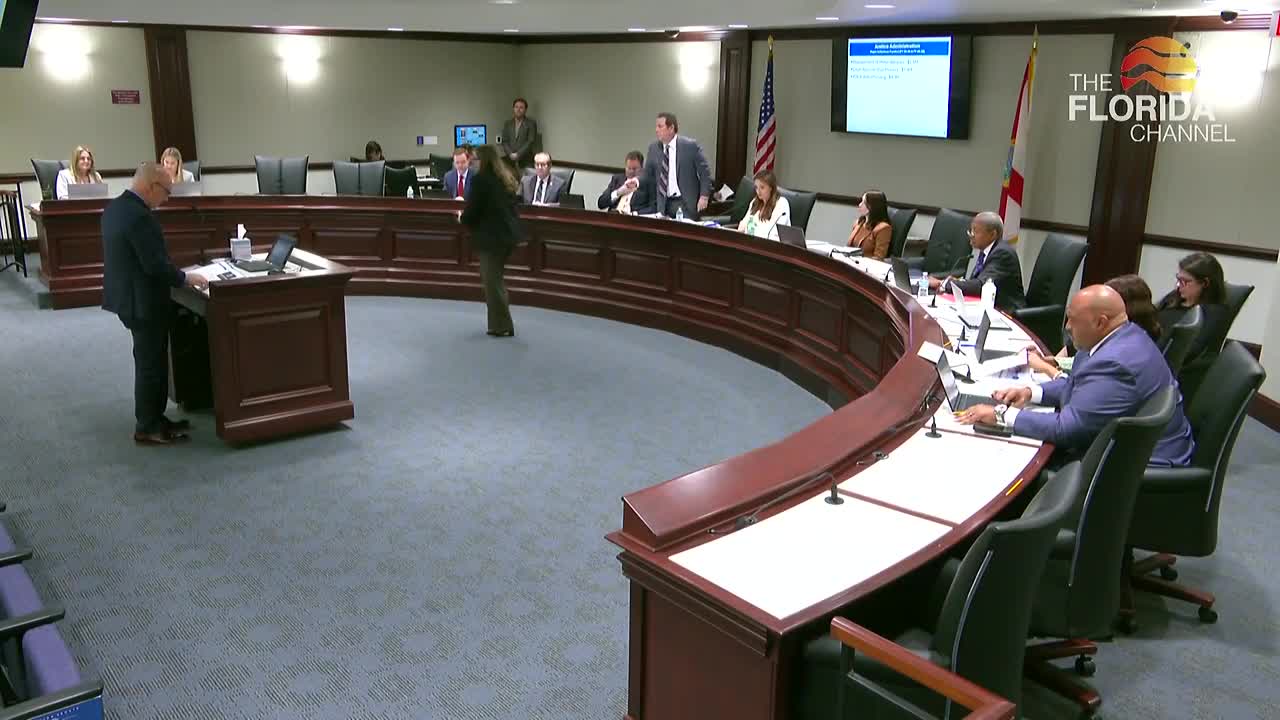
Department of Corrections tells appropriations committee staffing shortfalls strain programming but education gains lower recidivism
Loading...
Summary
Secretary Ricky Dixon reported that Florida’s prison population has grown by roughly 8,000 inmates since January 2021 while staff levels have not kept pace; the department described investments in teachers and programs that officials say are linked to reduced recidivism.
Secretary Ricky Dixon told the appropriations committee that Florida’s corrections system is operating under sustained staffing pressure even as the inmate population has climbed. Dixon said the department employs about 24,000 staff, incarcerates more than 87,000 people and supervises roughly 145,000 offenders in the community.
Dixon told members about three operational facts he said shape programming and reentry: a large proportion of inmates arrive without a verified high‑school diploma (about 64%), roughly 58% need substance‑use treatment, and the average reading level of people in custody is at about a sixth‑grade level. Dixon also described the “churn” in the system: the department releases roughly 24,000–25,000 people and admits about 26,000–27,000 annually, meaning a substantial portion of the population changes each year.
The secretary said the department has added roughly 8,000 inmates since January 2021 while staffing recovered more slowly, forcing the openings of 53 housing units that the department does not have funded FTE to staff. “We’re having to operate those housing units on the backs of our officers with overtime,” Dixon said, and he warned that continued reliance on overtime produces a large operational deficit and risks burnout.
Dixon described programs and results tied to recent investments: the legislature funded significant increases in teachers and program positions in prisons (he cited roughly a 88% increase in teacher and program positions), which the department says correlated with a 55% increase in inmates enrolled in education and a 19% increase in GEDs earned. The department also reported a 53% increase in career‑technical programs offered, a 78% increase in enrollment in those programs and a 121% increase in career‑technical credentials and industry certifications earned.
Dixon said the department has developed “incentivized” prisons that reward participation and good behavior and a counterpart administrative unit (Jackson CI) for inmates who pose higher security or disciplinary risks. He also described reengineering reentry so that housing units and programming are located closer to where people will return, and highlighted employer partnerships and a role for the Florida Foundation for Correctional Excellence in connecting employers with trained candidates.
On outcomes, Dixon said Florida’s recidivism rate is about 21% (he noted recidivism data are reported on a three‑year lag, with the latest complete year in the public data being 2020). He listed ongoing challenges including security staffing, technology and connectivity needs in housing units, classroom space and continued demand for substance‑use treatment.
Several senators followed with questions on teacher hiring, vacancy rates, the use of National Guard personnel in earlier staffing support and the $5,000 retention incentive for certain facilities; Dixon answered with further staffing, vacancy and programmatic details.