
Philadelphia committee adopts amendment and advances bill to protect workers from discrimination tied to menstruation, perimenopause and menopause
Get AI-powered insights, summaries, and transcripts
Subscribe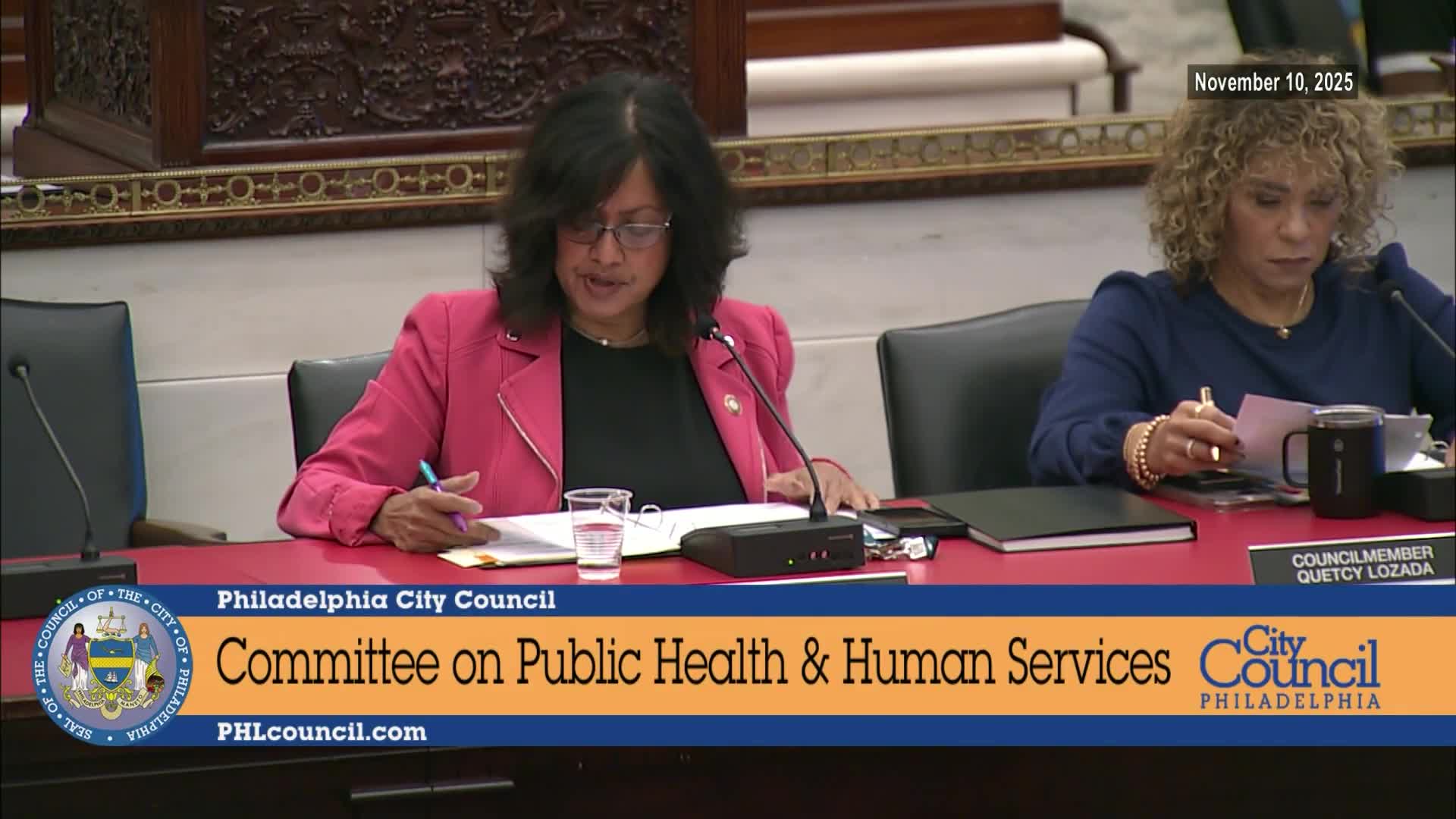
Summary
Philadelphia City Council's Public Health and Human Services Committee adopted an amendment to bill 250,849 and voted to report the measure favorably, directing it for first reading at the next council session; the bill would add explicit protections and require reasonable workplace accommodations for menstruation, perimenopause and menopause.
Philadelphia City Council's Committee on Public Health and Human Services on Monday heard hours of expert and community testimony, adopted an amendment and voted to report bill 250,849 favorably to the full Council with a request to suspend rules so the measure can receive first reading at the next session.
The measure, as explained by Chairperson Councilmember Ahmad, would amend Chapter 9-1100 of the Philadelphia Code to add explicit protections against discrimination "on the basis of menstruation, perimenopause and menopause" and to require employers to consider reasonable accommodations. "No one should have to choose between their health and their paycheck," Ahmad said in opening remarks, arguing the change would reduce stigma and address disparities that often affect Black and Latina workers and hourly or uniformed employees.
Supporters framed the bill as a practical, low-cost workplace reform. Dr. Robin Fay, co-director of the menopause program at Jefferson Health, told the committee that "70 to 80 percent of women experience perimenopause," and that for some "up to 23 percent" symptoms are severe enough to interfere with daily functioning and work. She recommended straightforward steps employers can take, including flexible scheduling, temperature controls and private spaces for brief respite.
Legal and public-health experts urged an individualized approach. Elizabeth Kokura, associate professor of law at Drexel University, said existing federal protections such as Title VII and the Americans with Disabilities Act offer limited or uneven coverage and that local, explicit language removes uncertainty for both workers and employers. Kokura cited research on symptom duration and racial disparities and told the committee a 2023 Mayo Clinic study estimates substantial annual productivity losses tied to menopausal symptoms.
Medical panelists cautioned that some terms in the legislation—most notably a provision in the amendment that ties accommodations to symptoms that "substantially interfere" with job performance—are clinically individualized. "From a medical perspective, that's a difficult thing to define," Dr. Asda Mehta, director of the Division of Reproductive, Adolescent and Child Health at the Philadelphia Department of Public Health, said, recommending that patient-provider conversations guide determinations.
Community witnesses and labor leaders stressed implementation details. Catherine Scott, retired president of AFSCME District Council 47, asked the committee to clarify the role of the Department of Public Health or an advisory panel in developing regulations and timelines so employees are not left waiting for months on accommodation requests. Monica Harmon, a public-health nurse who said she recently left a job because symptoms and lack of workplace support affected her performance, said the bill would give workers legal recourse and "bring awareness" that could empower employees to use HR and employee-assistance programs.
The panel adopted a circulated amendment moved by Councilmember Cindy Bass and seconded by Councilmember Roulandau; the chair announced the ayes had it. Bass then moved that the bill, as amended, be reported from the committee with a favorable recommendation and that council rules be suspended to permit first reading at the next council session; that motion was seconded and approved by voice vote.
Implementation questions remain. Multiple witnesses asked the committee to require clear timelines for employer responses to accommodation requests, stronger employer and HR training, and guidance about when and how public-health staff or medical advisers will be consulted to resolve disputes. The committee said it plans follow-up with the administration and indicated an amendment in committee to provide more implementation detail.
The measure now proceeds to the full City Council for first reading at the next scheduled session under the rules-suspension the committee approved.