Town split as public hearing opens on adding Water District parcels to preservation plan
Summary
At a May 12 public hearing, Red Hook residents, the village mayor and board members debated whether to add five surplus Water District No. 1 parcels to the town's Community Preservation Plan; critics alleged procedural errors and called for intergovernmental agreement before expanding CPF authority.
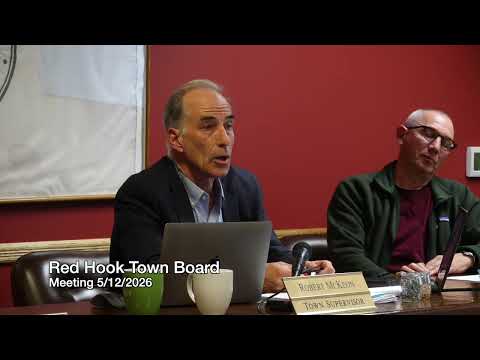
The Red Hook Town Board opened a public hearing May 12 on a proposed Local Law A to add five surplus parcels owned on behalf of Water District No. 1 to the town's Community Preservation Fund (CPF) plan, a step that would make the properties eligible for future acquisition to protect water resources.
Karen Smyth, mayor of the Village of Red Hook, read a letter from the village board asking the town to delay the amendment until a memorandum of understanding is negotiated between the town and its villages, saying "the community preservation fund gets its funding from the entire town including both villages. However, the village has 0 input, and, control over what may happen with these funds." Smyth asked the town to "fulfill the recommendations of the Community Preservation Fund Advisory Board" before expanding the fund's scope.
Several residents urged protection of the wetland parcels. Eric Harpuzes told the board he has maintained an easement and pond area for years and thanked the board for acknowledging local stewardship. Other neighbors warned that any hint of development would change the character of Linden Acres and urged preservation.
But the hearing turned contentious as critics pressed procedural and legal concerns. Public commenter Roxanne Fisher argued the notice carried errors and the environmental review form (EAF) classification was inconsistent: "Your notice labels tonight's action as type 1, yet your resolution calls it unlisted," she said, adding that the short EAF filed was incorrect for a Type I action. Lisa Pilaro told the board the hearings had been "pro forma with the outcomes predetermined" and accused the board of manipulating the CPF to offset water-district costs.
Board members and staff responded that inclusion in the plan is only an eligibility step, not an acquisition or development decision. The supervisor said the advisory-board referral would target four of the five parcels and emphasized that title and appraisal work are required before any purchase. The board discussed filing a DEC jurisdictional determination (JD) to clarify wetland jurisdiction but agreed a JD would not be made a precondition to including the parcels in the plan.
A motion to extend the public hearing to May 27 failed after discussion and voice votes, leaving the public hearing open and the issue unresolved. The board agreed to request a partial JD from DEC for additional information and to continue deliberations at future meetings.
AI generated
The text on this page is AI generated. Summaries, highlights, analysis, and video transcripts are all produced from the original source material.
AI can make mistakes, so if you spot one, and we will fix it for everyone.
Note: the source content is unaltered by us. Any content source we link to, be it a video, an audio recording, or a document, is presented exactly as its publisher released it. That publisher is usually a government body, sometimes an individual official or another organisation.