Board walks through millage components and why statute forces a tax-increase declaration
Summary
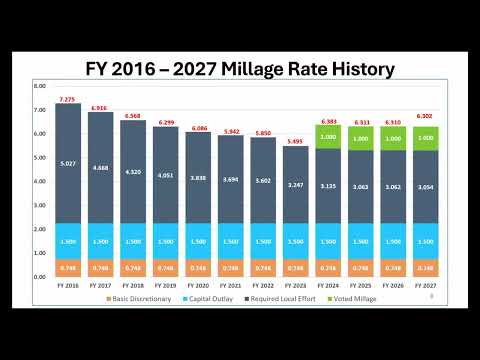
Officials explained the proposed millage mix — required local effort set by the state, discretionary operating, capital outlay and a voter-approved mill — and why adopting a rate above the rollback rate must be presented as a tax increase even when the effective tax rate per property may decline.
District staff walked the board through the components of the proposed millage for FY27 and how rollback rates are calculated. Dr. Andell said the required local effort (RLE) — the state-prescribed piece — is roughly 3.054 mills and is not under local control, while other components include a discretionary operating rate (about 0.748 mills), capital outlay (1.5 mills) and a voter-approved 1.0 mill.
Miss Campbell pushed back on the optics, saying the rollback-rule requirement can be frustrating. "The rollback rate is something that frustrates me, but I would just say even though we have to because it's higher, we have to call this a tax increase," she said, and Dr. Andell and others explained that the presentation and statutory disclosure are required even when property-value changes affect the effective rate.
AI generated
The text on this page is AI generated. Summaries, highlights, analysis, and video transcripts are all produced from the original source material.
AI can make mistakes, so if you spot one, and we will fix it for everyone.
Note: the source content is unaltered by us. Any content source we link to, be it a video, an audio recording, or a document, is presented exactly as its publisher released it. That publisher is usually a government body, sometimes an individual official or another organisation.