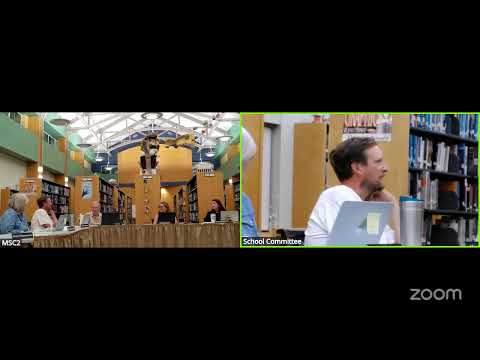
District proposes standardized framework for special-education programs
Summary
Student services director Lisa Murray presented a framework to standardize four specialized programs across Marblehead Public Schools, aiming for consistent placement criteria, clearer exit/entrance measures, expanded 18–22 planning, and to reduce out-of-district placements.
Lisa Murray, the district's student services leader, told the School Committee that staff are ready to present "a framework for standardization within the Marblehead Public Schools for our special ed program," describing four distinct program models and plans to make placement and exit criteria more transparent and data driven.
Murray spelled out the four program types — language-based programs, academic skills programs, life/functional skills programs (for students on the autism spectrum), and therapeutic programs for students with significant social-emotional needs — and said each includes defined instructional models, staffing structures and related services. "We operate four specialized programs within the district that uh span from substantially separate to inclusion," she said, and added that instruction uses research-based methods (for example, Orton-Gillingham/Wilson in the language-based program).
Murray described ongoing work to embed continuous data collection, align curriculum maps and scope-and-sequence documents, and expand family-facing materials and program open houses so parents can see program practices. She said the district has worked to return some students to district programs; committee members highlighted that seven students were brought back this school year as an indicator of progress.
On staffing and supports, Murray said the district now employs four BCBAs to support behavior programming and that collaborative placements and private placements remain in use for some students whose needs exceed what the district can provide. "So, we have four," Murray said when a committee member asked about BCBA staffing. In the presentation the administration reported 13 students in collaborative placements and 31 in private placements, with cost-sharing arrangements used in some cases.
Committee members pressed on early identification and screening for young students (Tier 2 interventions, early literacy screeners such as DIBELS/I-Ready), and on how the district balances inclusion with specialized instruction. Murray emphasized individualized IEP-team decisionmaking and said the district is working toward an 18–22 transition program to support adult outcomes for students with long-term needs.
The presentation was informational; no new policy or funding decision was taken at the meeting. Committee members asked for continued updates, additional family-facing materials, and clearer metrics for measuring whether standardization improves access and outcomes.
AI generated
The text on this page is AI generated. Summaries, highlights, analysis, and video transcripts are all produced from the original source material.
AI can make mistakes, so if you spot one, and we will fix it for everyone.
Note: the source content is unaltered by us. Any content source we link to, be it a video, an audio recording, or a document, is presented exactly as its publisher released it. That publisher is usually a government body, sometimes an individual official or another organisation.