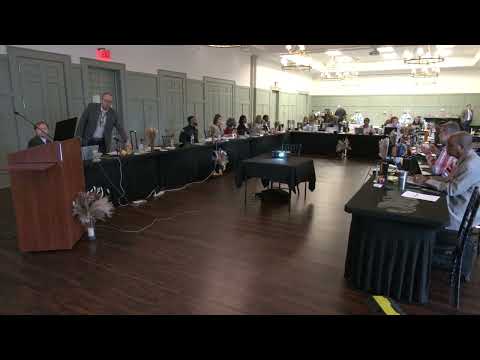
Board debates objective 'guardrails' as data show numerous underutilized schools
Summary
Administrators presented updated utilization figures and a draft six-criteria rubric to guide reuse/closure decisions for underutilized schools; board members debated weighting adjustments, equity considerations and the need for early community co‑creation.
District staff presented updated utilization metrics and proposed objective decision-making guardrails intended to guide reuse, renovation or disposal of underutilized school properties.
The district’s utilization analysis (based on architects’ capacity projections, not the Facilities Condition Index) flagged a number of elementary and middle facilities below 60% utilization, with specific examples cited such as Mercer Middle (~34% utilization) and Haven Elementary (~36%). Staff noted that some high-capacity sites (e.g., Groves High at roughly 134%) help absorb enrollment variations in nearby attendance areas.
To help the board make consistent decisions, staff proposed six guardrails with suggested weights: Students and programs first (25%), plan for future need (20%), invest strategically (15%), total cost and value (15%), reuse before disposal (10%), and equity and community impact (15%). The board debated the weights vigorously. Some members argued for increasing the share allotted to total cost/value and to partnerships/revenue-generation, while others pushed for stronger weighting on equity and community impact to avoid closing neighborhood assets without robust outreach. One board member asked that partnership/subleasing or revenue potential be reflected explicitly so that reuse could produce ongoing income streams.
Staff tested the rubric live using a fictional “Oak Tree Community School” case study: 48% utilization, six acres, 432 students in a 900‑student facility and a $30 million reinvestment need, with a recent $3.8 million emergency spend. Board members used the test case to explore trade-offs: redeploying programs (Pre‑K, special needs classrooms), consolidation scenarios, community co‑creation to reduce opposition, and legal risks around charter access to unused facilities after two years.
What the board asked staff to do next: refine guardrail language and weights to reflect board preferences; add clearer criteria for partnership and revenue potential; and prepare community engagement materials and a timeline for site-level consultations (Schuman and others). Staff said they will return with revised guardrails and additional data to inform decisions.
Quote: "We want your initial reactions. What do you think about these guard rails?" staff asked at the retreat, and board members responded with both fiscal and equity-focused refinements.
Provenance: school utilization slides and guardrail presentation; Oak Tree test case exercise.
AI generated
The text on this page is AI generated. Summaries, highlights, analysis, and video transcripts are all produced from the original source material.
AI can make mistakes, so if you spot one, and we will fix it for everyone.
Note: the source content is unaltered by us. Any content source we link to, be it a video, an audio recording, or a document, is presented exactly as its publisher released it. That publisher is usually a government body, sometimes an individual official or another organisation.