City tackles lead service line crisis with aggressive replacement plan
October 22, 2024 | Two Rivers, Manitowoc County, Wisconsin
This article was created by AI summarizing key points discussed. AI makes mistakes, so for full details and context, please refer to the video of the full meeting. Please report any errors so we can fix them. Report an error »
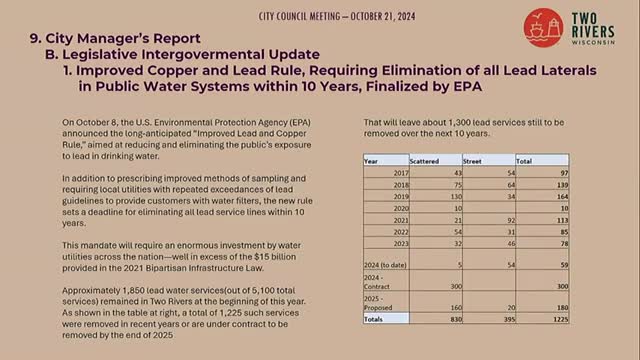
The city has utilized funds from the American Rescue Plan Act (ARPA) and received additional support from Manitowoc County to tackle the replacement of these hazardous lines. So far in 2024, the city has made progress, particularly with the Roosevelt Avenue Reconstruction project, which accounted for 54 replacements. A contract for an additional 300 replacements has been approved, with work already underway in the north-central part of town.
Looking ahead, the city has applied for loans and potential principal forgiveness from the Department of Natural Resources (DNR) to assist with replacing another 160 scattered service lines, primarily on the east side. The capital plan for next year includes the reconstruction of three blocks of street, which will involve replacing about 20 lead service laterals.
Despite these efforts, officials estimate that approximately 1,300 lead service lines will remain by the end of 2025, highlighting the need for ongoing replacements at a rate of 130 to 150 lines each year for the next decade. City leaders emphasized the importance of securing additional state and federal support to alleviate the financial burden on local taxpayers and ratepayers.
The discussion also touched on the broader regulatory context, noting that while the focus is primarily on lead, copper service lines are also monitored under the same EPA regulations. However, the city does not plan to replace copper lines unless specific corrosion issues arise, which are not currently a concern for Two Rivers.
As the city continues its efforts to address this public health priority, officials remain committed to exploring all funding avenues to ensure the safety and quality of the community's water supply.
View the Full Meeting & All Its Details
This article offers just a summary. Unlock complete video, transcripts, and insights as a Founder Member.
30-day money-back guarantee
Sponsors
Proudly supported by sponsors who keep Wisconsin articles free in 2026

