Controversial 279 Unit Affordable Housing Project Proposed
September 05, 2024 | Meridian, Ada County, Idaho
This article was created by AI summarizing key points discussed. AI makes mistakes, so for full details and context, please refer to the video of the full meeting. Please report any errors so we can fix them. Report an error »
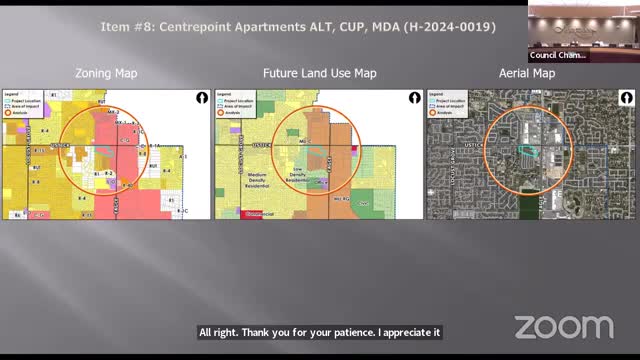
In a recent government meeting, officials discussed a significant proposal for the Centerpoint Apartments, which seeks to modify an existing development agreement and conditional use permit (CUP) to facilitate the construction of a 279-unit affordable housing complex. The site, located at 3100 Centerpoint Way, spans nearly 10 acres and is currently zoned for commercial use.
The proposed modifications include increasing the building height from three stories to 45 feet and expanding the number of residential units from 215 to 279. However, the applicant is requesting alternative compliance for several requirements, including a reduction in the qualified open space by approximately 8,940 square feet and the removal of parking lot islands under covered parking areas.
City staff expressed concerns regarding the proposal's compliance with the city’s comprehensive plan and Unified Development Code (UDC), particularly regarding the adequacy of open space and amenities. The proposed project would provide 104,345 square feet of open space, which falls short of the required minimum. Staff emphasized that adequate open space is essential for maintaining vibrant neighborhoods and that simply being near parks does not suffice for community needs.
The applicant defended the proposal by highlighting the unique demographic targeted by the affordable housing community and the extensive amenities planned, including a clubhouse, fitness facility, children's play area, and a dog park. They also proposed solar carports to enhance sustainability and reduce utility costs for residents.
Despite the applicant's arguments, the city council received seven written testimonies opposing the development, raising concerns about increased density and potential impacts on the surrounding area. Staff recommended approval of the project, contingent on addressing the outlined conditions, while emphasizing the need for a cohesive design that aligns with the surrounding community.
The meeting underscored the ongoing challenges of balancing development needs with community standards and the importance of maintaining adequate open space in urban planning.
The proposed modifications include increasing the building height from three stories to 45 feet and expanding the number of residential units from 215 to 279. However, the applicant is requesting alternative compliance for several requirements, including a reduction in the qualified open space by approximately 8,940 square feet and the removal of parking lot islands under covered parking areas.
City staff expressed concerns regarding the proposal's compliance with the city’s comprehensive plan and Unified Development Code (UDC), particularly regarding the adequacy of open space and amenities. The proposed project would provide 104,345 square feet of open space, which falls short of the required minimum. Staff emphasized that adequate open space is essential for maintaining vibrant neighborhoods and that simply being near parks does not suffice for community needs.
The applicant defended the proposal by highlighting the unique demographic targeted by the affordable housing community and the extensive amenities planned, including a clubhouse, fitness facility, children's play area, and a dog park. They also proposed solar carports to enhance sustainability and reduce utility costs for residents.
Despite the applicant's arguments, the city council received seven written testimonies opposing the development, raising concerns about increased density and potential impacts on the surrounding area. Staff recommended approval of the project, contingent on addressing the outlined conditions, while emphasizing the need for a cohesive design that aligns with the surrounding community.
The meeting underscored the ongoing challenges of balancing development needs with community standards and the importance of maintaining adequate open space in urban planning.
View the Full Meeting & All Its Details
This article offers just a summary. Unlock complete video, transcripts, and insights as a Founder Member.
✓
Watch full, unedited meeting videos
✓
Search every word spoken in unlimited transcripts
✓
AI summaries & real-time alerts (all government levels)
✓
Permanent access to expanding government content
30-day money-back guarantee
