Get Full Government Meeting Transcripts, Videos, & Alerts Forever!
Get email alerts on the Transportation Capitol Boulevard topic
No spam. Unsubscribe anytime.
Wake Forest leaders debate tolling options for Capitol Boulevard; staff to draft resolution to seek state funding alternatives
Summary
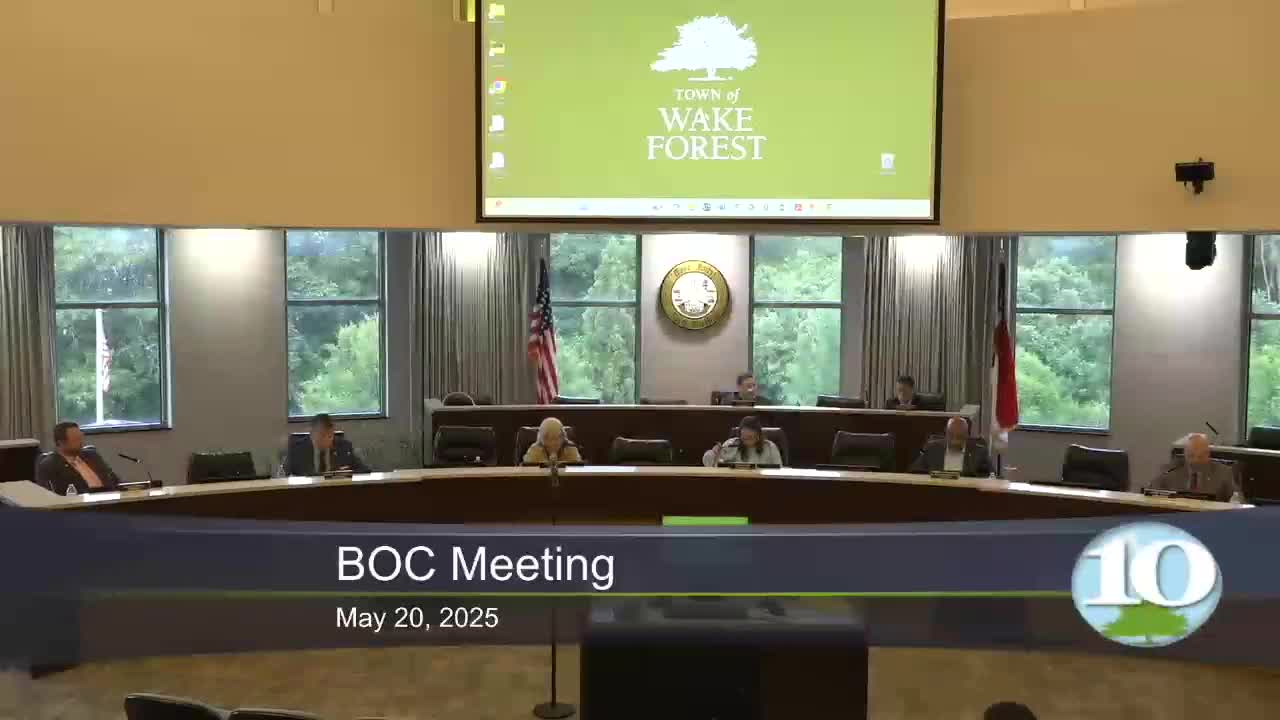
Wake Forest commissioners discussed toll and express‑lane options to speed construction of the Capitol Boulevard corridor after learning NCDOT plans to start right‑of‑way acquisition earlier than previously shown in the STIP.
Wake Forest commissioners and residents discussed tolling and express‑lane options to accelerate construction of the Capitol Boulevard corridor after town officials reported new information from NCDOT that right‑of‑way acquisition will begin earlier than previously planned. The board did not take a binding vote to endorse tolling; members said they do not favor tolls but were unwilling to close the option as a financing backstop, and they asked staff to prepare a resolution urging the General Assembly and NCDOT to pursue non‑toll funding alternatives.
Why it matters: Capitol Boulevard (project referred to as U‑5307 in planning materials) is a major capacity and safety project for northern Wake County. Delays in funding and project scheduling have prompted public concern about travel times, economic access and long construction timetables; town and regional business representatives said accelerated funding is a high priority.
Recent scheduling update: Those at the meeting were told NCDOT will start right‑of‑way acquisition for sections A and B in 2026 and for sections C and D in 2028, two years earlier than shown in earlier drafts of the State Transportation Improvement Program (STIP). The mayor summarized that change: “They are changing the right of way, to start 2 years earlier than it was on the draft step ... start purchasing the right of way 2 years earlier than they were gonna purchase it.” The town noted the change does not yet establish a construction start date.
Options and tradeoffs: Planning staff and the toll authority’s study team briefed commissioners on four scenarios the toll authority studied: full tolling of the corridor, express‑lane variants, and a no‑toll alternative. Staff said all four study scenarios include the full build‑out of the U‑5307 alignment; express‑lane options would add a tolled lane to the cross‑section and require additional right of way beyond the current U‑5307 plans, increasing cost. In staff’s words, “all of those options include the full build out of U‑5307. With the express lane scenario specifically, they would require additional right of way ... which is why the cost for those express lane scenarios were higher.”
Public comment and regional view: Joe Milazzo, executive director of the Regional Transportation Alliance, told the board his organization supports tolls only as a tool to accelerate construction, not as a first choice: “Our group does not look for toll funding as our first choice to accelerate this or any road. But we have endorsed the pursuit of tolls as an option to supplement state funding and accelerate this needed freeway.” Milazzo and others urged consideration of discounted or zero‑toll windows (overnight or off‑peak) to reduce the burden on lower‑income commuters; Milazzo said the turnpike authority has been receptive to studying discount windows.
Concerns and political context: Several residents and commissioners expressed strong reservations about adding a toll to a route that many drivers now use for everyday travel. Commissioners asked staff to pursue a resolution urging the General Assembly and DOT to secure non‑toll funding and to continue exploring federal grant options. Planning staff also reminded the board that state legislation or changes to turnpike authority rules could be required for some tolling scenarios.
Outcome and next steps: The board did not adopt a formal endorsement of a toll option. The town manager agreed to return with a draft resolution for the board to consider that would convey the town’s preferences — opposing tolls as the primary funding mechanism while keeping acceleration options on the table — and to continue engagement with regional partners and state representatives. Officials also encouraged continued outreach to legislators and DOT to identify non‑toll financing solutions.
Ending: Commissioners and regional stakeholders emphasized that, despite differing views on tolls, there is widespread agreement on the need to complete the Capitol Boulevard project. The board’s action was procedural: staff will draft language for a resolution to send to the General Assembly and NCDOT, and the council will continue to press for accelerated funding and further study of tolling impacts.