Committee clarifies creative-writing electives; keeps flexible local implementation
Summary
The SRC revised wording for creative-writing electives to reduce prescriptive assessment language, emphasize flexibility, and retain local discretion for course content and publishing options; members agreed to collect supporting language and glossary items for later review.
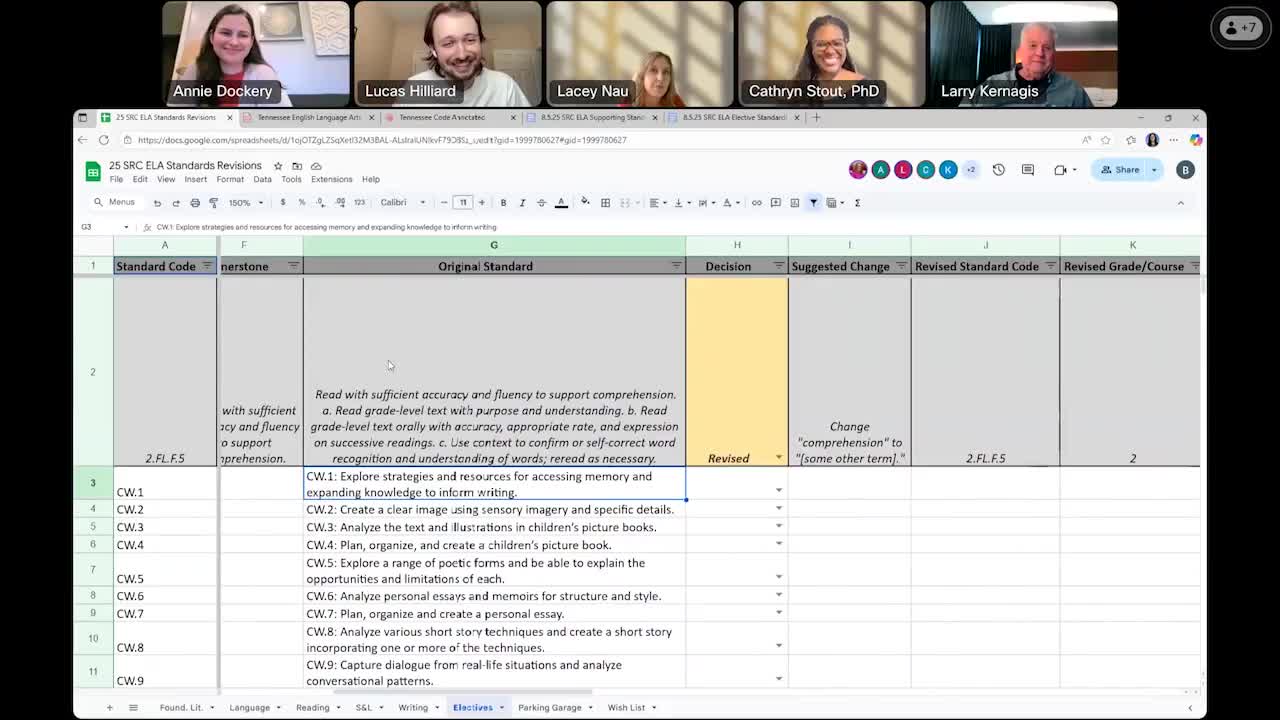
The Tennessee State Board of Education's English Language Arts Standards Recommendation Committee revised and clarified the elective creative-writing course standards during a virtual session in October 2025, emphasizing flexibility for local implementation and simplifying overly prescriptive language.
Committee members reviewed the creative-writing course description and a sequence of standards (CW 1–CW 16). They agreed the course should emphasize imaginative writing across fiction, poetry and literary nonfiction and accepted language that the course “focus[es] on the imaginative aspects of writing fiction, poetry, and literary nonfiction” and that teachers may use lectures, workshops and exemplars to support instruction.
On specific standards, the committee generally moved away from tightly prescriptive assessment wording. Members kept standards that encourage use of sensory imagery, techniques for short stories and poetry, and planning and creating children’s picture books when schools choose that pathway. At several points the committee consolidated near-duplicate items. For example, standards about revising and peer evaluation were combined and reworded so the course requires students to “revise writing effectively” and to “evaluate peer writing effectively using a provided system” rather than being limited to revising a single short story in one specified context.
Committee members also agreed to broaden language about publishing and public sharing. The previous draft referred to “micro essays” and specific publishing venues; the revised wording asks students to “develop writing and explore available ways to publish or publicly share this writing,” which members said allows teachers and districts to adapt to local contexts and publication requirements.
On digital practices, the committee chose wording consistent with other electives, adopting “use available digital tools in the creative process” to leave room for district resources and future technology changes. Members repeatedly noted electives are typically implemented at the local level and that the state does not centrally enforce classroom assessments for electives; the committee therefore avoided highly prescriptive assessment steps that would limit local creativity.
The committee flagged glossary needs and “parking garage” items — including a clear definition for “digital citizenship” — for a subsequent session before finalizing the supporting documents. Staff said electives are implemented by local education agencies and that inclusion of flexible language helps districts design courses that fit local teacher expertise and student interest.
No formal roll-call votes on individual creative-writing wording were recorded in the transcript; the committee used a practice of soliciting objections and adopting changes when members signaled agreement.