Get Full Government Meeting Transcripts, Videos, & Alerts Forever!
Get email alerts on the Grand List Taxes topic
No spam. Unsubscribe anytime.
Candidates outline different paths to grow Simsbury’s grand list and ease tax pressure
Summary
At the Chamber forum, candidates debated strategies to increase Simsbury’s grand list — from targeted business recruitment and no‑interest loans for facades to preserving high‑value taxpayers — while warning that absent growth, homeowners will bear more tax burden.
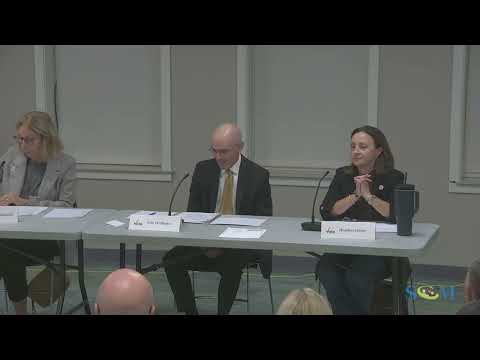
Simsbury’s first‑selectman candidates told the Granby Simsbury Chamber of Commerce on Oct. 18 that growing the grand list is essential to relieve pressure on homeowners, but they emphasized different tools and priorities.
Why it matters: Connecticut towns rely heavily on property taxes for local services. Candidates said deliberate policies are necessary to attract and retain commercial taxpayers and to plan capital spending so that the tax burden is shared more broadly.
What candidates proposed: Heather Goetz, Republican candidate and member of the Board of Selectmen, said Simsbury should “target businesses that are good fits” for commercial zones, cap the mill rate and streamline permitting to make the town more competitive. She warned the town’s mill rate is becoming “uncompetitive” compared with nearby municipalities.
Wendy Max Dudas, Simsbury’s first selectman and Democratic candidate, said the town needs a careful fiscal analysis whenever a new housing project is proposed to determine net fiscal impacts on schools, police and emergency services. Dudas said current grand‑list growth has been driven largely by apartment development and that recent revaluation cycles concentrated tax increases on homeowners.
Eric Wellman, independent candidate and former first selectman, urged a mix of growth and fiscal restraint and proposed a town‑backed, low‑ or no‑interest loan program for small businesses to fund facade improvements and technology upgrades. He highlighted past successes in retaining and attracting high‑value taxpayers, citing Tobacco Valley Solar’s tax payments and Ensign Bickford’s investment and job retention while he was in office.
Details cited at the forum: Wellman said the town’s average grand‑list growth over the past 20 years has been under 1% annually, but several years in his tenure reached roughly 2.6–2.9% and in 2022 approached 3.75%. He said deliberate policies, targeted recruitment and retention can yield measurable results.
Constraints and tradeoffs: All candidates acknowledged a tension between residents’ dislike of multifamily housing and the fiscal reality that apartments often provide grand‑list growth. Dudas and Goetz said the town must ensure new housing proposals include full fiscal impact analyses. Goetz also suggested regional coordination to oppose or influence state laws such as the 8‑30g framework, which she said can allow out‑of‑town developers to pursue projects that bypass local zoning.
Next steps: Candidates proposed stronger coordination among the Economic Development Commission, the Main Street Partnership, the Chamber and town staff, plus targeted outreach to businesses. Specific incentives, loan program details, and mill‑rate policy changes would require board action and budgetary analysis.