Get Full Government Meeting Transcripts, Videos, & Alerts Forever!
Get email alerts on the Street Infrastructure topic
No spam. Unsubscribe anytime.
Eagan council approves five street-revitalization projects totaling about $5.1 million
Summary
On Feb. 4 the Eagan City Council approved plans and authorized preparation of specifications for five neighborhood street improvement projects that will cost about $5.1 million in total, with roughly $1.4 million to be assessed to property owners under city assessment policy.
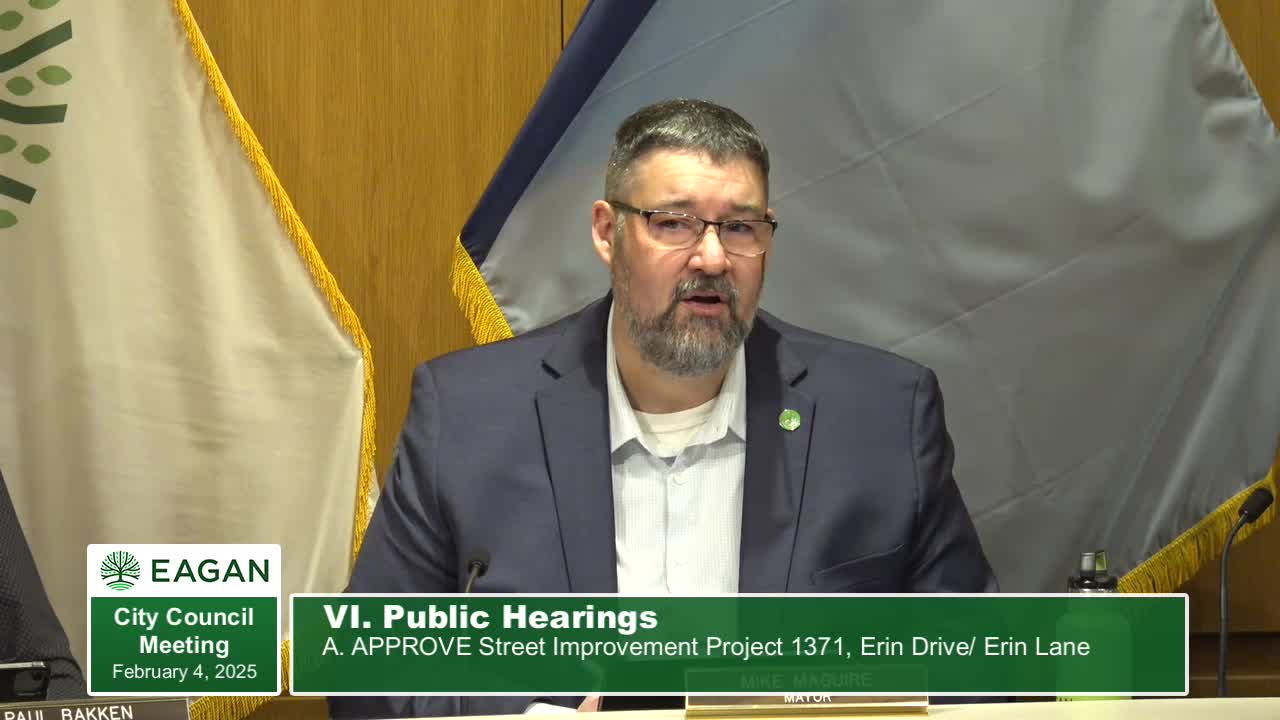
EAGAN, Minn. — The Eagan City Council voted Feb. 4 to advance five neighborhood street-revitalization projects, authorizing staff to prepare detailed plans and specifications and move the work toward bidding and construction this summer. The projects — identified as 1371 (Aaron Drive/Aaron Lane), 1568 (Gulf View Drive), 1569 (Harvey/Burview Acres/Highway 55/Cherrywood), 1570 (Lakeside Estates) and 1573 (Sunset/Northview Meadows/Overview Estates/Dana Drive/Lexington Point Parkway/Patrick Road) — have a combined estimated cost of just over $5.1 million, with about $3.7 million to be paid by the city and roughly $1.4 million assessed to property owners under the city’s established assessment policy.
The council’s action came after a presentation by Assistant City Engineer Ben Perkey and public hearings in which residents raised questions about timing, property access during construction, assessment calculations and coordination with Dakota County trail work. Perkey said the projects emphasize mill-and-overlay pavement work in most areas; Aaron Drive is proposed for a full reclamation because it is more deteriorated. City-funded items include curb and gutter repairs and utility adjustments; assessable work generally covers the pavement between curbs and commercial driveway apron repairs.
Why it matters: The projects affect thousands of property frontages and establish assessment obligations for homeowners and commercial properties. Under current policy, typical low- and medium-density residential assessments are split 50/50 between the city and property owner for mill-and-overlay work; high-density residential property assessments are 75% to the owner, while commercial properties are assessed 100% for pavement work. For Aaron Drive’s full-depth reclamation, medium-density (R-3) properties are proposed to carry a 75% assessment share.
Perkey told the council the five projects are part of a formal city revitalization program that dates to 1990; to date the city has improved 323 miles of streets at a cost of more than $103 million. Staff provided estimated first-year installment amounts for assessments and said property owners may choose five- or 10-year payment terms. After construction, a final assessment hearing will follow in the fall; unpaid assessments will be certified to the county and appear on property taxes in May 2026. Residents will be given a 30-day interest-free window after the assessment hearing to pay all or part of their bill before certification.
Public comments summarized the main concerns. Colleen Van Blarcom, who said she owns the McDonald’s in Eagan, asked how businesses will maintain customer access during construction; Perkey replied that the city provides a construction contact and that contractors will maintain a drivable surface except when work is directly at a driveway. Residents in Lakeside Estates and elsewhere asked about coordination with Dakota County’s planned lake-trail work; Perkey said the city is coordinating review with the county but cannot guarantee schedules will not overlap, and staff will work to avoid simultaneous heavy-equipment activity in the same area. Another resident asked whether crack sealing rather than a mill-and-overlay had been considered; Perkey and council members explained the city’s pavement-management practice is intended to apply overlays at a lifecycle point that maximizes pavement life and avoids earlier need for complete reconstruction.
Other points raised during the hearings included on-street parking and neighborhood organization to reduce heavy-vehicle traffic (residents described neighborhood-level consolidation with a single trash hauler to limit wear); staff and council noted the city’s road design accounts for service vehicles and that assessments and timing follow engineering scores and the pavement lifecycle.
The council approved the motion to close the public hearings and to proceed with the projects; the motion was seconded and carried. After council authorization, staff will return in two weeks with plans and specifications if the council proceeds as planned, with bidding and contract awards anticipated in March and construction over the summer.
Residents with project-specific questions will receive notices from city project coordinators or the selected contractor when schedules are set. Perkey said individualized notices and on-site contact information will be provided once contracts are awarded. The city also offers five- and 10-year assessment schedules and a 30-day interest-free early payment window after the final assessment hearing.