
Salinas planners outline three‑phase zoning code update; commissioners raise parking concerns for West Area
Get AI-powered insights, summaries, and transcripts
Subscribe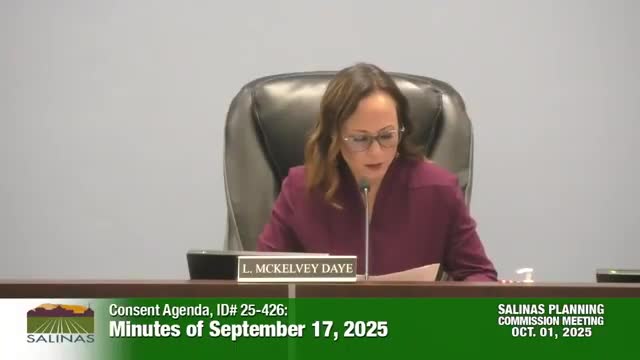
Summary
Salinas planning staff on Oct. 1 presented a multi‑year approach to updating the city’s general plan and zoning code and described a public‑engagement program; commissioners pressed staff about parking and street‑width standards for the West Area specific plan as tentative subdivision maps move toward consistency review and eventual Planning Commission recommendations to City Council.
Salinas planning staff on Oct. 1 presented a multi‑year approach to updating the city’s general plan and zoning code and described a public‑engagement program; commissioners pressed staff about parking and street‑width standards for the West Area specific plan as tentative subdivision maps move toward consistency review and eventual Planning Commission recommendations to City Council.
The study session was led by Chairperson McKelvey Day, who opened the Planning Commission meeting and introduced staff. Jonathan Morrison, senior planner, reviewed the hierarchy of planning documents and the schedule for the zoning code update and public engagement. “We’re starting the first phase,” Morrison said, describing the initial work to bring the code into compliance with recent state law changes.
Why it matters: The general plan and zoning code determine land uses, development standards and the procedures developers follow to submit tentative maps and building permits. Changes to the code affect future housing supply, street design, parking supply and the timing of projects that are already in the pipeline, including multiple West Area tentative maps that staff said are in review.
Staff presentation and the three phases
Morrison described the planning hierarchy — state and federal law, local general plan, specific plans, municipal code and implementing ordinances — and said the city will coordinate updates across those levels. He noted the general plan’s long‑range horizon (historically twenty to thirty years) and that some elements, especially the housing element, must be updated on a state timetable (housing elements on roughly an eight‑year cycle). He told commissioners the consultant team will produce draft code language but that staff intends to review drafts with the commission “just about every step of the way.”
Lisa Prenton, community development director, summarized the three phases staff expects for the zoning code work: Phase 1 will align the municipal code with state law requirements; Phase 2 will implement changes needed to make the zoning code consistent with the newly adopted general plan land uses; and Phase 3 will be a broader community‑driven overhaul or retooling of the code (for example, hybrid or form‑based approaches) if the city elects to pursue them. “That’s more than just public hearings; it’s study sessions, stakeholder groups and targeted outreach,” Prenton said.
Public‑engagement and advisory structure
Staff described a layered outreach approach: a technical advisory group (for architects, builders and frequent code users), focused stakeholder meetings, broader public workshops and online surveys. The Planning Commission will be a primary review body and will make formal recommendations to City Council, which has ultimate adoption authority. Staff said quarterly updates and study sessions with council are planned as the process advances.
West Area and parking questions
Commissioners used the presentation to press staff about how the code updates and specific plans will affect the West Area and new subdivisions. Commissioner Rakimora raised neighborhood parking concerns, saying residents report multiple vehicles per household: “...average household has about five cars,” he said. Staff cautioned that household vehicle ownership can be driven by housing shortages and multi‑family occupancy patterns; in one staff response, Morrison said data suggest vehicle ownership per household is not necessarily higher than regional averages but that multiple families in single houses can create concentrated demand.
Courtney Grossman, planning manager, described standards embedded in current specific plans and what the commission will see when tentative maps return for consistency review: “The garages will be approximately 20 feet wide by 20 feet deep on the interior, which would contain two cars,” she said, and added that some designs under review include narrower streets, alleys and limited on‑street parking. Grossman said developers are negotiating waivers in some areas where map designs differ from the standards in adopted specific plans; those waiver requests and revised lot standards are likely to appear in Planning Commission packets in the coming months.
Staff clarified that the specific plans now guiding West Area design were adopted under the city’s 2002 general plan framework and that those plans include varied land‑use categories and lot standards to create a mix of housing types (single‑family detached, townhomes, multifamily). She said the planning department is currently assessing tentative map completeness; after applications are made complete, staff will perform a consistency review that applies the specific‑plan standards to the submitted designs before a Planning Commission recommendation goes to City Council for final action.
What was not decided
No formal actions on the zoning code or on specific tentative maps were taken at the Oct. 1 meeting. The commission lacked a quorum to act on a consent item (approval of minutes for Sept. 17, 2025, ID 25‑426), so that item was continued. Staff also reported no public comments were received for this meeting.
Next steps
Staff said the zoning code update work will proceed in parallel phases, with Phase 1 work to start immediately to meet state‑law requirements and Phase 2 and Phase 3 work following as the draft general plan and public feedback advance. Tentative subdivision maps for the West Area that are currently under review are expected to be returned to the Planning Commission for consistency review in the coming months; any requested waivers or standards changes shown on those maps will be part of future commission agendas.
The meeting adjourned after administrative reports; no public testimony was taken on the zoning code update at this session.