Get Full Government Meeting Transcripts, Videos, & Alerts Forever!
Get email alerts on the County Finance Audit topic
No spam. Unsubscribe anytime.
Independent auditor issues clean opinion on Greenville County FY 2024 financial statements; public calls for simpler reports
Summary
An independent auditor told the Oversight Ad Hoc Committee the county’s fiscal 2024 financial statements received an unmodified opinion and a clean single-audit for ARPA; the auditor reported one finding on collateralization of certain public deposits. A resident urged clearer, more readable reports before taxpayers accept additional levies.
An independent auditor told the Oversight Ad Hoc Committee on Oct. 7 that Greenville County’s fiscal year 2024 financial statements received an unmodified (clean) opinion and that the county also received a clean federal single-audit opinion on ARPA spending.
The presentation by Grant Davis, a partner with Mullen Davis CPA Advisors, set out the audit results and highlighted key financial figures, while a public commenter said the audit documents are too technical for most taxpayers.
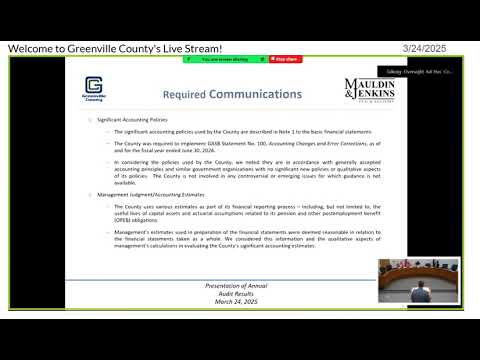
Davis said the firm issued an unmodified opinion on the county’s financial statements for the year ended June 30, 2024, which he described as “really the only acceptable result in a financial statement audit.” He also told the committee the auditors issued a separate report required by government auditing standards and identified one instance of noncompliance with state law involving collateralization of certain public deposits held outside the county treasurer’s purview.
The auditor’s presentation included high-level financial figures the firm summarized as total assets “a little bit over a billion dollars,” cash and investments of about $195,000,000, liabilities nearing $800,000,000 and net position of about $359,000,000 (an increase of roughly $39,000,000 from 2023 to 2024). Davis said the county’s general fund expenditures were about $236,000,000 and that the general fund’s fund balance was roughly $81,000,000 at June 30, 2024 — which he calculated as about four months of operating coverage.
On federal funding, Davis said the county spent about $13,700,000 in federal monies in fiscal 2024; roughly $8,400,000 of that — about 62% — was ARPA (American Rescue Plan Act) funds. The auditors issued an unmodified opinion on compliance for the ARPA program under Office of Management and Budget and U.S. Treasury requirements.
Davis explained the three documents issued with the audit: the annual comprehensive financial report (including the opinion), the auditor’s discussion and analysis (the ADNA), and the government-auditing-standards report on internal control and compliance. He told the committee auditors found no internal control deficiencies and no audit adjustments that rose to the materiality threshold.
Council member McGaughey asked whether the audit compares Greenville County’s grant activity or grant procurement to peer governments. Davis said that type of analysis — a grants strategy or comparative grant-evaluation review — is not part of a standard financial statement audit but could be provided by the firm’s advisory arm, which is kept separate from the audit practice to preserve independence.
During public comment, Michelle Schumann, who identified herself as a Greenville County resident at 22 Mayfair Lane, said the audit document is written at a “professional” level and is hard for ordinary taxpayers to understand. “The audit absolutely must come down where we can understand it,” she said, also criticizing requests for millage increases while reports remain difficult to read.
The committee did not take formal action on the audit presentation. Earlier in the meeting members moved to approve the minutes and later moved to adjourn; those procedural motions were recorded but the transcript does not show full roll-call tallies.
The auditor also noted upcoming GASB (Governmental Accounting Standards Board) changes that will require ongoing work by the finance team and offered continuing-education resources to county staff and elected officials.
The presentation and public comment together highlighted two themes for committee follow-up: (1) the fiscal health indicators the auditors presented — including the unmodified opinion, fund-balance coverage of roughly four months, and the single finding on collateralization of some deposits — and (2) resident concerns about the readability and transparency of audit and budget documents.
Committee members indicated interest in follow-up work outside the financial-statement audit scope, such as a grants strategy review; Davis said the firm’s advisory group could perform that work while maintaining the audit team’s independence.