
Board asks Wonder Foods to test generator noise, applicant agrees to mitigation if levels exceed limits
Get AI-powered insights, summaries, and transcripts
Subscribe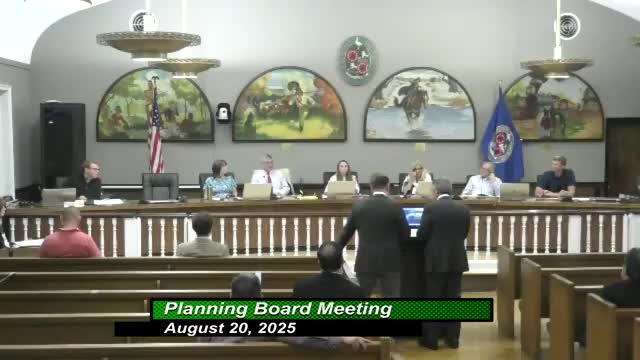
Summary
Board members asked the applicant to run decibel tests on the facility generator and to meet state/local noise limits when the generator is exercised; the applicant agreed to test and explore noise mitigation measures.
During the Aug. 27 Planning Board hearing, board professionals asked Wonder Foods if the facility’s emergency generator exceeded local and state noise limits when exercised and whether the company would commit to mitigating generator sound. Planning consultant Mr. Dickerson cited the state noise code and said exercising a generator is subject to local noise rules; he told the applicant that the typical limit cited is 65 decibels at the nearest residential property line during the day and 50 decibels at night. The applicant’s representative, Mr. Botcher, said the company had not performed a sound study but agreed that the company would do decibel testing and “explore options to mitigate the sound,” and he also agreed the board could impose a condition about the day and time for weekly tests. Board members suggested designating a single weekly time for generator exercise to reduce unpredictability; the applicant agreed to a midweek time (Wednesday around 2 p.m.) if the board imposes that condition. The applicant also agreed to report decibel test results and to implement noise-reduction measures if tests show exceedances. Why it matters: residents described the generator as loud and disruptive; the board asked for measurable verification so that any required mitigation (mufflers, screens or enclosure work) could be required as a condition of approval. Follow-up: the board requested decibel measurements at residential property lines during generator exercise, and the applicant agreed to provide tests and to consider sound mitigation that will bring levels below the applicable municipal/state limit.