
Glendale council selects flexible rental-stability program, directs planning for county funds
Get AI-powered insights, summaries, and transcripts
Subscribe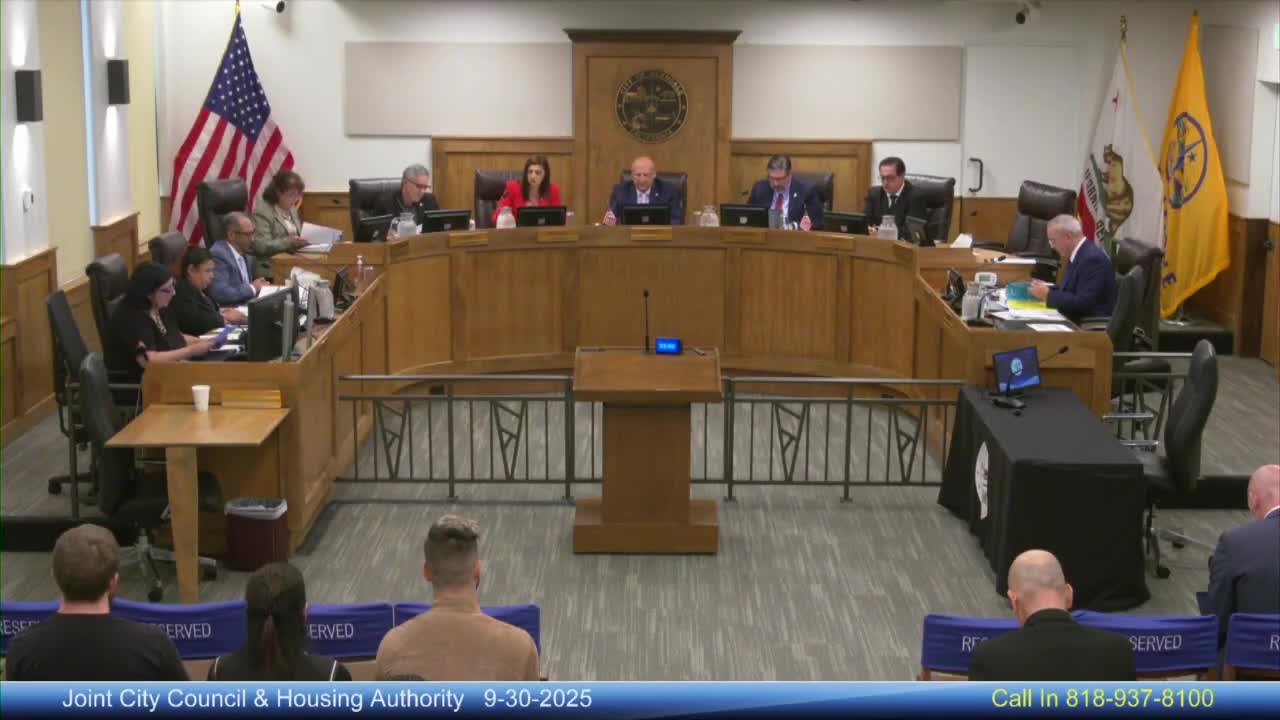
Summary
The Glendale City Council voted to preliminarily select a flexible rental-assistance package (GRASP) and continue an existing working-family subsidy (Life Wrap), directing staff to proceed with program planning using anticipated La Casa funds pending final guidelines.
The Glendale City Council on Sept. 30 preliminarily approved a package of renter-assistance programs that pairs a flexible emergency and stability program called GRASP (Glendale Rental Assistance and Stability Program) with continuation of the Life Wrap monthly subsidy for working families, and authorized staff to begin preliminary planning for those programs using anticipated La Casa funds, pending final funding guidelines. Council made the decision during a joint meeting with the Glendale Housing Authority and approved staff’s recommended Option A by roll call.
The vote directs staff to develop program details and return with a final plan and implementation schedule; the funds are not yet in the city’s bank account. “This program is very in line with La Costa’s ideology to prevent evictions and stabilize low income renters,” Housing Supervisor Sipan Zadorian told council during the presentation.
Why it matters: City staff said Glendale is expected to receive $2,100,000 from La Casa for rental protection and homeless prevention; 20% of that must be used for legal services under La Casa rules, staff estimated $300,000 for program staffing and administration, leaving about $1,400,000 for direct assistance in year one. Council members and public commenters debated how to allocate limited funds among seniors, people with disabilities, families and students and how much to reserve for administration.
Most important facts: Staff described three program options for the La Casa money: continue the Life Wrap working-family monthly subsidy (staff projected Life Wrap could serve about 60 households), fund GRASP — a three-arm program with emergency rent assistance, a short-term income-support arm and a small “special assistance” category for items such as car repairs or medical bills (estimated capacity roughly 150 households) — or a senior rent-stability subsidy (estimated 180 households). Zadorian said La Casa requires served households have an immediate housing crisis and that income limits must be at or below 80% of area median income unless council sets a deeper threshold.
Council discussion and public comment: Councilmember Brotman and others supported Option A (GRASP plus Life Wrap), calling the flexible model more likely to prevent homelessness and to allow staff to target seniors and people with disabilities within the broader program. “I support the recommendation for Option A. I think it makes a lot more sense because it’s targeted, it’s flexible, and we really are preventing homelessness, if we do it right,” Brotman said. Resident Beth Brooks spoke during public comment and urged prioritizing seniors and disabled residents and criticized the Life Wrap program’s income eligibility and subsidy levels, saying the program directed aid at households she described as able to work.
Staffing and administration: Staff proposed adding three mid-level case managers and one entry-level employee to run GRASP and a single hourly staffer for the senior subsidy option; estimated staffing and administration costs were roughly $300,000 for the first year. Councilmembers asked staff to explore using existing homeless-services partners to reduce administrative costs and requested a follow-up evaluation at the end of the funding period to measure program effectiveness.
Restrictions and next steps: Galania (city staff member Rubik Galania) and Zadorian told council the La Casa guidelines were in draft and still changing; staff said the city must submit a plan to draw down funds. Garpetian asked whether the $2.1 million had been received; staff replied that funds were not yet received but would be available to draw down once the city submits a compliant plan. Council directed staff to submit the plan to La Casa to secure funding and return with a detailed breakdown of priorities, eligibility tiers and proposed outreach.
Concluding note: Council approved the motion to proceed with Option A (GRASP plus continuation of Life Wrap) and asked staff to refine eligibility, minimize duplicate payments with other homeless-service providers, and return with a final program design after consulting La Casa’s finalized guidelines.