Get Full Government Meeting Transcripts, Videos, & Alerts Forever!
Get email alerts on the Economic Development topic
No spam. Unsubscribe anytime.
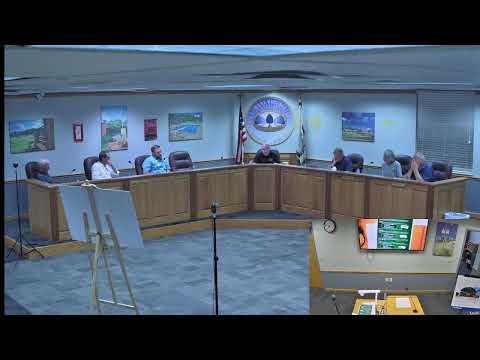
Council discusses phased funding, infrastructure first for Spencer’s Landing project
Summary
City council held a nonbinding discussion on funding options for Spencer’s Landing, prioritizing restrooms, walking paths and river access while urging pursuit of grants, donors and earmarks for a larger multiuse venue estimated at about $8.5 million.
City council members and project representatives held a nonbinding discussion about funding and phasing for Spencer’s Landing, concentrating on immediate infrastructure needs and strategies to attract outside funding for a larger multiuse venue. The meeting opened the floor for questions and explicitly asked that no formal commitments be made during the session.
The conversation centered on sequencing and funding options. Council participants and presenters agreed that city funds should first support basic infrastructure — restrooms, walking paths and river access — before committing to the higher-cost multiuse facility. “We’re not seeking any decisions or commitments,” a council member leading the meeting said, opening the discussion.
Why it matters: council members stressed that the city’s cash reserves and competing infrastructure needs mean any city investment must be staged to preserve the ability to match grants. One council member said it would be prudent to prioritize items that “everybody in our community is going to utilize,” listing restrooms, walking paths and boat access before a large venue.
Key funding options discussed included a USDA Community Facilities loan (noted as available up to 35 years at roughly 5.25 percent in the presentation), federal earmarks, foundation grants and private donors. Presenters said federal earmarks often favor projects that are further advanced; earmark applications typically open in spring and have historically favored projects supported by multiple congressional offices.
Participants raised several quantitative figures during the discussion. Presenters described a possible financing stack that included an illustrative bond financing figure of about $1.5 million and a city cash commitment “at 2 and a half million,” and noted a private donor conversation in which an individual expressed interest in a $100,000 gift but said they would not be the first contributor. A council member referenced an example multiuse venue cost of roughly $8.5 million (described in the meeting as “eight and a half million”). One speaker warned that construction inflation could raise that figure if the project is delayed.
Multiple funding and grant constraints were flagged. Presenters said federal and state grant dollars were currently limited compared with the COVID-era influx; respondents noted that some grant programs disperse small premium dollars in modest increments (examples: $50,000) rather than funding a single large-ticket project. An ARC grant opportunity of $2 million that would require a $1 million local match was also mentioned as an example of a grant that would need matching city funds.
Speakers discussed the value proposition of a multiuse venue versus incremental investments. Industry consultant Rick (identified in the meeting as an events professional) described two uses for venues: smaller, festival-style events that rely on public amenities and larger ticketed events that require controlled access and box office revenue. Several council members said rental income alone would unlikely cover the full cost and operating expenses of the proposed multiuse facility, making outside funding and philanthropic participation necessary.
Infrastructure needs and utility capacity were also reviewed. Staff said water, sewer and electric capacity already has some improvements in place: a water pump and limited service were installed to enable future upgrades, but additional sewer, water and power work would be required to support the full buildout. No firm city cost estimate for utilities was provided during the discussion.
Timing and next steps: presenters recommended staging work so that modest, “low-hanging fruit” improvements could be completed quickly to show momentum and strengthen future grant applications. Council members discussed setting aside recurring, modest amounts from reserves (one proposal mentioned $250,000–$325,000 annually for infrastructure across years) to protect the city’s ability to match grants and avoid overcommitting on long-term debt.
No formal motions or votes were taken on Spencer’s Landing during the discussion. Earlier in the meeting the council did adopt a budget resolution and approved a United Bank bid (the budget resolution and bank bid were approved before the Spencer’s Landing discussion), but council leadership reiterated that the evening’s Spencer’s Landing conversation was intended only to gather feedback and align priorities rather than to authorize spending.
The council asked city staff and presenters to continue developing funding scenarios, to pursue available grants and to return with more detailed cost estimates and phasing plans. Several council members suggested holding a community meeting so residents can provide input on which components (playground, walking path, multipurpose venue, river access) they prioritize.
The discussion closed without a decision; the council adjourned following the presentation.