
Senate committee advances omnibus disaster bill after hearings on camps, volunteers and warning systems
Get AI-powered insights, summaries, and transcripts
Subscribe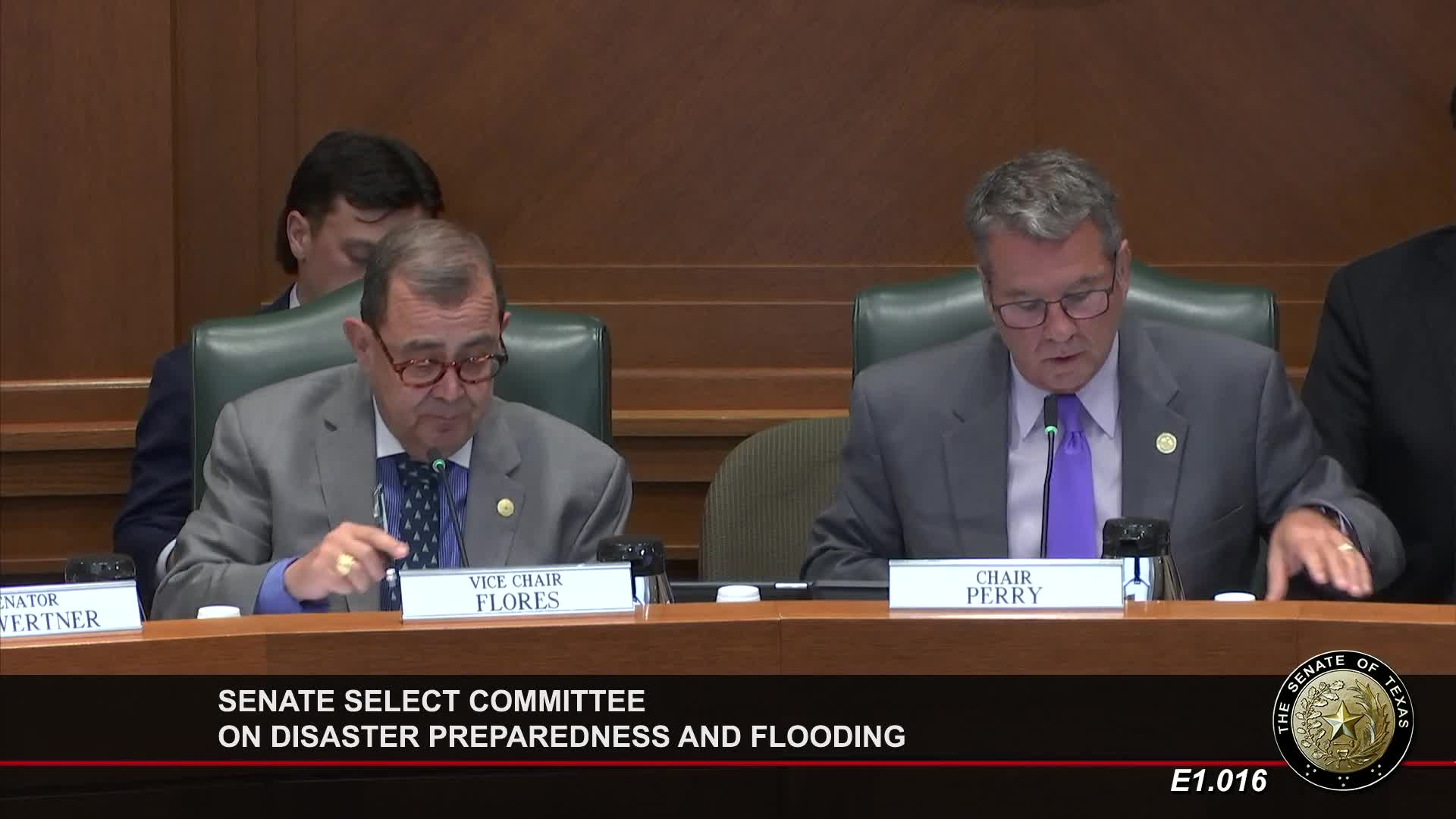
Summary
The Senate select committee on disaster preparedness and flooding advanced an omnibus bill Monday that would tighten rules for youth camps and campgrounds, require emergency-management training and drills, create a statewide data hub for flood gauges and weather stations, and set up a credentialing and volunteer-management system for disaster response.
The Senate select committee on disaster preparedness and flooding advanced an omnibus bill Monday that would tighten rules for youth camps and campgrounds, require emergency-management training and drills, create a statewide data hub for flood gauges and weather stations, and set up a credentialing and volunteer-management system for disaster response.
Chairman Charles Perry, chairing the committee, said the measure is the product of weeks of hearings and field visits after July flooding that killed 138 people. “Senate Bill 1 is the primary product of the work we performed the last few weeks,” Perry said during the committee’s layout of the bill.
Why it matters: Committee members said gaps in local leadership, coordination and training contributed to the slow or inconsistent emergency response during July’s flash floods. The bill’s sponsors said the changes aim to give local officials clearer authority and minimum training so they make evacuation or sheltering calls earlier in fast-moving floods.
Key provisions - Campground safety: Youth camps located in the 100-year flood plain would have to adopt and practice a written flash-flood evacuation plan and provide it to local emergency managers; the committee substitute requires an annual full drill, not just a tabletop exercise. The bill also directs retrofitting options, including rooftop access, so occupants have a last-resort place to reach higher ground if evacuation is impossible. - Emergency-management staffing and training: The bill defines lines of succession for county judges and mayors for emergency-management authority and establishes a three-tier training approach (basic, intermediate and advanced) for emergency-management coordinators; committee discussion raised a proposed minimum of 16 hours of required training for certain officials. - Statewide data hub and gauges: The committee panel directed the Texas Water Development Board to expand the state’s Mesonet network and to coordinate with other regional networks, modelers and the National Weather Service so local officials get timely forecast/model outputs tied to gauges for actionable warnings. - Volunteer management and credentialing: The bill creates a statewide volunteer registry and reception/coordination processes so spontaneous volunteers can be organized, trained and tracked. The measure allows background checks for volunteers in roles where screening is appropriate; committee discussion emphasized that the checks would not be FBI-level screenings for every walk-up volunteer and that established, credentialed nongovernmental organizations would be treated differently from spontaneous volunteers. - Other elements: the bill adds a mass-fatality response workstream, authorizes limited neutralization of unauthorized drones over disaster areas, expands existing small- and micro-business recovery loan programs and clarifies coordination on low-water crossings with TxDOT.
What committee members said: Brian McMath, executive administrator of the Texas Water Development Board, told the committee the state’s Mesonet is a “network of networks” and must be expanded and coordinated with regional partners. John Hoppin of the Lower Colorado River Authority supported coordinated warning systems and said adding sirens and gauges in flash-flood corridors “would make a real difference to protect lives and property.”
Volunteers and safeguards: Chief Nim Kidd of the Division of Emergency Management said the aim is not to dissuade volunteers but to organize them so they are effective and safe. He described the typical lifecycle of a disaster response — immediate volunteers, then organized responders — and said volunteers should be funneled through reception centers to allow notification, assignment and limited vetting when appropriate.
Justice of the peace and inquest questions: Several justices of the peace and the Texas Justice Court Training Center asked the committee to clarify inquest and death-certification procedures in mass-fatality incidents. The bill preserves JP authority to order or decline autopsies and directs additional training and coordination; the committee and training center staff said they will work together on implementation and education.
Next steps: The committee adopted the committee substitute for Senate Bill 1 with no recorded objection and left the bill pending for floor consideration. Sponsors said they expect additional technical amendments on the floor, particularly on training hours and volunteer procedures.
Limitation and scope: The bill applies to state-regulated youth camps and specifies different treatment for RV parks; committee members said they will consider additional floor amendments to refine how adult or mixed-use camps are treated.
The committee’s work grew out of two joint hearings and a site visit to the affected area; sponsors said the intent is to provide clear lines of authority and practical tools so local leaders can act quickly when flash-flood warnings arrive. The panel stressed drills and coordination as key to faster, more effective responses.