
Glendale council tentatively selects flexible rental‑assistance program using anticipated La Casa funds
Get AI-powered insights, summaries, and transcripts
Subscribe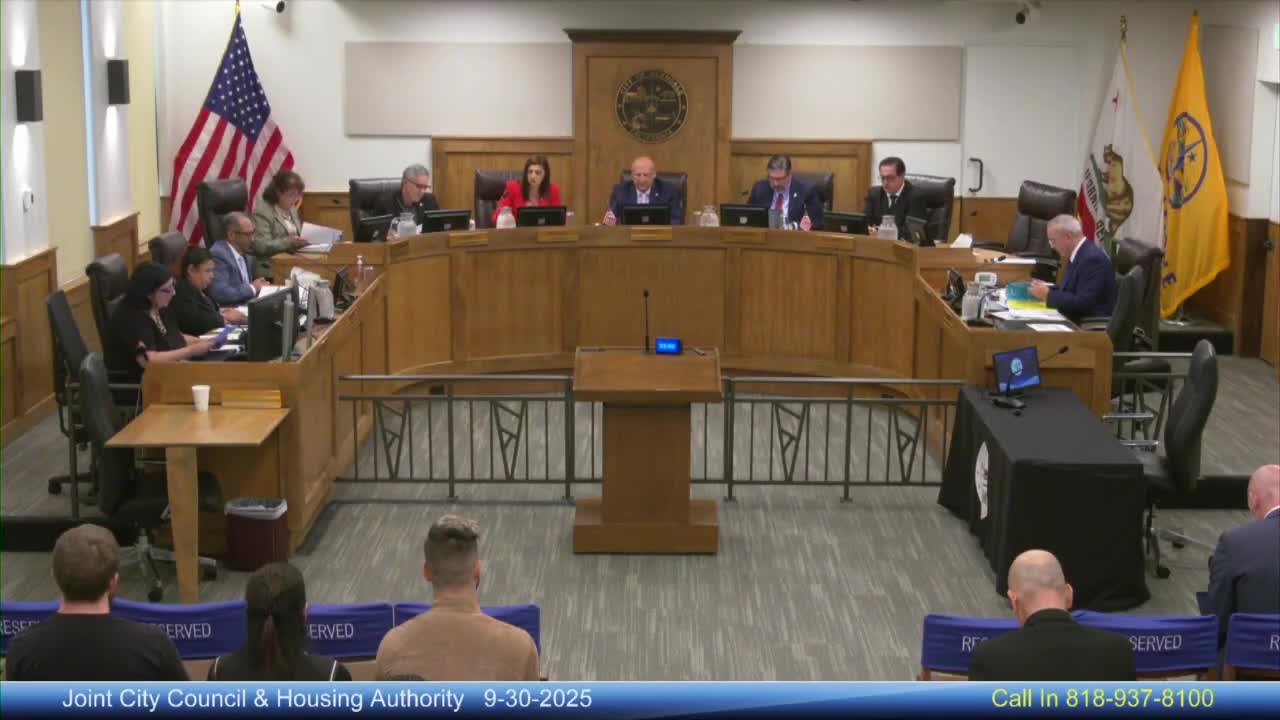
Summary
The Glendale City Council on Sept. 30 approved preliminary selection of a flexible rental‑assistance and stabilization program (GRASP) paired with continuation of an existing Life Wrap subsidy, authorizing staff to prepare detailed program plans using anticipated La Casa funds pending final La Casa requirements.
The Glendale City Council on Sept. 30 approved preliminary selection of housing assistance programs and authorized staff to proceed with program planning using anticipated La Casa rental protection and homeless prevention funds, pending final funding approval and La Casa requirements.
City staff presented three options and recommended a flexible Glendale Rental Assistance and Stability Program (GRASP) paired with continuation of the Life Wrap monthly subsidy rather than a stand‑alone senior rent subsidy. Staff said the city expects $2,100,000 from La Casa for rental protection and homeless prevention; after reserving 20% for legal services and roughly $300,000–$380,000 for staffing and administration, about $1,400,000 would be available for direct assistance in the first year.
Why it matters: La Casa requires that funds be used for households in an immediate housing crisis (at risk of losing housing or unable to resolve an issue that could lead to loss of housing). The council’s preliminary direction lets staff draft program details now so the city can draw down funds when final La Casa guidelines are issued.
Staff presentation and council direction Sipan Zadorian, housing supervisor, described the recommended GRASP as a three‑arm emergency program that would include (1) emergency rental assistance for tenants behind on rent and at risk of eviction, (2) short‑term income support for households that need a bridge to maintain housing, and (3) special assistance for discrete barriers (for example, car repairs or medical bills). Zadorian said La Casa requires income eligibility at or below 80% of area median income, and that the city could set a lower (30%) cap for some priorities if council desired. He said staff anticipates hiring three mid‑level case managers and one entry‑level employee to operate GRASP and estimated roughly $300,000–$380,000 for staffing and administration depending on scope.
Zadorian summarized prior city programs funded from the general fund, including a monthly housing subsidy program that served 1,200 seniors with $300 monthly subsidies, a low‑income student rental assistance program that served 141 students, the Life Wrap program (about 106 working families) with average subsidies near $1,000 per month, and affordable housing development that produced 575 units. He said about 2,022 households have been served since Measure S was passed in 2019–2020.
Program tradeoffs and staff recommendation Staff presented three recommended options: continue Life Wrap (staff estimated Life Wrap could serve about 60 households), adopt GRASP (estimated to serve about 150 households), or a senior rent‑stability subsidy (estimated 180 households). Zadorian said GRASP is “more impactful, flexible” and can target seniors within its population if council directs (staff suggested an option to dedicate 20% of GRASP funds to residents 62 and older). He also noted that La Casa funding limits assistance to six months for rental assistance and that the senior flat subsidy has the downside that aid ends after six months while deeper, service‑rich programs may give participants a better chance to stabilize long term.
Public comment and council questions Resident Beth Brooks spoke during public comment and urged narrowing assistance to seniors and people with disabilities. Brooks said, “The Life Wrap program should be eliminated,” and criticized the proposed payout scale, arguing the city should prioritize the neediest residents and suggested smaller payments to a larger group (for example, a $150 utility‑focused assistance) rather than larger six‑month payouts to fewer households.
Councilmembers asked about program timing, recurring funding, staff needs and coordination with existing homeless services. Staff said the city has not yet drawn down funds; La Casa’s guidelines were still in draft and the city must submit a plan to access the allocation. Staff also said many existing homeless prevention grants are ending and that the new program would be coordinated with local homeless services providers to avoid duplicate assistance. Councilmember Brotman questioned whether three new staff positions were necessary and asked staff to revisit staffing and possible use of outsourced providers; Zadorian said prior subsidy programs hired multiple staff and staffing could be adjusted over time.
Action taken and next steps Councilmember motioned to approve staff’s recommendation (option A: continue Life Wrap and adopt GRASP). The council took a roll‑call vote and approved the motion. Staff said it will submit a plan to La Casa to secure the first year of funds and will return with a detailed program plan that incorporates council priorities (priority tiers for seniors and people with disabilities, outreach and marketing, and program performance and evaluation). Zadorian said council could revisit funding decisions at the end of the first year and adjust program design for subsequent funding cycles.
Additional details Staff estimated GRASP could be structured as a recurring intake (for example, quarterly openings or monthly cycles) rather than one annual lottery so that households entering crisis later in the year can apply. The recommended program design allows targeted utility assistance if the household is at risk of losing housing; staff said general utility assistance for all low‑income customers would not meet La Casa’s homeless‑prevention requirement unless paired with evidence the household faces imminent housing loss. Outreach would use the city’s usual channels: mailers, social media, posters and partner referrals. Staff committed to returning with a detailed breakdown that shows percentage of funds going to specific income tiers, proposed priority rules (for example, seniors and disabled residents), staffing plan, and performance measures.
Ending note Councilmembers supported moving forward to lock down funding and directed staff to return with the final program details and reporting requirements once La Casa’s guidelines and the city’s plan are finalized.