
City staff outlines municipal credit‑enhancement option to lower borrower rates; legal and revenue limits cited
Get AI-powered insights, summaries, and transcripts
Subscribe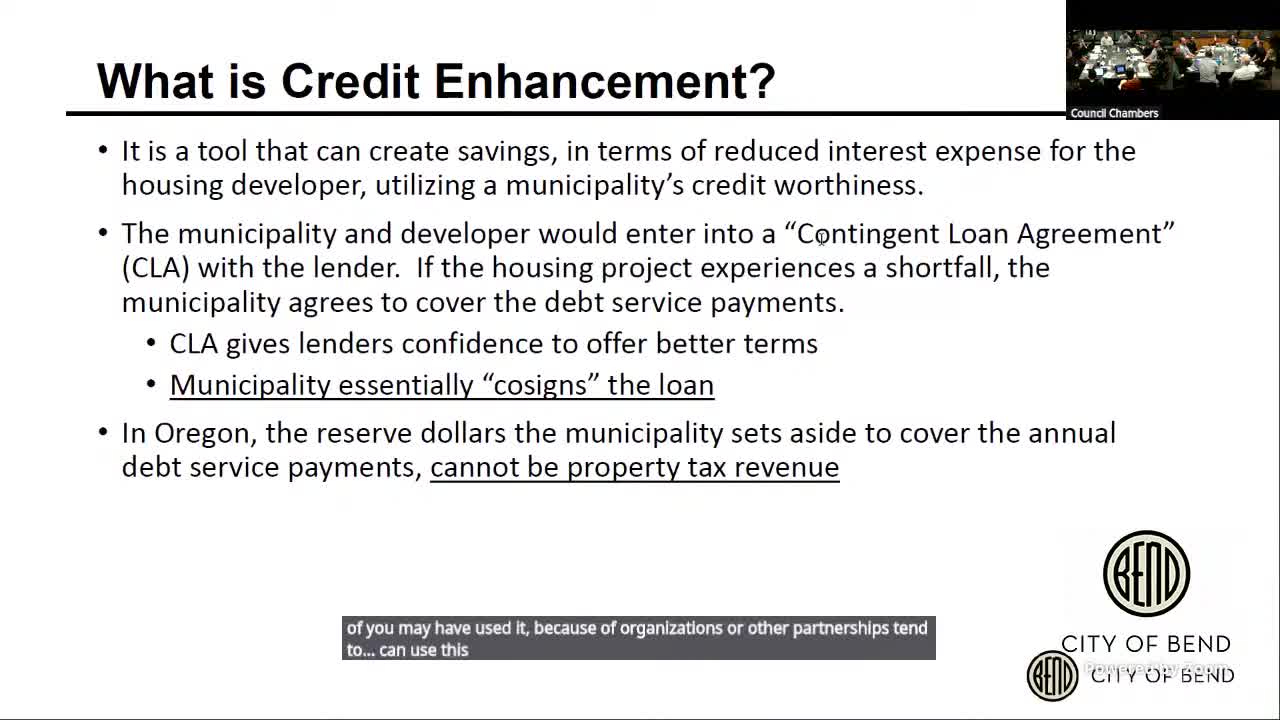
Summary
Staff briefed the committee on municipal credit enhancement — using the city's credit or non‑property‑tax reserves to back developer loans and reduce interest costs — and identified legal limits in Oregon and practical constraints, including the need for non‑property‑tax revenue or a voter‑approved housing bond to create a scalable program.
City staff presented a credit‑enhancement option that would use a municipal pledge or reserve to reduce lenders’ perceived risk and lower borrowing costs for large housing projects.
Staff said credit enhancement typically works by the municipality entering a contingent loan agreement with a lender: the city would not pay upfront but would commit identifiable non‑property‑tax revenues or other reserves that the lender could draw on if a borrower defaulted. Staff and council members noted a constitutional constraint in Oregon: municipalities generally may not lend or pledge their credit to a private party, although the 2018 statewide constitutional amendment authorizes voter‑approved affordable‑housing bonds with defined measures and revenues.
Presenters outlined pros and cons. Potential benefits cited were: significant leverage (a relatively small reserve can support large borrowing), lower interest rates for developers and no immediate cash outlay if the guarantee is not called. Risks include the city reserving funds for the duration of the contingent obligation, reputational and financial risk if a project defaults, and statutory limits that generally exclude property‑tax revenue as an unrestricted backing source. Staff said the most readily available non‑property‑tax source in the near term is proceeds from prior Juniper Ridge land sales but that council has other priorities for those funds.
Committee members and staff discussed operational details: whether the city would rely on interest‑only construction carry, a construction‑to‑permanent structure to limit carrying costs, required debt‑service coverage ratios (staff used a conservative 1.5 example), and whether to require an LOI or other lender commitment before the city agrees to exposure. Some committee members favored piloting credit enhancement on a single market‑rate or workforce rental project expected to reach stabilization and pay back the support at exit. Others emphasized the need to preserve funds and to define who benefits and how revenue generated (fees or eventual proceeds) would be used to seed future housing programs.
Staff said they will return with a more detailed proposal showing required reserve sizes, proposed non‑property‑tax revenue sources, program eligiblity criteria and risk‑mitigation language for council consideration.