Get Full Government Meeting Transcripts, Videos, & Alerts Forever!
Get email alerts on the Spencers Landing Funding topic
No spam. Unsubscribe anytime.
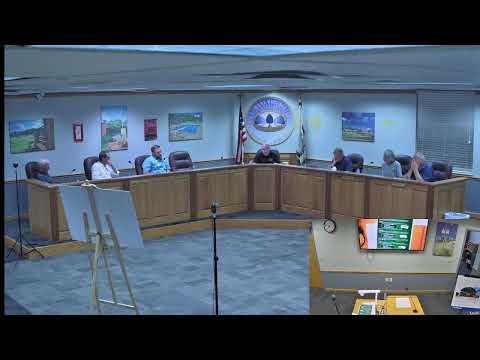
Vienna council discusses funding priorities, infrastructure before committing to Spencer’s Landing venue
Summary
Councilors at a Vienna City Council meeting held a lengthy, nonbinding discussion on funding priorities for the Spencer’s Landing riverfront project, emphasizing infrastructure and river access first and reserving larger funding decisions for future budget deliberations and grant pursuits.
At a recent Vienna City Council meeting, councilors and project representatives held an extended discussion about funding and phasing for Spencer’s Landing, a proposed riverfront development that would include restrooms, walking paths, river access and a multiuse event facility. The discussion was exploratory; no formal commitments or votes on Spencer’s Landing were taken.
The council’s chair opened the agenda item by saying the meeting’s purpose was “just simply to have open discussion” about potential city commitments and funding approaches for Spencer’s Landing. He emphasized the session was a conversation, not a decision: “No decisions. We’re not seeking any decisions or commitments,” he said.
Councilors and outside consultants framed a staged approach that would prioritize infrastructure — restroom facilities, a walking path and river access — ahead of the larger, multiuse venue. The presiding official said he was prepared to recommend a city commitment in the range of $2 million to $2.5 million toward those infrastructure needs, but said larger-ticket items such as the multiuse facility should be pursued with outside grants, earmarks and private donors.
Consultants and private-sector representatives described the current grant climate and financing options. One presenter noted federal and state grant dollars have tightened since COVID-era funding and described the U.S. Department of Agriculture Community Facilities loan as an option that can finance an entire project over 35 years at about a 5.25% rate. He also said federal earmarks are competitive and that applications usually open in spring, with a typical “sweet spot” around $1 million.
Rick, owner of RMA Presents, described the market for events and how a multiuse venue could generate indirect economic activity for local restaurants and retailers: “My company, RMA Presents, we actually do events in 15 states,” he said, adding that events can create revenue streams beyond ticket sales through visitor spending.
Council members raised fiscal-reserve and matching-funds concerns. One councilor cautioned against relying heavily on long-term borrowing without secured matching funds from grants or donors, and another pointed to a competitive Appalachian Regional Commission (ARC) program that could provide $2 million but would require a $1 million local match.
City staff and the presiding official outlined more immediate municipal priorities and limits. The presiding official said he intended to ask the budget and finance committee for $250,000–$325,000 per year over the next four years toward general infrastructure improvements (roads, stormwater and similar needs), noting that reserves must be managed to cover such commitments. He and other council members said easily achievable items — restrooms, picnic pavilions and walking trails — could be advanced sooner while the city pursues larger grants and private fundraising for the multiuse facility.
Private-donor interest was reported but described as contingent: a private donor reportedly said they would consider a six-figure gift but “we’re not gonna be the first one in.” Several speakers said that demonstrating some city dollars committed to initial infrastructure would strengthen future grant and donor requests.
Speakers flagged timing and cost escalation as factors: one consultant warned that construction costs rise over time, meaning a multiuse facility estimate could increase if the city delays. Councilors also discussed naming-rights and sponsorship strategies and the city’s capacity to operate and maintain new facilities if built.
The council ended the discussion without vote. The presiding official suggested holding a public community meeting at the community building to gather more local input and continue planning work.
For now, the council’s stated path is to focus city resources first on basic infrastructure and river access at Spencer’s Landing, pursue grants and private funding for larger features, and return to formal budget committees for any planned city commitments.