Get Full Government Meeting Transcripts, Videos, & Alerts Forever!
Get email alerts on the Parking Pay By Plate topic
No spam. Unsubscribe anytime.
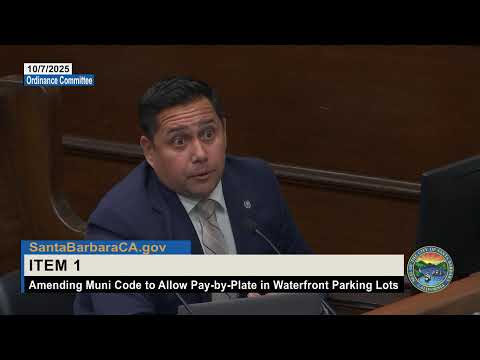
Ordinance committee forwards pay-by-plate change for Santa Barbara waterfront parking
Summary
The Ordinance Committee voted unanimously Oct. 7 to forward an ordinance to City Council that would amend Title 17 to permit pay‑by‑plate enforcement in six self‑pay waterfront lots, keep two staffed lots unchanged, and require vendors to retain license‑plate data for 30 days.
The Santa Barbara Ordinance Committee on Oct. 7 voted unanimously to forward to City Council an ordinance amending Title 17 of the Santa Barbara Municipal Code to permit a pay‑by‑plate (license‑plate) system for waterfront parking lots, city staff said.
The change would replace the current “pay and display” requirement at six self‑pay waterfront lots — where drivers buy a paper receipt and display it on the dashboard — with a system that requires drivers to enter their license plate at the pay station and allows enforcement using license‑plate reader (LPR) cameras. Cesar Barrios, Waterfront business manager, told the committee the change would “support and enhance the operational efficiency significantly.”
The committee’s action matters because the waterfront operates eight parking facilities with about 2,600 stalls. Two locations — Stearns Wharf and the Harbor — will remain staffed and continue using existing point‑of‑sale and gate systems, staff said. The proposed amendment applies to the other six lots, which include Leadbetter Beach, Harbor West, Palm Park, Garden Street and the two lots adjacent to the Cabrillo Pavilion.
City staff described operational details and consumer options. Visitors would enter a vehicle license‑plate number at a pay station when purchasing a session; paper receipts would remain an optional feature at machines. Barrios said the pay‑by‑plate approach eliminates the need for paper receipts to be displayed on dashboards, reduces litter at beach lots and allows for remote payment options in the future, such as phone apps and mobile wallets. He said the city is not yet rolling out remote app features but that the ordinance would “lay the foundation” for them.
Council member Jordan asked whether the system would allow a driver to pay remotely from inside a parked car on day one. Jordan asked, “So when you implement this from day 1, I won't be able to park, sit in my car, enter my information in on my phone app, get a notification of payment, and walk away from my car?” Barrios replied that initially users must go to the machine and that mobile app and remote‑payment capabilities will require additional planning, contracting and IT work.
Staff said two of the six machines at Leadbetter currently accept cash, and the city intends to preserve cash options where practical to serve cash‑reliant customers. Barrios also said vendors providing the system are California based and that the city’s policy limits retention of license‑plate images to 30 days; the images are kept on a closed system and, according to staff, are not linked to personal data.
The city attorney told the committee the city would continue to follow state law and existing city privacy policies governing license‑plate data, noting enforcement actions in other jurisdictions and the need to comply with California rules. “We would continue to follow state law,” the city attorney said.
Committee discussion included a request to remove the word “prominently” from the ordinance language; the motion forwarded to council included that change. Council member Jordan moved to forward the item; Mayor Ralphs seconded. The committee voted unanimously to forward the ordinance for introduction at City Council.
Next steps: the committee forwarded the ordinance to the full City Council for introduction; if introduced, City Council would consider the ordinance in a future meeting and staff would return with implementation details, vendor contracts and any required IT integration before remote payment features are activated.