Orange County reviews draft 2050 land‑use plan and potential changes to rural buffer
Loading...
Summary
County planning staff presented population, housing and land‑use data and described draft 2050 policy options — including rural conservation neighborhoods and mixed‑use nodes — that would require coordinated changes with Chapel Hill and Carrboro under the existing joint planning agreement.
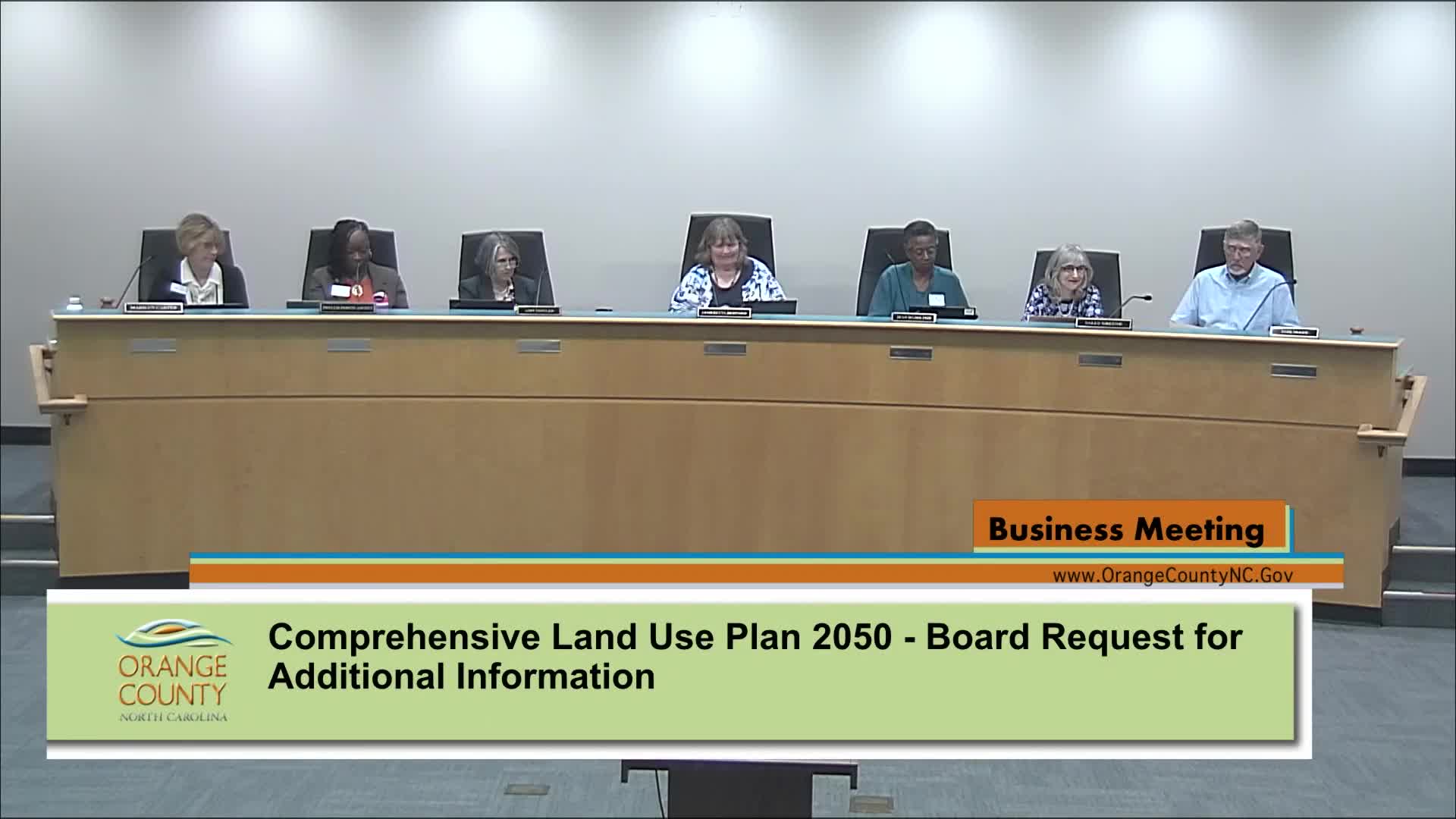
Orange County planning staff briefed the Board of County Commissioners on Sept. 9, 2025, about a preliminary draft of the county—s comprehensive land‑use plan for 2050, providing census and consultant data and describing policy options for the county—s rural buffer and joint planning areas.
Tom Altieri, Orange County senior planner, said the presentation combined data from the project fact book, U.S. Census figures and other consultant deliverables to support an update to the county—s current 2030 plan. He noted population growth in Orange County from 2010 to 2020 as about 11%, compared with roughly 9% for North Carolina, and that municipal annexations since 2004 totaled a little over 3,000 acres. "The land use plan does not and will not tie hands," Altieri said, adding that the plan is a policy guide rather than an ordinance.
Why it matters: The update would reframe long‑range guidance on where housing, economic development and rural conservation should occur across the county. The draft introduces several new concepts that could change how land is regulated or developed, but staff said none of those changes is final and several would require agreement with neighboring towns.
The presentation summarized several findings from the fact book and other sources: Chapel Hill contains about 40% of the county population; Mebane showed the largest percentage population increase (reported by staff as about 77% from 2010 to 2020); and regional housing supply data showed a constrained for‑sale market in 2024, with a large share of listings above $400,000 and very limited inventory under $200,000. Altieri said the county will update the fact book as new authoritative sources are identified and that staff will compare it with data from the North Carolina Association of County Commissioners when practical.
Staff described how the county—s future land use map (FLUM) and the Unified Development Ordinance (UDO) interact: the FLUM contains broad land‑use categories, while the UDO and a matrix in the plan provide the technical link between those categories and zoning districts. Altieri stressed the plan is advisory: the board may make land‑use or zoning decisions inconsistent with the plan but would normally direct staff to amend the plan to reflect consequential changes.
Key draft policy options and constraints
- Rural buffer and subcategories: staff said the rural buffer that surrounds Chapel Hill and Carrboro covers roughly 36,000 acres and includes subcategories such as resource protection, public and private open space and rural residential. The existing rural buffer predates some state watershed rules and carries both land‑use and zoning implications.
- New land‑use concepts in the draft: the preliminary 2050 draft proposes adding "rural conservation neighborhoods," rural activity nodes and potential mixed‑use areas (notably an option shown around Blackwood Station). Altieri said these new categories could be implemented only through subsequent changes to the UDO and other implementing regulations.
- Joint planning requirement: several commissioners pressed staff on how changes in the joint planning area would proceed. Perdita Holtz (planning staff) told the board that the Orange County—s joint planning agreement (JPA) with Chapel Hill and Carrboro requires all parties to work together: any modification to the rural buffer that affects the joint area must be approved by all signatories and follow the JPA—s joint public‑hearing requirements. "By virtue of the agreement that we have with Chapel Hill and Carrboro, it requires all parties to work together on potential changes to the joint land use plan," Holtz said.
- Implementation and ordinance gap: staff reiterated that the plan itself is not the UDO and does not change development standards until implementing ordinances are adopted. Altieri described the plan as "aspirational" and said it would be implemented over years through subsequent decisions, zoning changes and, where needed, negotiated agreements with municipalities.
Public‑interest and historical perspective
Barry Jacobs, who attended as an invited guest and was asked to speak briefly, reviewed the history and original aims of the JPA (adopted 1986 and expanded in 1987 to include Carrboro). Jacobs said the plan—s early goals included protecting University Lake and other headwaters, guiding growth into town centers and preserving open space. He urged the board to keep those goals in mind as policy options are considered.
What was decided and next steps
No formal land‑use changes were adopted at the Sept. 9 work session. Commissioners asked staff to return with follow‑up information on several items, including: the assumptions behind population projections; a comparison between the fact book and state association data; further detail about proposed conservation subdivision options and implementation requirements; and the specific steps and timing required to modify policies in the joint planning area. Staff said they will provide additional materials and invite technical presentations (for example, the county is arranging a session on conservation subdivision tools with an outside expert).
Ending
Commissioners did not vote on the draft plan; staff will continue outreach and technical follow up. Any recommended amendments that affect adopted interlocal agreements will be brought back through the joint‑hearing processes outlined in the JPA and will require approval by the towns involved. The county—s project website and the fact book remain the primary sources for the data discussed by staff.