Get Full Government Meeting Transcripts, Videos, & Alerts Forever!
Get email alerts on the Homelessness Services topic
No spam. Unsubscribe anytime.
Partnership presents PIT count and launches monthly homelessness dashboard; unsheltered count up slightly
Summary
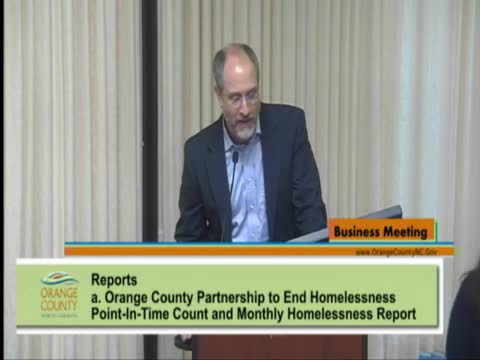
The Orange County Partnership to End Homelessness briefed the Board of Commissioners on June 17 about the January point‑in‑time (PIT) count and a new monthly homelessness report intended to track services and outcomes.
The Orange County Partnership to End Homelessness briefed the Board of Commissioners on June 17 about the January point‑in‑time (PIT) count and a new monthly homelessness report intended to track services and outcomes.
Why it matters: The PIT count and ongoing reporting feed federal Continuum of Care (CoC) requirements and guide local planning and funding for homelessness services, including shelter, rapid rehousing and outreach.
The PIT count, held Monday, Jan. 27, counted 149 people experiencing homelessness in the county, nearly the same total as 2024. Presenters said the PIT methodology is known to undercount unsheltered people and is sensitive to weather and timing; this year's count occurred on a night with modest rain rather than extreme cold.
Highlights from the presentation:
- Total counted experiencing homelessness: 149 (2025) — largely adults; about 6% of counted households had children. Presenters said the total is similar to 2024’s count of 148. - Location breakdown: respondents were distributed among emergency shelter, transitional housing and unsheltered locations; unsheltered counts rose from 33 in 2024 to 48 in 2025. - Age and race: more than 50% of individuals counted were age 45 or older; 63% of those counted identified as African American. - Gender: majority male; small percentages identified as women and a small share as transgender on the PIT instrument. - Chronic homelessness and special populations: chronic homelessness increased by one person year‑over‑year; mental‑health and substance‑use disorders, HIV/AIDS and domestic‑violence survivorship were noted as sizeable shares of the population served.
Presenters and board discussion
County staff and partnership representatives said the PIT count is only one required HUD data point and has known limitations; they described other HUD reporting tools used for planning, notably the Longitudinal Systems Analysis (LSA) completed at year end. Danielle (homeless programs staff) and Blake (housing staff) presented the new monthly dashboard, which compiles coordinated entry interviews, housing‑helpline contacts, street‑outreach engagements, program placements and landlord outreach metrics.
The monthly report (May was added to the dashboard after the board packet was printed) shows year‑to‑date coordinated‑entry interviews, total households assisted (hundreds) and thousands of total contacts across phone, in‑person and email outreach. The county’s SOAR (SSI/SSDI Outreach, Access, and Recovery) effort has two certified staff and staff said they expect an increase in successful benefit enrollments.
Street outreach data showed 25 persons had exited to a positive housing destination year‑to‑date (the street‑outreach team counts shelter placements as a positive destination when moving people off the street); outreach distributes survival supplies, provides clinical assessments and coordinates with jail and other institutional release planning.
Board members asked clarifying questions about data definitions, household continuity year‑to‑year, program eligibility timing (e.g., coordinated entry interview rules tied to expected release dates) and landlord engagement work to increase housing availability for rapid rehousing and vouchers. Staff said they will add rapid‑rehousing metrics to future dashboards and return in early fall with an annual report covering FY24–25.
Ending: The board received the PIT results and the first monthly homelessness dashboard. Staff will continue monthly reporting, add rapid‑rehousing metrics, share quarterly data‑quality reports and return to the board with an annual report in the fall.