Get Full Government Meeting Transcripts, Videos, & Alerts Forever!
Get email alerts on the Property Taxes topic
No spam. Unsubscribe anytime.
Residents decry large property tax increases and ask county to review revaluations
Summary
Dozens of residents from multiple historically Black neighborhoods told the Orange County Board of Commissioners on June 17 that recent property revaluations produced steep increases that many said could force long-term homeowners from their homes.
Dozens of residents from multiple historically Black neighborhoods told the Orange County Board of Commissioners on June 17 that recent property revaluations produced steep increases that many said could force long-term homeowners from their homes.
Speakers described large percentage increases on individual parcels and asked the board to pursue neighborhood-level adjustments, explore changes in assessment methodology and expand anti-displacement supports.
Why it matters: Commissioners oversee the county budget and property-tax policy that affect homeowners' bills. Several speakers said the reassessment results disproportionately affected longtime, lower-income and older residents, raising equity and displacement concerns going into the new fiscal year.
Community members, led by George Barrett of the Orange County Property Tax Justice Coalition, presented a petition and a list of neighborhoods they say were hit hardest, including Councilville, Rogers Road, Pine Knolls, Cedar Grove and others. “Recent inequitable property tax valuations have caused widespread concern in our neighborhoods,” Barrett said, asking the board to bring neighborhood evidence to the Board of Equalization and Review and to pursue “neighborhood adjusted adjustments.”
Individual homeowners recounted their new valuations at the microphone. Lily Brown said her assessed land value rose from about $51,300 in 2024 to $131,600 under the new assessment, and that another property of hers rose from $128,500 to $247,300. “It's just plain old land,” Brown said, asking why the reassessment was so large.
Other speakers gave similar examples. Elizabeth Adams said a lot that had $400 in taxes in 2020 is now listed at roughly $1,800. William Gaddis, who said he is 79 and on Social Security, compared his small two‑bedroom home’s new tax value to a much larger nearby rental and asked why the smaller house was taxed more. “On a fixed income, I am 79 years old,” Gaddis said. Betty Geer, 81, said the increases felt like a coordinated effort to push longtime Black residents out of the county.
Board response and process limits
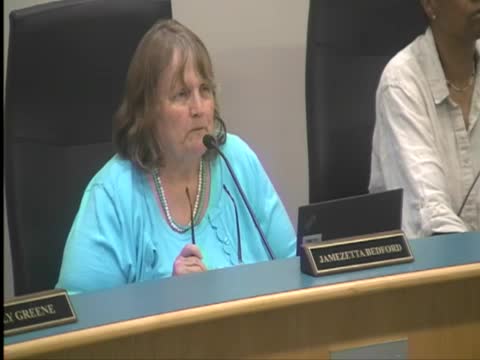
Chair James Edda Bedford and other commissioners acknowledged the concerns and explained some limits on county action. Chair Bedford asked county staff about whether a civic organization could present neighborhood appeals to the Board of Equalization and Review. County staff (tax office) responded that the board of equalization handles individual property appeals; homeowners must file appeals themselves, and community members may attend in supportive roles but cannot appeal on behalf of others.
Commissioner Hamilton said she took residents’ concerns seriously and that county staff had already discussed the issue with community members and would follow up. Commissioner Hamilton asked for a report on the reassessment process and fairness at a future meeting.
Commissioner Green recommended improved public presentation of the county’s transit and other plans but also proposed a petition-style change to require certain major development decisions to be considered over two meetings so questions can be addressed; that remark was not directly about taxation but reflected commissioners’ interest in more public input and deliberation.
What residents asked the board to do
Speakers and the Property Tax Justice Coalition asked the board to: 1) accept neighborhood evidence before the Board of Equalization and Review, 2) undertake a focused reassessment of the named communities to remedy perceived inequities, 3) correct undervalued luxury apartment assessments so the tax burden is more evenly shared, 4) integrate mass‑assessment tools that consider vertical equity, 5) work with academic and housing experts rather than outside consultants, and 6) continue and expand anti‑displacement funding such as the Long‑Time Homeowners program.
County staff and commissioners said state law limits some actions — for example, the Board of Equalization and Review accepts property‑level appeals — and encouraged homeowners to file appeals while the county considers what broader steps it can take. Commissioners said they will try to provide an update and asked staff to bring back information on the reassessment process for the July 8 business meeting.
Ending: The board did not take a formal countywide policy vote on reassessment that night; residents were urged to pursue individual appeals where appropriate, and commissioners said they would continue to examine options and report back at a future meeting.