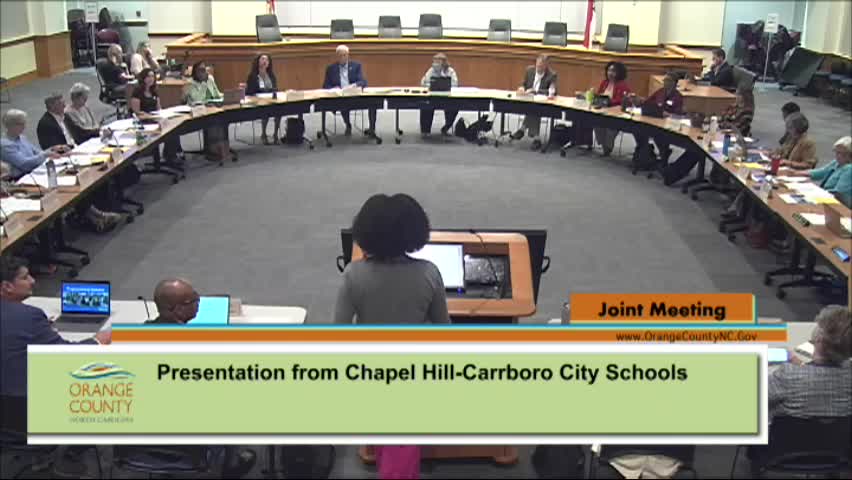
District officials cite staffing, licensing and allocation rules for 97-child pre-K wait list
Loading...
Summary
Orange County Schools officials said they have 226 pre-K enrollees and 97 children on a tuition wait list; staffing certification, seat allocations for Head Start and NC Pre-K, and space constraints limit moving tuition students into vacant slots.
Orange County Schools told county commissioners that pre-K programs currently enroll 226 students and maintain a tuition wait list of 97 children, and officials said the wait list exists because eligibility rules, program seat allocations and staffing constraints prevent simply moving tuition students into vacant slots.
‘‘Our wait list currently is only parents that fall under the tuition category. So, no students that fall under Head Start, NC Pre-K, ECR subsidy are on our wait list,’’ said the district presenter (pre-K lead), explaining that each funding source or program has designated seats and that the district holds those seats for eligible students.
Why it matters: Local pre-K availability affects early-childhood access and family planning. Officials said staffing — particularly the shortage of pre-K–licensed teachers and teacher assistants who meet the required college credit thresholds — and space limits are primary constraints.
Officials’ explanation of separate classrooms: The district described ‘‘separate’’ pre-K classrooms as those serving students with Individualized Education Programs (IEPs) who have significant needs and perform below typical pre-K expectations. Those classrooms lower student-to-teacher ratios; they cover the same foundational curriculum adapted to individual levels, the presenter said.
On moving children into vacant slots: The district said it holds slots by program type (Head Start, NC Pre-K, tuition) to accommodate eligible students who may enroll later; moving a tuition child into a subsidized seat can leave a later-eligible student without a slot, officials said.
Staffing constraints cited: The presenter said a shortage of teachers with the specific pre-K license and of teacher assistants with required college hours — and funding to recruit them — limits expansion. ‘‘It's a staffing concern as well as a space concern,’’ the presenter said.
What was not decided: No policy change or new funding was approved at the meeting. Commissioners asked questions about whether the wait list had changed year to year; the district said it was about the same as prior years.
Ending: Officials said the district will continue to monitor enrollment, staffing and program allotments and reiterated that current program rules and funding sources determine how slots are held and filled.