Get Full Government Meeting Transcripts, Videos, & Alerts Forever!
Get email alerts on the Economic Development Incentives topic
No spam. Unsubscribe anytime.
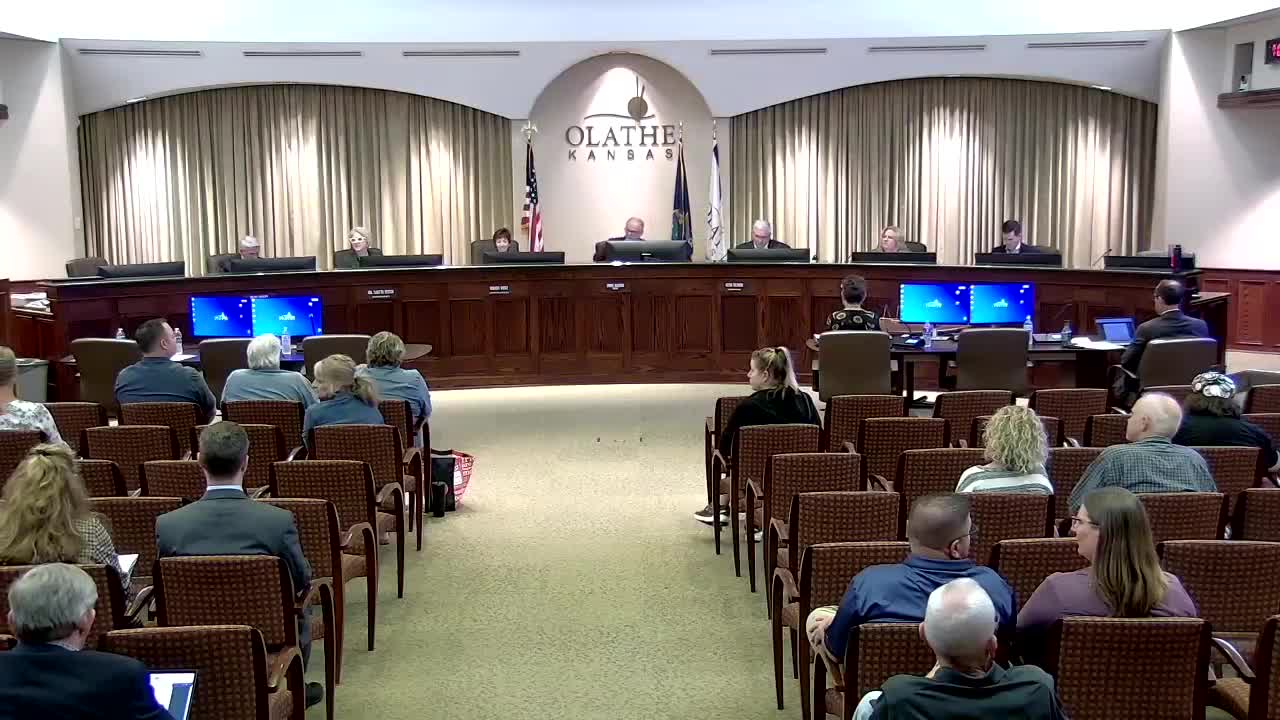
Olathe council approves tax breaks for Lineage Logistics amid neighborhood pushback
Summary
On Oct. 7 the Olathe City Council voted 5-2 to approve a resolution authorizing industrial revenue bonds and a tax abatement for Lineage Logistics LLC’s planned 450,000-square-foot refrigerated warehouse at Lone Elm Road and 170th Street. Residents warned the incentives shift service costs and traffic burdens onto local neighborhoods.
The Olathe City Council on Oct. 7 approved a resolution authorizing industrial revenue bonds and a property tax phase‑in for Lineage Logistics LLC’s proposed 450,000‑square‑foot refrigerated warehouse at the northeast corner of Lone Elm Road and 170th Street, passing the measure 5‑2.
The decision followed a public hearing in which neighbors urged the council to reject the incentives, saying the package would shift maintenance and public‑service costs to existing taxpayers, increase heavy‑truck traffic near homes and schools, and degrade property values. “Please do the right thing tonight and do not approve this massive package of incentives and tax abatements for Lineage,” said Mike Hibbett, who identified himself as an 11‑year Olathe resident.
The issue matters because the city will forgo some property tax revenue and issue industrial revenue bonds to support the project; residents said the lost revenue would otherwise support schools, roads and public safety. Jeff Walters, a neighborhood resident, questioned the project’s job creation math and said the facility is highly automated: “This new lineage development is 1 tenth of a square mile, 64 acres, and will employ 200 people.” Janice Walters, another resident, criticized the requested building height and the corporate tradeoffs: “Lineage is requesting permission to build a 140 foot facility… This is about corporate convenience. It is not about community benefit.”
Council members debated the measure after the public hearing. Councilmember Mayers moved to approve resolution number 205‑1084; the motion carried 5‑2. Roll call in favor included Mayor John Bacon and a majority of the council; two members recorded no votes. The council also approved related industrial development requests in the same area during the meeting: a master resolution and tax abatement request for a 2.2 million‑square‑foot business park on roughly 145.78 acres and a resolution of intent for about 2.28 million square feet on approximately 150 acres; both measures passed 5‑2 earlier in the session.
City staff acknowledged infrastructure pressures in the Lone Elm/170th corridor and described planned improvements tied to broader capital work. Nate Baldwin, city engineer, said the city has road work planned: “we do have a, Artiller Mill and overlay project planned for loan out from about January to January. We're actually adding pavement thickness to it. We're also going to be paving the shoulders.” Baldwin told the council staff continues to monitor intersections along 170th Street and will require turn lanes and other developer‑side road work per traffic impact studies. He also confirmed excise tax and other development fees will contribute to arterial improvements.
Neighbors told the council they fear the cumulative impacts of multiple large industrial projects in the Lone Elm/170th area — heavy trucks, noise, lighting and wear on two‑lane roads. Speakers linked the incentives debate to earlier approvals that allowed increased building height and waived certain road‑improvement requirements, and asked the council to prioritize long‑term community value over short‑term incentives.
The council’s action is final for the resolution approved Oct. 7, and the city will proceed with bond and tax‑phase paperwork tied to the granted authorization. Councilmembers and staff said they will continue to coordinate road improvements and monitoring; residents said they will press for stronger conditions or enforcement to limit truck routes and to require off‑site mitigation.
The council also considered a community improvement district (CID) request for the same commercial node and other financial instruments for area projects during the same meeting; those proposals were discussed separately but are part of the same concentration of industrial and commercial activity in southwest Olathe.