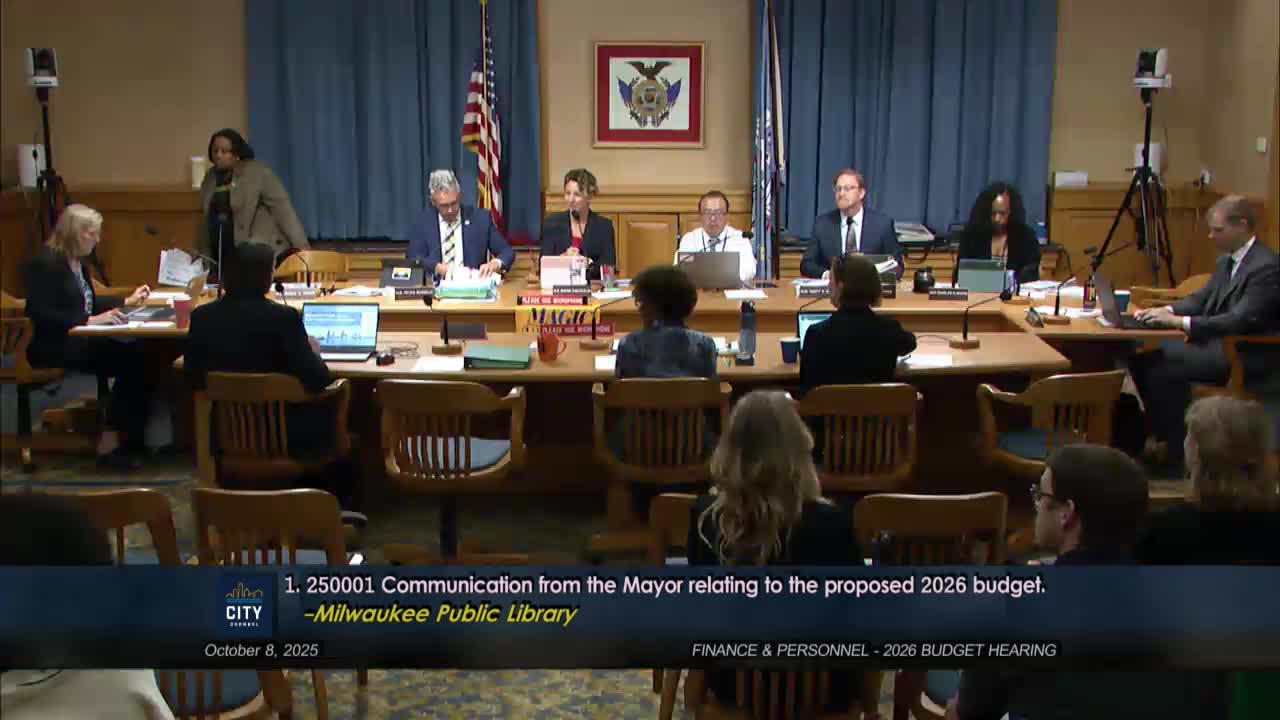
Milwaukee Public Library budget proposal would cut Sunday hours at two branches, shift security and staff roles
Loading...
Summary
Milwaukee — The Milwaukee Public Library’s proposed 2026 budget would reduce system spending and eliminate year‑round Sunday hours at the Good Hope and Tippecanoe branches while keeping Central Library’s year‑round Sunday service, according to presentations to the Common Council Finance & Personnel Committee on Oct. 8.
Milwaukee — The Milwaukee Public Library’s proposed 2026 budget would reduce system spending and eliminate year‑round Sunday hours at the Good Hope and Tippecanoe branches while keeping Central Library’s year‑round Sunday service, according to presentations to the Common Council Finance & Personnel Committee on Oct. 8.
The proposed budget, presented by Nathaniel Hack of the Budget and Management Division, reduces overall Milwaukee Public Library (MPL) expenditures by “just over 2%” from the prior adopted budget and moves some operating lines into salary accounts as the library brings security services in‑house. Hack said “the big service impact of the 2026 proposed budget is the elimination of Sunday hours at the 2 branches of Good Hope and Tippecanoe, while maintaining year round Sunday hours at Central.”
Why it matters: the committee emphasized they want departments to explain how 2026 changes will affect residents. Committee members raised concerns about the effect on neighborhood access, especially for districts served by Tippecanoe and Good Hope, and asked the library to supply comparative daily usage data to support scheduling decisions.
Most important details
Nathaniel Hack, Budget and Management Division, told the committee the change would save the city about $800,000 for 2026 and that the library was able to propose that reduction “without any layoffs, due to vacancies within the department.” The mayor’s proposed budget for the library is $33,000,000 compared with the library’s cost‑to‑continue request of $34,130,000; library staff said that gap represents a 3.3% reduction from their request and that the proposal would result in the loss of 10 positions relative to the cost‑to‑continue figure, and 16 fewer positions in total after related staffing changes.
Library director Joan Johnson said the department will keep all 12 neighborhood branches open 40 hours per week and maintain Central at 54 hours per week, including Sundays; she also described a new, systemwide staffing pilot for Sundays using Central as a scheduling model. “We will be implementing a new, more equitable Sunday staffing rotation, using the central branch, Sunday service as a pilot to test this new scheduling model,” Johnson said.
Other staffing and service changes include moving security expenditures from operating to salary as the library intends to in‑source many security positions, and converting several librarian and customer service positions to “connected learning specialists” who staff four makerspaces (Mitchell, MLK, Good Hope and Washington Park). The library said it added the King branch in 2025 and welcomed over 1,200 visitors on opening day.
Capital and technology
The proposed capital budget includes $3,000,000 for the library: $2,700,000 for masonry and dome repairs at Central, $75,000 for security and IT upgrades such as cameras and card readers, and $200,000 for initial planning and feasibility for a new branch to replace a facility that has “exceeded its useful life,” the library said.
Digital access and revenue
The library reported system Wi‑Fi usage and E‑Rate funding details: library staff said unique device counts for January–August showed heavy Central usage (roughly 128,113 unique users systemwide at Central for that period), with East (11,190), Washington Park (10,421) and Mitchell (10,322) among the higher‑use neighborhood branches and a lower‑use branch listed at about 5,579 unique devices. The library expects Wi‑Fi costs for July 2025–June 2026 of about $344,000, with an E‑Rate discount covering roughly $309,000 and a city share of about $34,421.
The library is exploring revenue opportunities, including room rentals for for‑profit customers (about $10,000 so far this year) and potential monetization of social media. Library staff reported combined followers across platforms of 428,292 (a 9% increase year‑over‑year) and said they have monetized Facebook and are exploring Instagram revenue models; committee members encouraged pursuing additional, permissible revenue while checking legal limits.
Discussion, pushback and next steps
Committee members pressed library staff for more granular day‑of‑week usage and circulation data and asked whether eliminating the two neighborhood Sunday services disproportionately affects communities that have newly adopted Sunday hours. Alderman Peter Spiker and others urged intentional outreach—promotion, school coordination and programming—before removing hours. Several committee members asked the library to produce a scheduling analysis (e.g., weekday vs. Sunday use) and to run the pilot quickly so policymakers can judge effects before finalizing amendments.
No formal Council vote on the library budget was taken at the committee meeting; members asked for further data and said they would consider amendments during the budget process.
Ending note
Library staff said they will pilot the new Sunday scheduling approach in 2026, continue to recruit to fill vacancies, and seek private and foundation funding for capital and program support. Committee members signaled strong interest in preserving neighborhood access while balancing the mayor’s budget constraints and asked for more usage and staffing data to inform amendment discussions.