
Committee backs one-year extension for downtown shared micromobility contract
Get AI-powered insights, summaries, and transcripts
Subscribe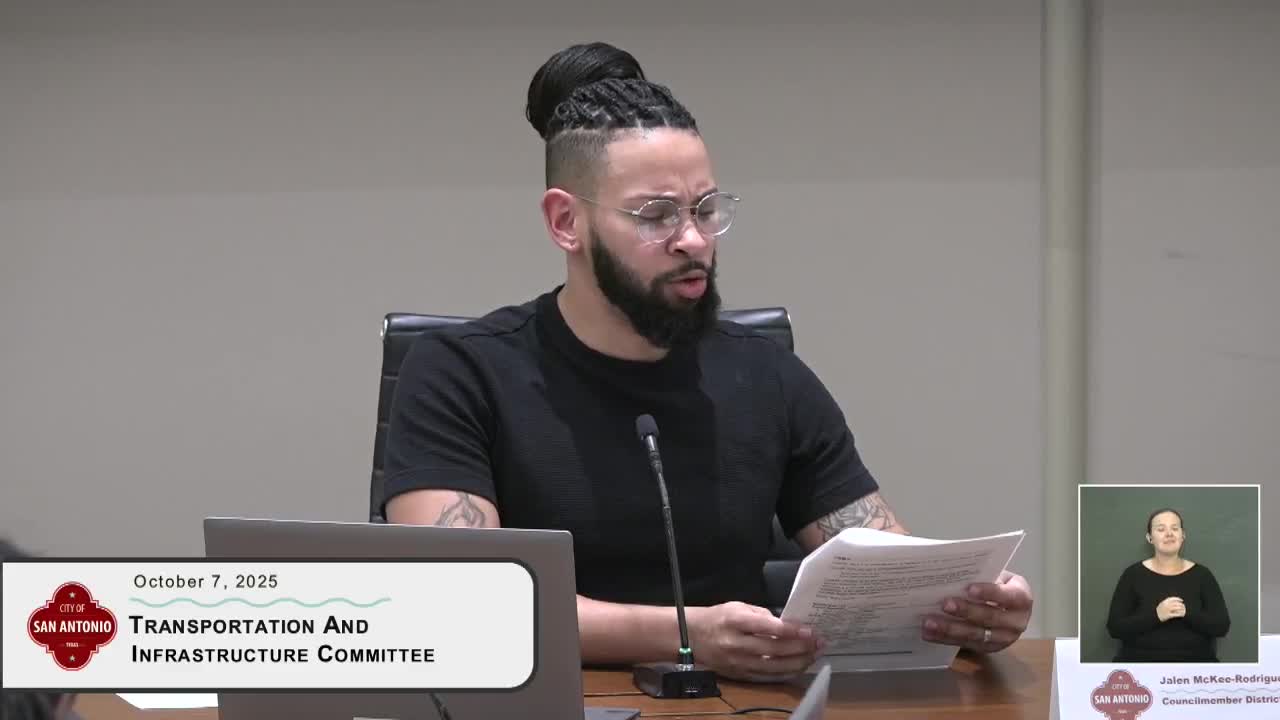
Summary
The Transportation & Infrastructure Committee voted to support a one-year amendment to the city's two-operator shared micromobility contract and signaled staff will pursue a new RFP with similar terms; members asked for more analysis on geofenced zones, enforcement revenue and market competition before the full council vote in November.
The San Antonio City Council Transportation & Infrastructure Committee on Oct. 7 supported a one-year amendment to the city's shared micromobility (dockless vehicle) contract and directed staff to prepare a Request for Proposals with similar terms later this year.
The extension would preserve the current two-operator model while staff develops an RFP structured as two two-year terms with an option for an additional year. Committee members asked staff for further analysis of geofenced zones in the downtown core, enforcement practices and how additional competition might affect user fees and operator behavior.
City staff member John Stevens presented the item, saying the program began as a pilot in 2018 and that the current contract schedule was restarted in October 2023. He told the committee the city is seeking a one-year amendment now and to issue an RFP with the same basic terms for future service.
Committee members pressed for details on enforcement and revenue. Committee members asked how many vendors responded to past solicitations; Stevens said there had been consolidation in the market and that "about 6 to 8" firms had responded historically, with the current recommendation based on two operators each deploying up to 1,000 vehicles.
Members also questioned the city's geofenced enforcement approach in high-priority downtown locations (River Walk, main plaza, Market Square, La Villita) and asked staff to clarify the one-hour correction window that triggers a citation in those zones. Stevens stated the city uses geofencing to flag vehicles left in sensitive areas and that tickets are issued if operators do not collect or otherwise remedy vehicles within the posted correction time.
The committee reviewed usage and revenue figures supplied by staff: total trips rose from roughly 730,000 in 2024 to about 785,000 year-to-date; staff said per-vehicle usage had been roughly constant. Revenue columns presented to the committee separated annual fees paid by operators and enforcement/citation revenue; staff cautioned that early quarters under the current contract showed lower enforcement revenue as operators adjusted to enforcement rules and that enforcement receipts rose in later quarters.
Several members asked staff to include comparisons to peer cities (examples named during discussion included Tampa and other similarly sized cities), to analyze membership and low-income fare programs, and to model how adding a third operator might affect availability and price. Staff told the committee those items would be part of the RFP and a follow-up memorandum.
The committee made a motion to support the one-year extension and the motion passed unanimously. Staff said the item will return to the full City Council in early November with the committee's feedback incorporated.
Background and next steps: staff recommended the one-year amendment to avoid a lapse in service while the city develops a new procurement and said the RFP will follow the current structure (two-year terms with a one-year option). Committee members asked staff to engage disability stakeholders and provide a comparative summary of downtown transportation modes in the RFP materials.