Get Full Government Meeting Transcripts, Videos, & Alerts Forever!
Get email alerts on the Zoning Urban Design topic
No spam. Unsubscribe anytime.
Nations rezoning and urban design overlay advance after heated public comment and committee amendments
Summary
The Planning and Zoning Committee approved zoning and an accompanying urban design overlay for the Nations neighborhood with amendments clarifying short-term rental treatment, adding traffic study language and removing a height bonus; opponents complained of rushed outreach and infrastructure concerns during public comment.
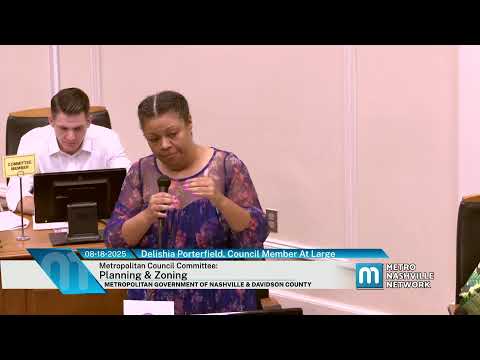
The Metropolitan Council Planning and Zoning Committee on Aug. 20 approved a set of rezonings and an urban design overlay (UDO) for the Nations neighborhood after adopting two amendments that clarified short‑term rental rules, requested traffic analysis be incorporated into a forthcoming multimodal study and removed a proposed height bonus.
The measures, covering BL 2025‑830 (zoning changes) and companion BL 2025‑831 (the UDO), are intended by sponsor Council member Horton to expand housing options, protect tree canopy, address flooding and support neighborhood businesses. Horton said the amendments reflect additional public input and community meetings held since the planning commission hearing.
Why it matters: The package changes base zoning for hundreds of parcels and establishes design rules intended to shape future development in a large swath of west Nashville. Supporters say the changes enable more walkable housing options near the urban core; opponents warned the committee the process was rushed, that infrastructure capacity and public safety had not been adequately studied, and that the outreach described by staff and the sponsor did not reach many residents.
The committee adopted Amendment 1 to clarify that the rezoning will prohibit new short‑term rental permits but will not revoke existing permits, language Horton said was required by state and Metro law. Amendment 2, proposed to require that the multimodal mobility master plan account for the increased entitlements in the rezoned area, was accepted after NDOT and planning staff told the committee that the master plan process already will include the area and that the amendment directs staff to ensure entitlements are modeled. Planning staff also circulated a fiscal note estimating about $24,000,000 in potential water and sewer infrastructure needs under a full build‑out scenario; staff said the note assumed full build‑out and individual projects would still require capacity letters and agency reviews before permits could be issued.
Public commenters at the committee hearing pressed for more outreach and more time. Resident Lauren Magli said the neighborhood had seen “one meeting” and that “this is not community engagement,” adding that her group had gathered “20,823 signatures” on a petition opposing the rezoning and asking council to defer action. Rachel Gladstone, a longtime Nations resident, told the committee she had asked Council member Horton for a deferral and said residents worried about parking, sewer and fire safety if density increases without infrastructure improvements.
Committee debate centered on competing views of urban density. Supporters including Council member Benedict described the package as “thoughtful policy‑driven housing reform” and a response to long‑standing shortages of housing near the core; Horton argued that denser, walkable development reduces vehicle miles traveled and eases pressure on arterial roads. Opponents and some adjacent‑district members pressed for additional review by the Transportation and Infrastructure Committee. Vice‑chair Rutherford moved a two‑meeting deferral with referral; that deferral motion was met with a motion to table and the committee voted to table the deferral. After tabling the deferral, the committee voted to approve BL 2025‑830 as amended and BL 2025‑831 (UDO) as amended.
Key outcomes from the committee record: Amendment 1 (short‑term rental clarification) was adopted; Amendment 2 (traffic study language) was adopted; the UDO amendment removing a height bonus in most residential character areas was adopted. The UDO (BL 2025‑831) passed committee 10‑0, according to the committee record; the zoning bill (BL 2025‑830) was approved by the committee as amended (vote tally not specified in the transcript excerpt). The committee also approved BL 2025‑832 (building material restrictions tied to the UDO) on the same agenda.
What’s next: The committee record shows the measures advanced from committee as amended. Individual development projects within the rezoned area will still require site‑level reviews and capacity letters from Metro agencies before permits or infrastructure connections are granted. Planning staff emphasized the fiscal note represents a full build‑out estimate, not an immediate appropriation, and said private development or phased infrastructure work could address capacity gaps.
Community context: Speakers emphasized disagreement about whether the outreach conducted satisfied community expectations. The committee chair said a two‑page “recommended strategies for effective public engagement” document compiled by the Planning and Zoning Committee would be published for council members and the public.
Ending: The committee’s action advances a large, multiyear change in how the Nations neighborhood may redevelop; it leaves open follow‑on questions about infrastructure sequencing, final design rules for character areas and how Metro agencies will address capacity as projects come forward.