
Spanish Fort council adopts local excise tax and business-license changes for vape products
Get AI-powered insights, summaries, and transcripts
Subscribe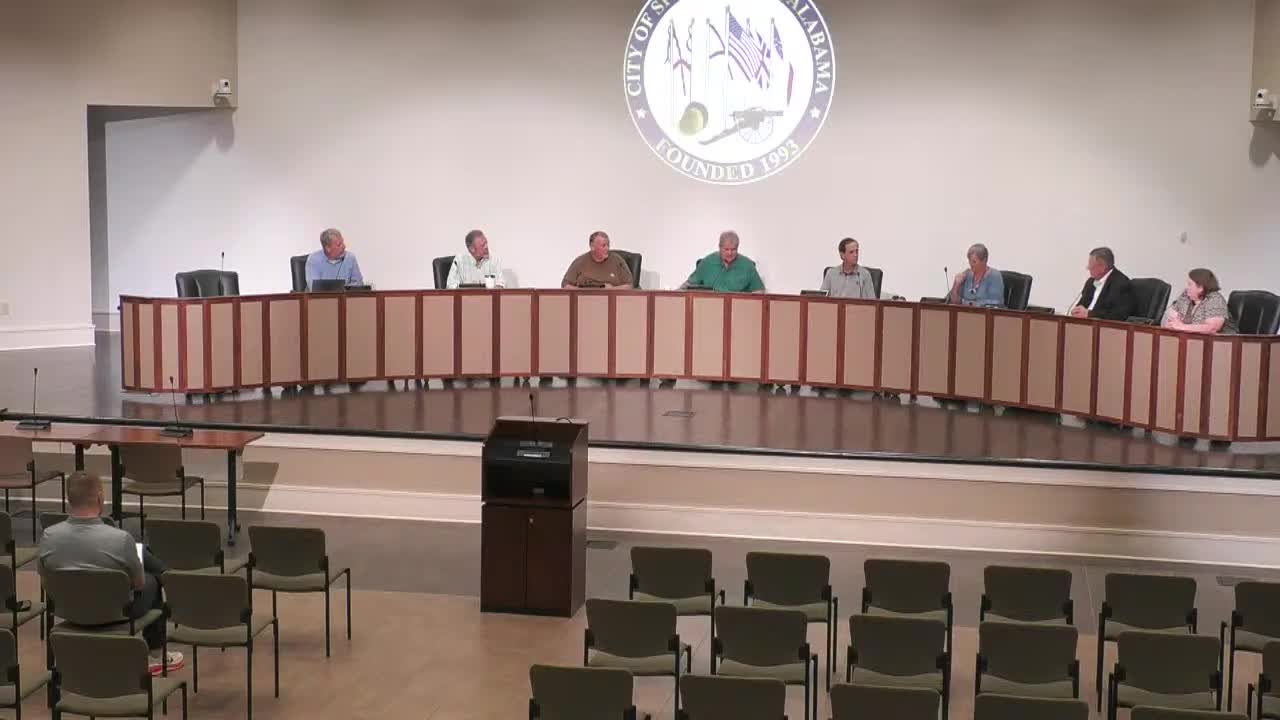
Summary
The Spanish Fort City Council adopted an ordinance establishing a 10-cent-per-milliliter local excise tax on consumable vapor products and a companion business-license amendment after discussion about state legislation, collection mechanics and whether the city should collect outside its corporate limits.
The Spanish Fort City Council on a 5-1 vote adopted an ordinance to levy a local excise tax of 10¢ per milliliter on consumable vapor products sold or delivered within the city, and approved a companion amendment to the city business-license code to add NAICS categories for vape retailers and wholesalers.
The ordinance, identified in the meeting as ordinance 7222025, was presented to the council as a response to recent state legislation (referred to during the meeting as Act 2025-377) that establishes a state excise tax on consumable vapor products, sets distribution of the state collections (50% to the state general fund, 25% to counties and 25% to municipalities), and includes a deadline provision referencing Oct. 1, 2025, even though the act’s stated effective date is Oct. 1, 2026. City staff said the local ordinance was prepared to ensure the city’s ability to levy a local tax that would remain operative under the state law’s transitional language.
City staff explained key features of the local ordinance: the tax is 10¢ per milliliter; the state also levies 10¢ per milliliter, which together would amount to 20¢ per milliliter if both apply; the city requires monthly reporting and establishes penalties for noncompliance; and the ordinance requires a business license to sell vape products within the corporate limits. Staff also said the ordinance includes an exemption path if a wholesaler pays the levy instead of the retailer, though the wholesaler may pass that cost to retailers and ultimately to consumers.
Council discussion focused on two practical and legal uncertainties raised by the state act. First, staff and council members debated whether a city that adopts its own local levy can later repeal it and still participate in the state distribution; staff characterized the act’s language as unclear on the mechanics of repeal and said this may require future state clarification or amendments. Second, councilmembers asked whether the city could collect a portion of the tax for sales outside the city’s corporate limits in areas that receive city police or fire services. Staff noted that Spanish Fort historically has not collected business-license or excise taxes on sales outside the corporate limits, but the city’s fire department now provides services beyond the limits, and the act’s language and prior legislation could affect the city’s ability to collect in a police or fire jurisdiction; staff recommended keeping collections consistent with past practice to avoid administrative complexity.
A staff speaker corrected an earlier description during the presentation, saying, "It's actually 10¢ per milliliter," confirming the tax unit as cents per milliliter rather than a percentage. Staff also noted a standard refill size example for context, saying a typical vape refill is about 2 milliliters.
After a motion to suspend the rules for immediate consideration, the council voted on the ordinance. The roll-call recorded votes as: Smith — yes; Gustafson — yes; Perry — no; Winn — yes; Bravner — yes; Mayor McMillan — yes. The council then adopted a related ordinance (recorded as ordinance 7232025) amending the business-license code to add NAICS categories for vape retailers and wholesalers and to apply the same license-rate structure used for tobacco retailers and wholesalers; that ordinance passed by an identical margin.
The council did not adopt additional policy directions beyond approving the ordinances; staff had prepared the ordinances at the mayor’s request so the council could decide whether to levy the local tax before the state deadlines noted in the act. Staff and council members flagged the possibility of future statutory amendments to clarify the state act’s effective dates and the mechanics of local participation in the state tax distribution.
Mayor McMillan announced the ordinances had been adopted. The meeting then moved to adjournment.