
Panel at University of Utah Says NATO Remains Central as Members Debate Limits of Collective Defense
Get AI-powered insights, summaries, and transcripts
Subscribe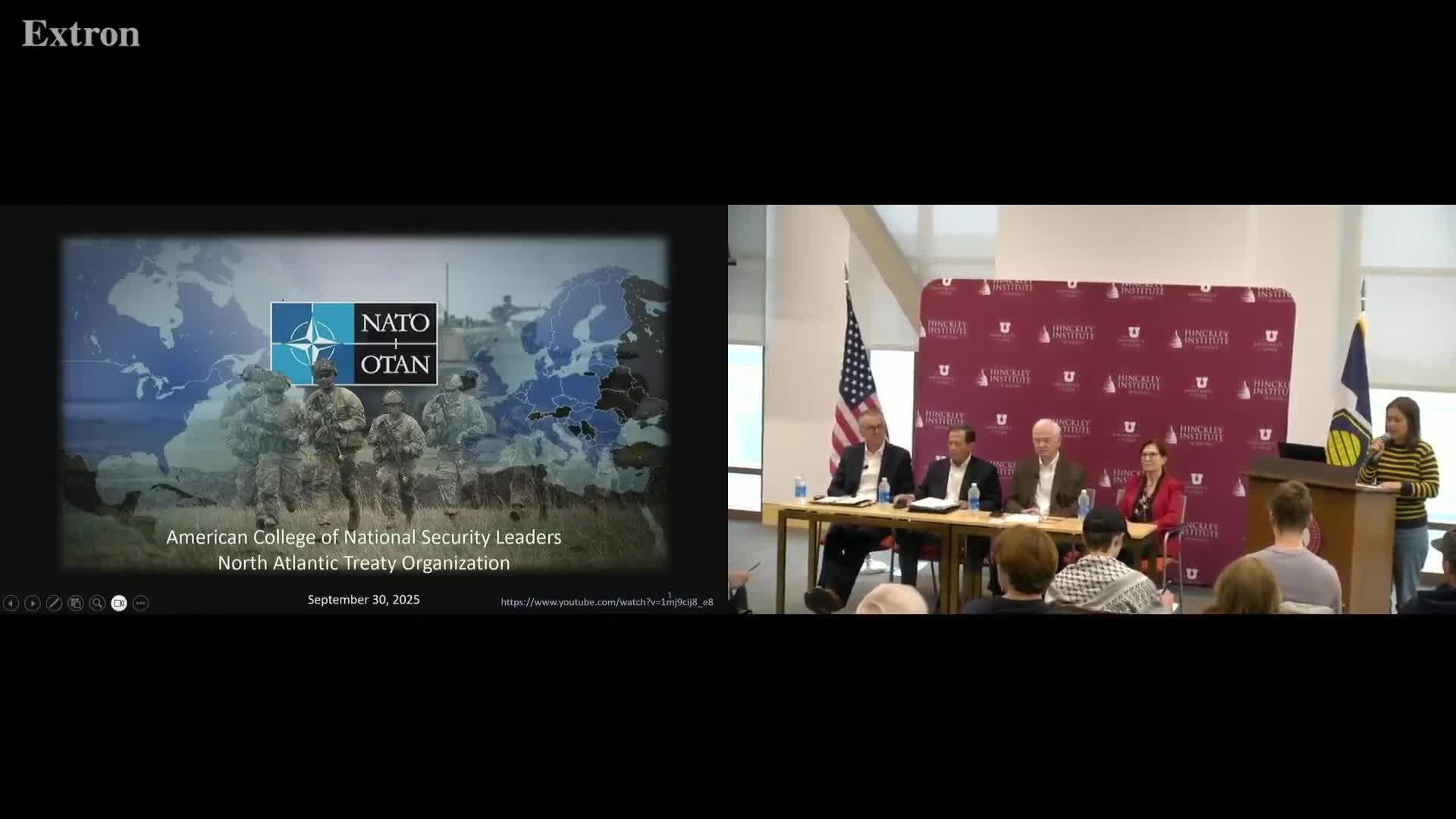
Summary
Retired and former U.S. military leaders at a Hinckley Institute forum said NATO remains indispensable for collective security, while panelists and audience members flagged gray‑area incidents, defense spending and the ally‑versus‑partner distinction as central challenges.
At a Hinckley Institute forum at the University of Utah, four panelists with extensive NATO experience said the North Atlantic Treaty Organization remains central to Euro‑Atlantic security even as members debate where collective defense begins and how much each country should contribute. Major General Donna Barbish, retired U.S. Army, convened the discussion and framed the panel around whether NATO — founded in 1949 — still meets member states’ needs as threats change. “Challenge your assumptions,” she told the audience before turning the session over to the panel. Vice Admiral Kevin Greene, U.S. Navy, described two priorities he said matter most for states: “The first is strength. Countries have to be strong. They have to be strong diplomatically, informationally, military, and economic,” he said, adding that NATO is “indispensable for the security ... of the free world.” Greene emphasized that eastern NATO members, including Poland and the Baltic states, are acting as the alliance’s “first responders.” Bruce Lemkin, a member of the Senior Executive Service and a former Deputy Under Secretary of the Air Force for International Affairs, said interoperability — the ability of militaries to train and operate together — is a central NATO benefit. “Interoperability. Simply the ability to train together, operate together, and fight and win together,” Lemkin said, noting NATO commands and permanent representation in Brussels enable day‑to‑day coordination. Rear Admiral Todd Squire, U.S. Navy, drew a distinction between allies and partners: “Allies are generation commitments to national defense. They’re treaties that are ratified by the Senate. They’re binding agreements between nations that became come a part of international law,” he said, contrasting that status with looser partnerships the United States maintains with many other countries. Panelists discussed how NATO has adapted since the Cold War — expanding from 12 founding members to 32 today — and cited post‑9/11 operations as examples of collective action. Lemkin recalled that the 9/11 attacks prompted the first invocation of Article 5 of the North Atlantic Treaty: “It was the first time Article 5 of the NATO charter was invoked. An attack on one is an attack on all.” He noted the alliance later assumed command of the International Security Assistance Force in Afghanistan in 2003. Audience questions focused on recent incidents near NATO borders and how the alliance decides whether an incident merits collective action. One attendee asked why Article 5 had not been invoked after drones struck territory in Poland. A panelist responded that Moscow appears to be “probing NATO defenses” and that many of the reported incursions involved unarmed drones, placing them in a “gray area.” Another panelist said invoking Article 5 is “a commitment to act, and it’s a big step.” Panelists also described Article 4 — the consultation mechanism — as the tool NATO has used so far in response to those border incidents. “Article 4 has been invoked, which is ... the nations will consult how they’re going to deal with this, whatever follow on action,” one panelist said, describing it as an emergency consultation process rather than an automatic trigger for military response. On defense spending, panelists said the trend among NATO members is toward increased budgets as perceived threats rise, but they also cautioned that how spending and contributions are measured varies by country and political will. Lemkin mentioned a new defense‑spending goal of “5% of their GDP” discussed at recent summits, while noting the transcript’s cited deadline was unclear. Panelists emphasized diplomacy and differing national perspectives as features, not flaws, of NATO’s decision‑making. “Let’s think about this. Let’s not be rash,” one said when comparing member responses to Russian overflights; another added that members’ differing reactions illustrate how consultation and compromise sustain the alliance. Several audience members asked related questions about neutrality and membership: why Switzerland is not a member (panelists said Swiss neutrality and national choice explain that status), how U.S. domestic politics affect allied coordination (panelists said policies shift with administrations and public attention matters), and whether NATO can sustain higher European defense spending targets (panelists said states closest to threats are acting but responses vary). The forum concluded after a roughly hour‑long discussion and a question‑and‑answer session. Panelists encouraged students and attendees to stay engaged on foreign policy issues and to use democratic channels to influence national policy. The discussion was a panel event hosted by the Hinckley Institute of Politics; it did not produce formal votes or policy decisions.