
Bridgeport board workshop focuses on committee bylaws, public-comment rules and staff burden
Get AI-powered insights, summaries, and transcripts
Subscribe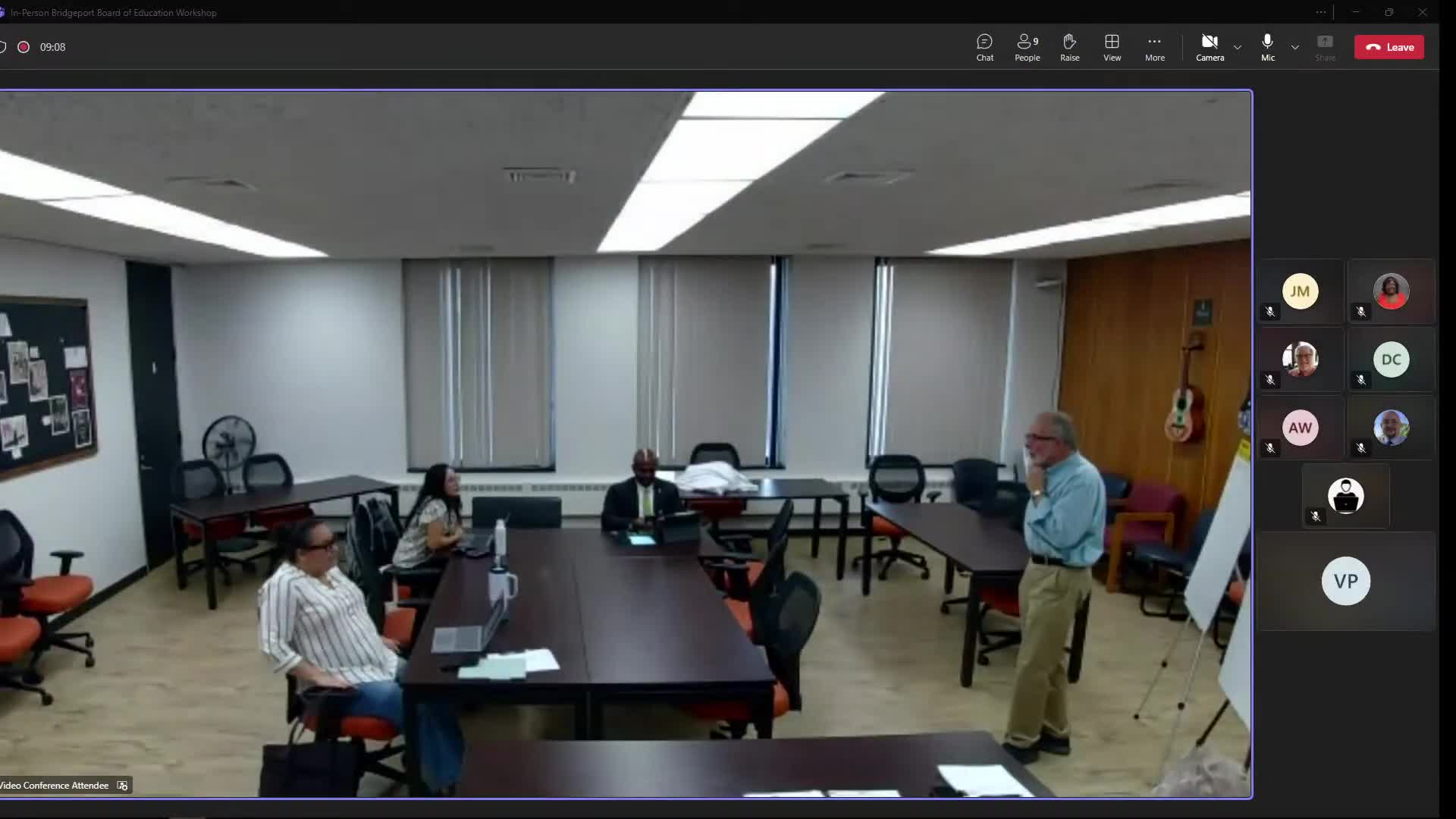
Summary
Board members, consultants and staff at a Sept. 30 workshop debated how the Board of Education should structure standing committees, who decides committee membership and what committee work should be reserved for administration — with no formal votes taken.
Sept. 30 — At an in-person workshop, Bridgeport Board of Education members, central-office staff and outside consultants opened a multi-hour discussion about rewriting bylaws and clarifying the role of standing committees, with agreement on the need for clearer rules but disagreement about specific changes.
Consultant Jody Golder, who led much of the discussion, said the district has “a vacuum of leadership” in places and one consequence is that “in the absence of any direction, everything becomes committee work.” Golder urged the board to define committee purposes first and then draft bylaws to support that structure.
The discussion focused on several recurring problems. Board members and staff described long meetings, numerous special meetings and an administrative burden from staffing frequent subcommittee sessions. Golder told the group that when committees lack clear charges, “central office has to staff every subcommittee meeting” and then do the follow-up work those meetings generate.
Several board members described practical frustrations. Andre Woodson said subcommittee discussions often repeat at full meetings and slow decisionmaking: “We're asking the same questions over and over.” Other members asked for clearer protocols for how items are referred to committees, how the chair and full board share authority to set committee rosters, and how to avoid last-minute requests that require central-office staff to stop other work.
On public-participation rules, board member Akisha asked about FOI practice; the group agreed that under open-meeting and FOI rules a board member who is not appointed to a committee is treated, legally, as a member of the public at that committee’s meeting. As Golder summarized, if a committee’s agenda provides a public-comment slot, “board members who are not on the committee and your public are under the guise of public, and they would be able to speak at that point.” Several members said whether and when to allow public comment at committee meetings should be decided in policy and could vary by topic.
The policy committee reported progress on drafting committee definitions and separating personnel and policy work. Board member Joe said the policy committee had “discussed separating policy and personnel” in part because state rules limit which individuals may participate in some personnel executive-session matters.
A contentious procedural question arose about combining finance and facilities oversight. Some members favored an operations-style committee to reduce repetition; others warned of past failures when finance and facilities were merged and urged leaving facilities oversight separate or using an ad hoc committee for long-range capital planning. Christine said explicitly she opposed re-merging finance and facilities, calling the combination “a very, very bad idea” given the district's current capital plan and recent history.
Board members and staff also discussed how the board should handle information requests. Consultants recommended routing substantive requests through the chair and superintendent so staff can prioritize work and avoid dozens of ad-hoc data pulls; one speaker described a past incident in which legal redaction of nurses' reports turned a single request into a huge workload. Participants recommended clearer guidance about when an individual board member's request becomes a board-level directive that requires staff resources.
On committee mechanics, the group talked through common practices: committees composed of fewer than a quorum (three members was the frequently cited norm), standing versus ad hoc committees, and a reporting chain in which committees research and recommend and the full board adopts policy or action. Several speakers urged bylaws that enable administration rather than simply react to past problems.
No motions or votes were taken at the workshop. Consultants said they would draft bylaw language and share model materials, including guidance from state school-board associations, for the board and legal staff to review before any formal adoption.
The board agreed to continue the conversation with drafts to be circulated to members and recommended legal review before changes are posted for public comment.