
Leander ISD board adopts resolution directing staff to set enrollment thresholds, staffing guidelines and financial analyses
Get AI-powered insights, summaries, and transcripts
Subscribe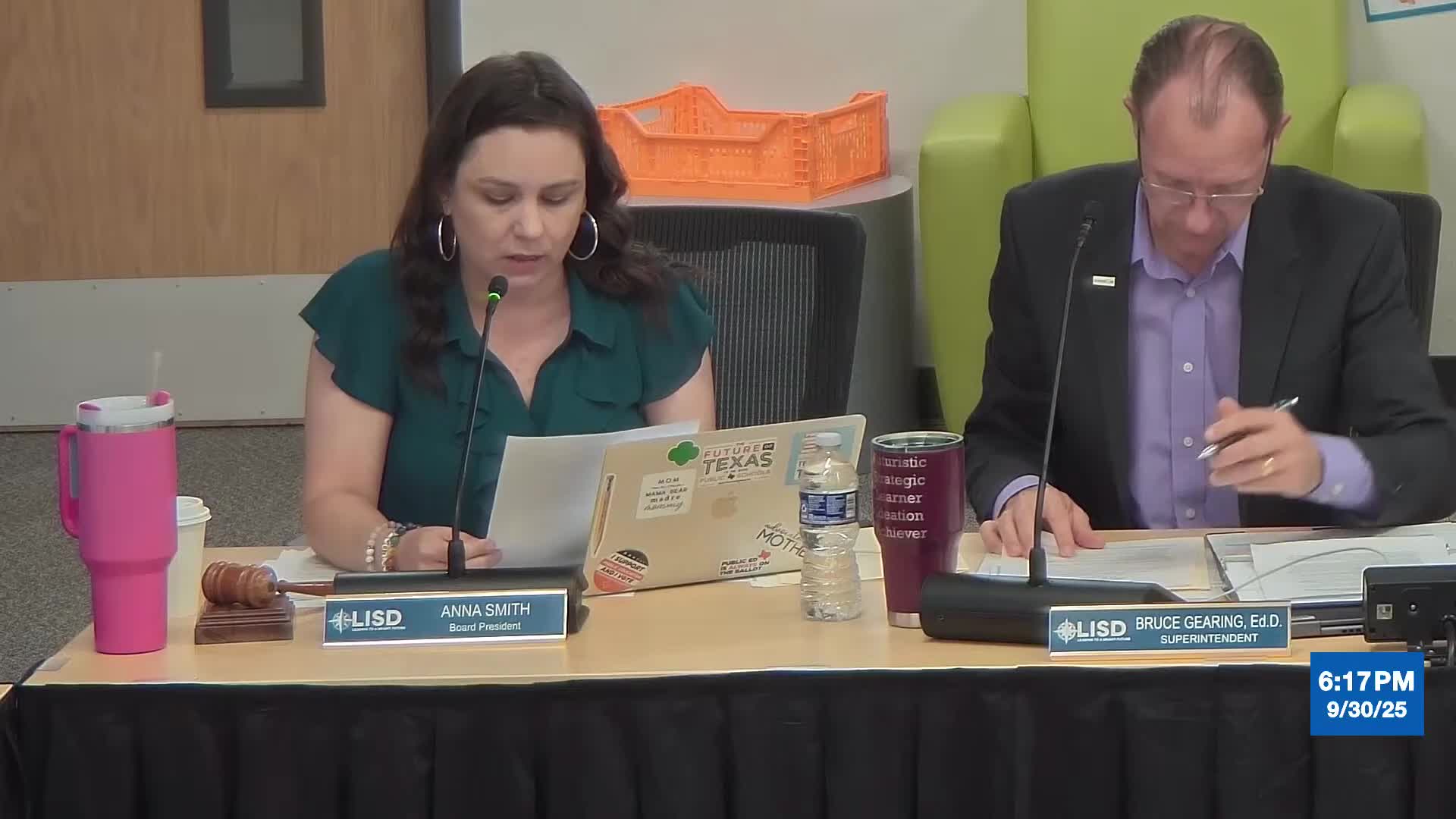
Summary
The Leander ISD Board of Trustees voted 7-0 Sept. 30 to adopt a resolution directing administration to develop criteria and timelines for long-range facility planning, staffing guidelines for low- and high-enrollment campuses, program evaluations and revenue options including House Bill 2 hold-harmless analysis.
The Leander Independent School District Board of Trustees voted 7-0 Sept. 30 to adopt a resolution directing administration to develop specific criteria, timelines and financial analyses for long-range facility planning and financial sustainability. The vote followed more than five hours of public comment and board deliberation focused on thresholds that would trigger staffing changes or consolidation and on how prekindergarten enrollment should factor into those calculations.
Board members said the resolution is intended to give administration clear direction to return with data-driven recommendations, rather than to order immediate campus closures. Trustee Francesca Romans moved to adopt the resolution as modified; Trustee Gloria Gonzales Celakia seconded. The motion passed by a 7-0 vote.
The resolution, as amended during the meeting, asks administration to draft: enrollment and capacity criteria that distinguish an initial “low-enrollment staffing” threshold from a higher threshold that would prompt consolidation discussions; district-wide staffing guidelines that can be applied consistently across campuses; an annual report of campuses mapped against the approved criteria using the PEIMS (PIM) snapshot; program analyses focusing on efficiencies, access and demand; and a financial analysis of revenue options, including an analysis of House Bill 2 impacts and a request that the Texas Education Agency and commissioner consider hold-harmless protections for LISD.
Board discussion centered on two linked needs: (1) a clear, auditable metric for when a campus is considered underenrolled and what specific steps follow, and (2) a timeline that shows what the district can reasonably do in the short term (one to three years) versus longer-term strategies (three to seven or ten years). Trustees repeatedly emphasized that community input and transparent reporting would be required before any actions affecting campuses or programs moved forward. Several trustees requested the timeline and criteria be the first deep topics taken up in a series of meetings the board plans to schedule through December.
During debate trustees and staff also clarified financial details and data sources the board expects to see. Chief Financial Officer Pete (last name not stated in the transcript) described differences in campus per-pupil expenditures driven by program mix (for example, campuses with multiple pre-K sections or dual-language programs will show higher per-pupil costs) and said the district would produce adjusted, “apples-to-apples” comparisons. Pete also summarized recent state funding changes and said the district has received new allotments this cycle but still faces structural pressure.
The resolution directs administration to: 1) return with recommended wording for enrollment thresholds and staffing guidelines; 2) provide a schedule for stakeholder engagement and regular updates to the board; 3) prepare a detailed revenue-and-expense workstream that includes potential land sales, bond savings and other revenue-generation ideas; and 4) bring a recommended public engagement plan that distinguishes exploratory analysis, draft recommendations and any action items so the community is alerted before decisions are made.
Board members said they expect those materials to be sufficiently developed for rigorous public discussion and for the board to give final direction at follow-up meetings. In closing remarks Trustee Romans said the resolution is a framework to clarify the board’s expectations and asked administration to be deliberate and timely in returning the requested analyses.
The board then moved to the next agenda item, review of Citizen Facility Advisory Committee charters, and later recessed into closed session.