
Appeals court hears land-dispute arguments over boundary, prescriptive easements and private-way improvements
Get AI-powered insights, summaries, and transcripts
Subscribe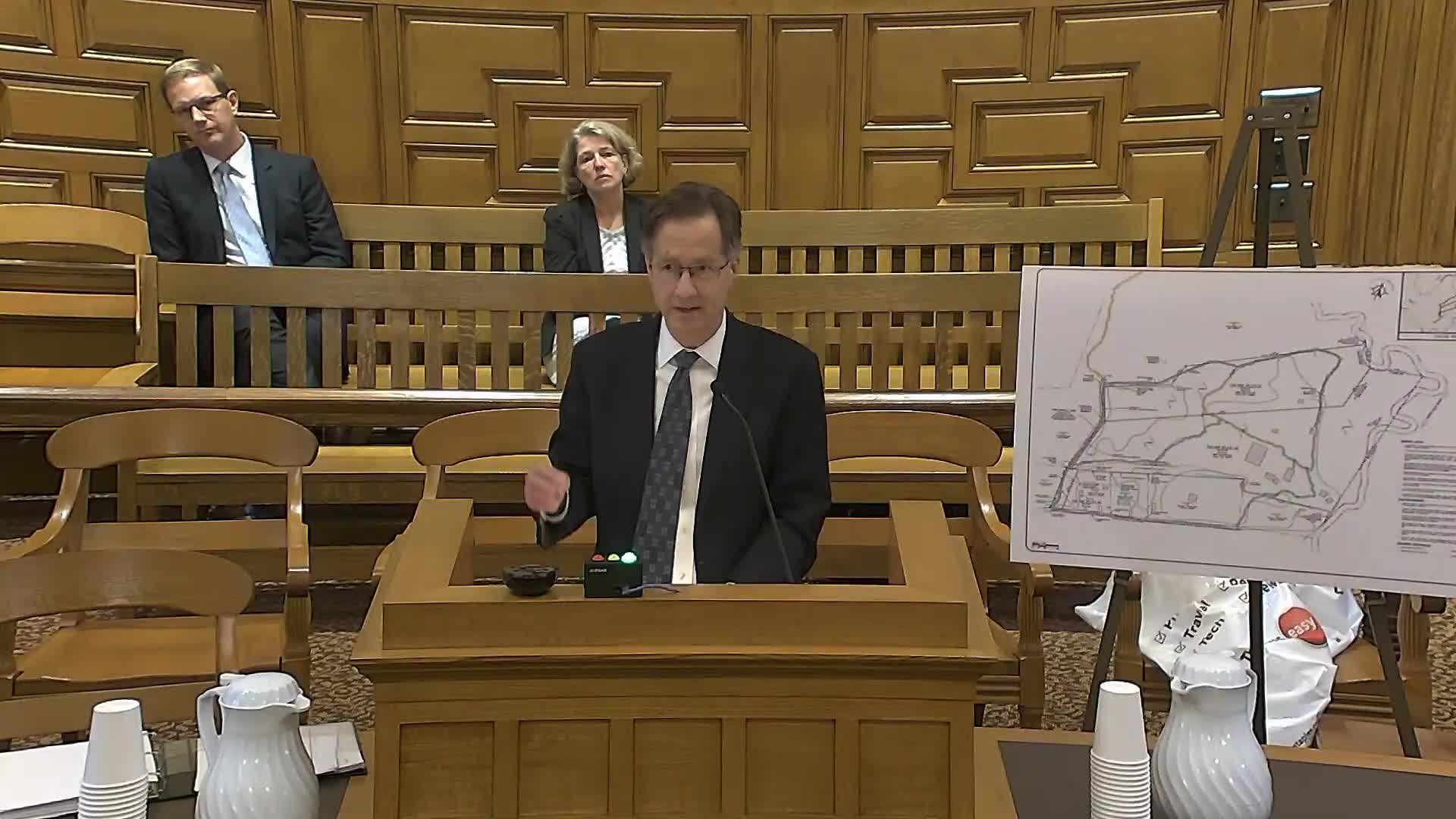
Summary
Attorneys disputed whether claims to quiet title and a later trial finding of prescriptive easements were fairly presented before trial and whether Chapter 187, Section 5 allows utility or roadway improvements where a private way is used by others.
The Appeals Court heard a long-running boundary and easement dispute between 40 Meadowbrook Lane Realty LLC and Kyle and Gary Andress over title, prescriptive easements and use of Pine Needle Lane and associated trails (40 Meadowbrook Lane Realty LLC v. Kyle Andress, 2024-1426).
Counsel for the Andresses, Kevin Considine, told the panel his clients were ambushed at trial when the plaintiff obtained prescriptive easements across portions of disputed property that had not been pled or developed in pretrial discovery. Considine said the amended counterclaim and pretrial papers focused on quiet-title relief as to a northerly boundary and that the prescriptive-easement claims were not pleaded or litigated sufficiently to permit targeted discovery. "We were absolutely ambushed at trial," Considine said, arguing the court awarded easements in places the defense had not had a reasonable opportunity to investigate.
Plaintiff counsel John Willis replied that the amended counterclaim and pretrial filings had put the prescriptive-easement issue before the court, that trial exhibits and witness testimony (including a view by the judge) demonstrated public or predecessor use of the Horse Farm Loop Trail and Crane Street Trail, and that the judge's factual findings were supported by the record. Willis also argued the plaintiff had not "abandoned" its boundary claims and that title evidence supported the plaintiff's position.
A statutory question also drew attention: counsel debated how G.L. c. 187, a7 5 (the statute governing existing owners of private ways and the right to lay utilities and improve private ways) interacts with existing private-way uses such as horse trails. The panel asked whether the statute permits construction or improvements that are "inconsistent with the existing use by others of such way," and whether a horse trail's continued use would bar the kinds of improvements the Andresses proposed. Considine suggested the statute would yield to incompatible existing uses; Willis argued the statute could take precedence in appropriate circumstances.
The parties also disagreed about historic records and chain-of-title evidence. Counsel cited an older plan (1920) and a deed that purportedly enlarged acreage recorded by a predecessor; the court asked whether a 1920 plan could properly alter physical monuments or change the elders's recorded boundaries.
Ending: The panel took the case under advisement. The written opinion will resolve whether the prescriptive easements were properly litigated and whether statutory limits on private-way improvements apply.