
Abington board approves first reading of responsible‑contractor policy requiring apprenticeship hours; public commenters express support and questions
Get AI-powered insights, summaries, and transcripts
Subscribe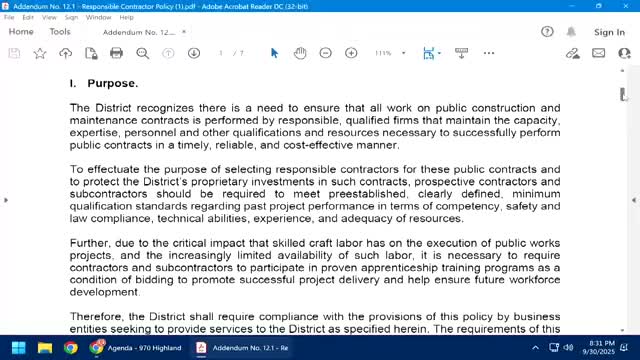
Summary
The board held a first reading and approved passage of a responsible‑contractor policy that would require 70% of labor hours on qualifying public‑works projects to be performed by workers enrolled in or graduated from registered apprenticeship programs. Supporters from building trades urged adoption; board members probed threshold, enforcement and
The Abington Board of School Directors on Sept. 30 approved a first reading of a new responsible‑contractor policy that would formalize bidder qualifications and add a requirement that 70 percent of labor hours on qualifying public‑works projects be performed by individuals enrolled in or graduated from a registered apprenticeship program.
The policy — modeled on Abington Township’s responsible contractor ordinance — would apply to public-works projects with a value at or above the draft threshold of $5,000,000 and would codify capacity, integrity and experience requirements the district has long enforced informally. “The policy is modeled after the township’s responsible contractor ordinance,” solicitor O’Donoghue told the board. “...The most notable of which is a requirement that contractors participate and staff the project with individuals who are either participating in or graduated from a class A apprenticeship program. In this case, we've actually imposed a requirement that 70% of the labor hours on the project must be worked by such individuals.”
Why it matters: the requirement aims to ensure a trained workforce on large district construction projects and to protect the long‑term quality of work on taxpayer‑funded buildings. Supporters at the meeting argued it will protect taxpayer investments and job quality; some board members asked detailed questions about thresholds, how the district would define a single project, and whether the local apprenticeship pipeline can meet the requirement.
Public commenters who testified in favor included John Spiegelman, a member of the Abington Township commission, and construction‑trade speakers. “I could not be happier to see that you have a responsible contractor policy,” Spiegelman said during public comment, urging the board to consider a lower monetary threshold than the draft $5,000,000. Kirby Toomey, introduced herself as a union electrician and said apprenticeship training provided extensive classroom and on‑the‑job hours. “We know how to do it right the first time,” she said.
Board members asked technical questions about how the policy would apply on large multi‑element projects — for example, whether separate bids for HVAC work at two schools would be treated as one project for threshold purposes — and asked whether the district could be circumvented by splitting work. O’Donoghue said the policy includes language to prevent splitting projects “for the purposes of avoiding this threshold” and that the board will retain authority in authorizations to identify scope and estimated cost for advertised procurements.
The first reading passed at the Sept. 30 meeting. The administration said it will return for a final vote at the Oct. 14 board meeting. Questions that remain include how the district will verify ongoing compliance (the draft requires documentation of workforce hours and certifications), how the district will handle legitimate phased work that spans sites, and whether the apprenticeship pipeline has capacity to supply 70 percent of labor hours on all qualifying contracts.