
Council hearing on vacant, abandoned garages spotlights safety, ownership gaps and new demolition funds
Get AI-powered insights, summaries, and transcripts
Subscribe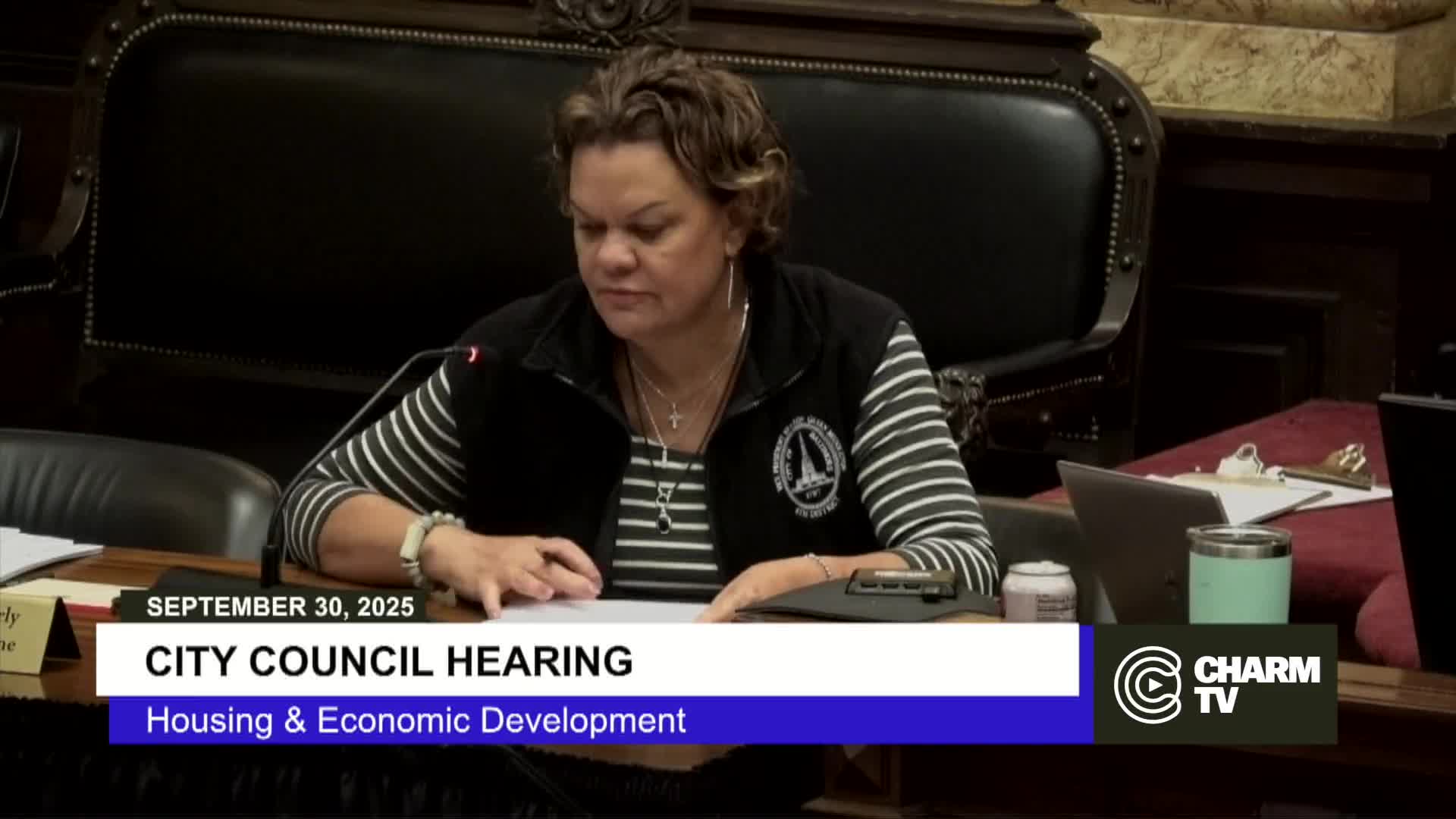
Summary
Council members and residents pressed DHCD on stalled enforcement and unclear ownership of dilapidated garages; department said it will set aside demolition funds and work with communities on acquisition and reuse, and the committee asked for a written SOP and named points of contact before the next hearing.
At an evening hearing of the Baltimore City Council Housing and Economic Development Committee, council members, neighborhood leaders and agency staff focused on long‑standing problems with vacant and deteriorating garages across multiple neighborhoods, including Garrison Hill, Windsor Hills and Parkway. Residents described safety hazards, illegal dumping and lost redevelopment opportunities; the Department of Housing and Community Development (DHCD) described enforcement limits and said the city will dedicate demolition funding for garages in the capital budget.
Council Vice President Middleton, who requested the informational hearing, said she has received hundreds of calls about dilapidated garages and asked DHCD to "clarify the process they follow to address this blight." Alice Kennedy, DHCD—s housing commissioner, told the committee that code enforcement inspectors begin investigations from 3‑1‑1 complaints or routine inspections and that the department can pursue demolition or stabilization when a garage "appears to threaten public safety," with proper due process and notification to owners.
Multiple council members said the city—s approach has been inconsistent and too slow. Councilman James Torrance described seeing stolen vehicles and large volumes of debris stored in some garages; Councilman Zach Blanchard and Councilwoman Odette Ramos pressed DHCD for a specific standard operating procedure, named points of contact, and a schedule so the council can report back to constituents with measurable progress.
Kennedy said the mayor—s Reframe Baltimore plan includes funding for demolition and that DHCD will set aside capital demolition funds specifically for garages. She also described practical obstacles: several garages are recorded on deeds separate from the main house, leaving ownership unclear, and some properties do not meet in rem foreclosure thresholds. DHCD said it has worked with community volunteers to research ownership and has piloted coordinated inspections in the Parkway community using code enforcement and special investigations teams.
Residents urged faster action. Daryl Dickerson of the Woodhaven community said his neighborhood has received promises of action dating back to 2008 and that many garages are held by deceased owners or are otherwise hard to trace. Talwan Rice, leader of the Garrison Hill Community Association, said "This is not just about aesthetics. It is about dignity," and asked that the city keep legacy residents and seniors in mind when planning demolitions or rehabs.
Committee requests and next steps included: - DHCD to provide a written standard operating procedure (SOP) describing the step‑by‑step response to dilapidated garages, including the responsible staff member(s) and timelines; - DHCD and Finance to confirm and document the capital demolition funds to be dedicated to garages and provide a timeline for when those funds will be available; - a list of community associations DHCD has visited and dates for planned outreach visits; - a special form and staff contact for owners who have completed rehabs but lack use‑and‑occupancy permits so the city can help resolve outstanding inspections and paperwork.
The committee recessed the informational hearing and scheduled a follow‑up session; DHCD agreed to return with written materials that the committee said must be delivered before the next public hearing so council members and community leaders can review them.
Ending: DHCD acknowledged the problem and confirmed targeted demolition funding and continued community engagement; the committee directed the department to deliver a written SOP, named contacts, and timetable for outreach and demolition funds before the next hearing.