
City planning staff propose quick amendments to mixed-use corridor rules to limit building massing and protect neighborhood edges
Get AI-powered insights, summaries, and transcripts
Subscribe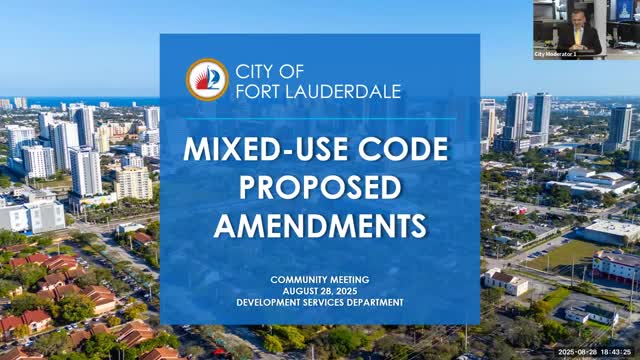
Summary
City planning staff on Wednesday presented proposed short-term amendments to mixed-use corridor regulations intended to control building massing, improve street-level design and strengthen transitions to adjacent neighborhoods.
City planning staff on Wednesday presented proposed short-term amendments to mixed-use corridor regulations intended to control building massing, improve street-level design and strengthen transitions to adjacent neighborhoods.
Jim Hetzel, principal urban planner, told the public the package is meant to address development pressure and to create “form based” design criteria missing from existing regulations. “The purpose of it was to create new regulations or amend our existing regulations to create a form based code to have better design criteria that is missing from our existing regulations today,” Hetzel said.
The package was framed as a set of “quick amendments” the city commission directed staff to develop to manage an influx of applications while a larger form-based code project continues. Staff said it expects to bring the amendments to the planning and zoning board in October and then back to the commission for final action.
Key proposals
- Street-wall length and facade articulation: A maximum street-wall length of 300 feet along the public realm, with required articulation. Staff proposed that within the 300-foot length the building must shift forward or back at regular intervals (staff cited every 25 feet) and include architectural elements to break up large, monolithic facades.
- Podium stepback and shoulder height: The package would formalize a podium or shoulder height and require the tower to step back a minimum distance above that podium. Staff identified a proposed shoulder height of four stories (48 feet) as the maximum height adjacent to the street for the podium portion of a building.
- Tower floor-plate cap: Staff proposed limiting tower floor plates to 32,000 square feet. As an example of scale, Hetzel referenced a recently built project with a roughly 58,000-square-foot floor plate.
- Residential transition/compatibility: Staff proposed increased setbacks and taller buffer walls where mixed-use development abuts lower-intensity residential zones. Examples discussed include: increasing a required buffer wall from 6 to 8 feet and increasing a mixed-use setback from 15 to 30 feet in some RMM-25 adjacency scenarios; matching lower building heights where projects abut RSA residential districts (staff cited a 35-foot residential height and a 15-foot setback under that district). Staff presented multiple typologies (low mid-rise, mid-rise, larger taller projects) so the rules would apply across varying corridor conditions.
- Frontage (streetscape) zone for trees and sidewalks: To create consistent space for street trees and sidewalks, staff proposed a frontage/streetscape zone. For roads with rights-of-way of about 100 feet or more, staff proposed a roughly 20-foot zone split between sidewalk and tree planting (described as about 10 feet for sidewalk and 10 feet for street trees, with trees no closer than 4 feet to the curb). For narrower streets staff described an alternate split — roughly a 7-foot sidewalk and an 8-foot planting strip to achieve a total of about 15 feet of pedestrian and tree space.
State law constraint: Live Local Act
Staff repeatedly noted the state Live Local Act (state statute referenced in the presentation) limits local control over certain aspects of qualifying affordable-housing projects. Hetzel said Live Local allows affordable-housing projects that meet the state criteria to be placed in commercial, industrial or mixed-use zones and that local governments cannot regulate density, height or floor area for qualifying projects. Staff described the income cap used by the state — projects may qualify for allowances tied to households earning up to about 120% of area median income — and observed that, under that standard, achievable rents can be relatively high (staff cited rents “around $2,700” as an illustrative figure). Hetzel said the city must design local rules to operate alongside that state law.
Outreach and timeline
Hetzel said staff and the consultant began outreach in September 2024 and conducted about eight meetings through January 2025, including an open house and district-level briefings. The city commission previously authorized project funding in the fiscal 2024 budget; the quick amendments are intended to be an interim response while the broader form-based code effort continues.
Process and next steps
Staff said the proposed amendment language will be posted online and that the presentation recording and a QR code to the draft code language will be available. Hetzel invited public comment via an email address and a comment card at the meeting. He said staff will take the amendments to the planning and zoning board in October, then to the commission for final action if the schedule holds.
Questions from the public
Attendees asked about specific corridors, how the study area was drawn, and whether the frontage rules would apply citywide. Hetzel said the study area follows corridors with commercial frontage and that the interdistrict corridor standard currently applied in limited areas would not automatically apply everywhere; expanding the study area would require additional commission direction. He also said projects that choose to rezone would not be eligible for Live Local administrative relief if the rezoning changes the qualifying conditions for that state procedure.
Ending
Staff encouraged people to review the draft language online and submit comments before the planning and zoning board review. Hetzel said staff would post the presentation recording and the proposed code text and that comment cards and an email address were available for written feedback.