
Newsom signs bills to bolster California quantum and fusion research; $5 million included for fusion
Get AI-powered insights, summaries, and transcripts
Subscribe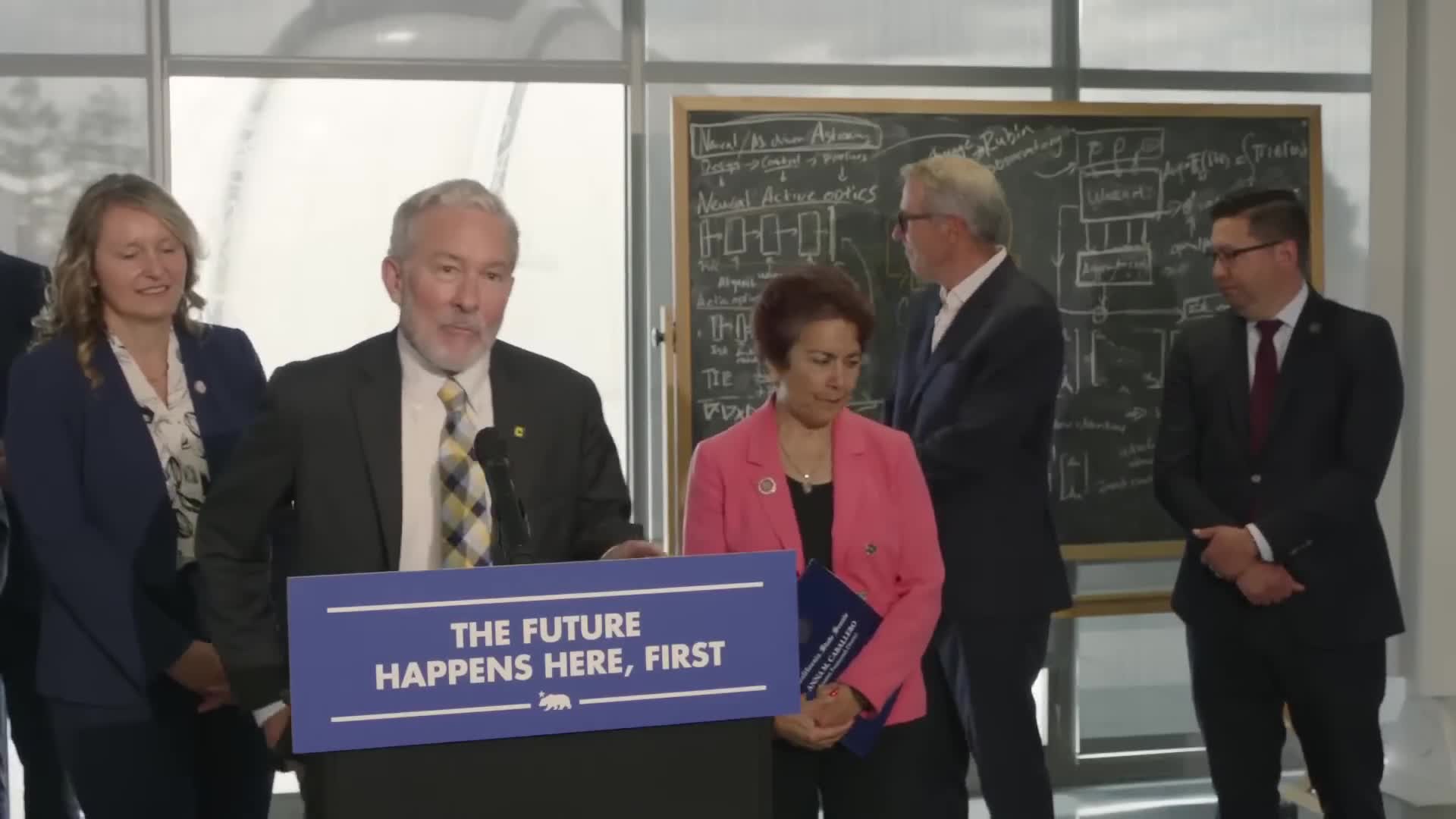
Summary
At UC Berkeley, Gov. Gavin Newsom signed two bills to support California's quantum and fusion technology sectors and announced a $5 million budget allocation for fusion research, officials said. The signing launches the state-backed Quantum California effort and highlights partnerships among state government, universities and industry.
At UC Berkeley, Gov. Gavin Newsom signed two bills advancing California's quantum and fusion research ecosystems and announced $5 million in budgeted funding for fusion energy research. The signing, attended by University of California and state leaders, was billed as the launchpad for "Quantum California," a state-supported effort to grow research facilities and workforce development in the sector.
Chancellor Rich Lyons of UC Berkeley said the campus will host a "quantum nexus," an interaction space to promote exchange among academia, industry and government. "Berkeley is thrilled and honored to be the launchpad for Quantum California," Lyons said.
JB Milliken, president of the University of California, said the legislation being signed will "strengthen California and continue to support innovation in a robust economy." Milliken described the bills as part of a broader partnership among state government, the university system and industry.
Dede Myers, senior advisor to the governor and director of the Governor's Office of Business and Economic Development (GO-Biz), described the bills as a response to regional economic planning and workforce needs. Myers said the state's regional planning process — part of the "California Jobs First" blueprint — repeatedly identified quantum and fusion as priority growth sectors. "And guess what came up over and over? Quantum infusion," Myers said.
Sen. Anna Caballero, the author of SB 80, described the bill as establishing a fusion research and development and innovation initiative and said it "provides a pathway for the state to invest directly in California's fusion energy economy." Caballero said the initiative and the paired budget allocation are intended to keep graduates and research talent in state.
Assemblymember Buffy Wicks, the author of the quantum bill being signed at Berkeley, said universities and private industry urged the legislature to give the state a role in supporting and coordinating quantum research. "Whoever owns quantum owns the future," Wicks said, describing bipartisan legislative support for the measure.
Officials and lawmakers framed the bills as investments to preserve California's research leadership and translate academic discoveries into commercial technologies and jobs. Newsom cited the state's research institutions and federal-affiliated labs as part of the pipeline, noting contributions from Lawrence Berkeley National Laboratory and Lawrence Livermore National Laboratory and academic centers across California.
The signing included an explicit budgetary detail: Caballero said the state budget includes $5,000,000 for fusion energy research to support the initiative created by SB 80. Other funding, program design and implementation details were discussed at the event but not finalized during the signing.
Newsom and university leaders said the bills aim to promote equitable regional benefits and workforce development across California rather than concentrating activity in a single metropolitan area. Officials also noted existing federal and private investments in fusion and quantum research and described the state funding as intended to complement those resources.
The event concluded with officials saying further implementation steps will follow through state agencies, the UC system and partnerships with industry. No vote or additional legislative action occurred at the event beyond the governor's signing of the two bills; participants said forthcoming reports and program plans will guide next steps.