Get Full Government Meeting Transcripts, Videos, & Alerts Forever!
Get email alerts on the Probate topic
No spam. Unsubscribe anytime.
Fort Bend probate court admits multiple wills, appoints executors and names administrators
Summary
The Fort Bend County Probate Court admitted several wills to probate, appointed independent executors to serve without bond in multiple estates, declared heirship in one case and set a $120,000 bond for a dependent administrator in another.
The Fort Bend County Probate Court admitted a string of wills and appointed executors and administrators during a docket hearing, resolving title and administration matters for several local estates.
The judge admitted the last will and testament of George Edward Gifford to probate as a muniment of title and said an affidavit of fulfillment of terms will be required. In a separate matter, Gerald A. Sellers was appointed independent executor of the estate of William G. Sellers to serve without bond and the court waived appraisers.
Rita Estridge was appointed independent executrix for the estate of Daisy V. Walwyn to serve without bond and appraisers were waived. Lance Edward Stafford was appointed independent executor for the estate of Rhonda Suzanne May to serve without bond and appraisers were also waived after testimony from subscribing witnesses. Lisa Gay Lansford was appointed independent executrix for the estate of Leonard ("Bud") Meredith, and James Richard Lawless was appointed independent executor for the estate of Marie S. Lawless; both were ordered to serve without bond and appraisers were waived.
The court admitted the will of Carl Porritt as a muniment of title and waived the affidavit of fulfillment of terms. The court also admitted the will of Jane Wylie Keep as a muniment of title and waived the affidavit requirement; the court record notes the Keep property at 6302 Breezy Hollow Lane in Katy, Texas was identified during the prove-up.
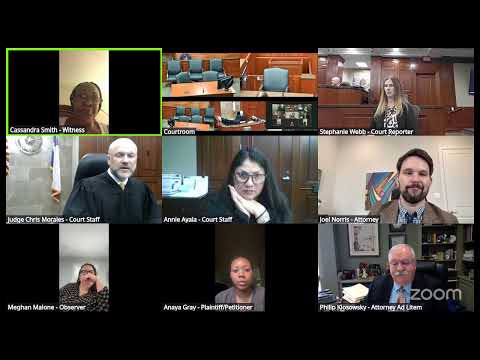
The court declared heirship for Michael R. Jensen and, after testimony from family and neighbors, appointed Barbara Ann Stringer as independent administratrix; the court discharged the attorney ad litem and awarded that attorney a $650 fee. In the estate of Tiffany Yvette Gray, the judge declared heirship and later appointed Anaya Gray as dependent administrator, setting bond at $120,000; the court also awarded the attorney ad litem a $650 fee in connection with the heirship proceeding.
Attorneys and family witnesses repeatedly confirmed that, in each matter admitted to probate, there were no post–will children or marriages, no charitable devisees, and no Medicaid receipt on or after March 1, 2005, as required by the court's routine screening questions. Where an estate had property or accounts requiring administration, the court granted administration; where no administration was necessary, the court admitted the will as a muniment of title.
Several applicants and witnesses described the procedural formalities the court relied on: proof of death, recognition of signatures on filed wills, testimony from subscribing witnesses, and the filing or judicial notice of originals on file with the clerk. The judge pronounced each disposition from the bench, for example stating, “The court will admit the will and the probate and appoint [the applicant] as independent executor to serve without bond,” language repeated in multiple matters.
A handful of details were clarified on the record: in the Lawless matter an attorney said the estate’s liquid and trust assets were reported to be less than $1.5 million; in the Gifford matter the court admitted the will as a muniment of title but required a later affidavit of fulfillment of terms; in one hearing an attorney acknowledged an administrative error with a notary stamp and said staff would review prior filings for any impact.
Decisions made at the hearing were procedural and case-specific rather than policy-setting: the court admitted wills, appointed personal representatives, set bond in the Tiffany Gray administration, waived appraisals where permitted, and awarded statutorily allowable ad litem fees to attorneys who had represented the interests of unknown heirs. Matters requiring more information or missing witnesses were continued or rescheduled by the court.
The dispositions settle ownership or start formal administration for the named estates, enabling executors and administrators to begin managing assets, filing inventories, and closing matters under the Texas Estates Code and related probate procedures.
The court did not discuss changes to statutes or county policy during the docket; remarks were limited to the formal proof and appointment steps for individual estates.