
Mercer Island asks public to weigh three design concepts to repair Clark and Groveland waterfront parks
Get AI-powered insights, summaries, and transcripts
Subscribe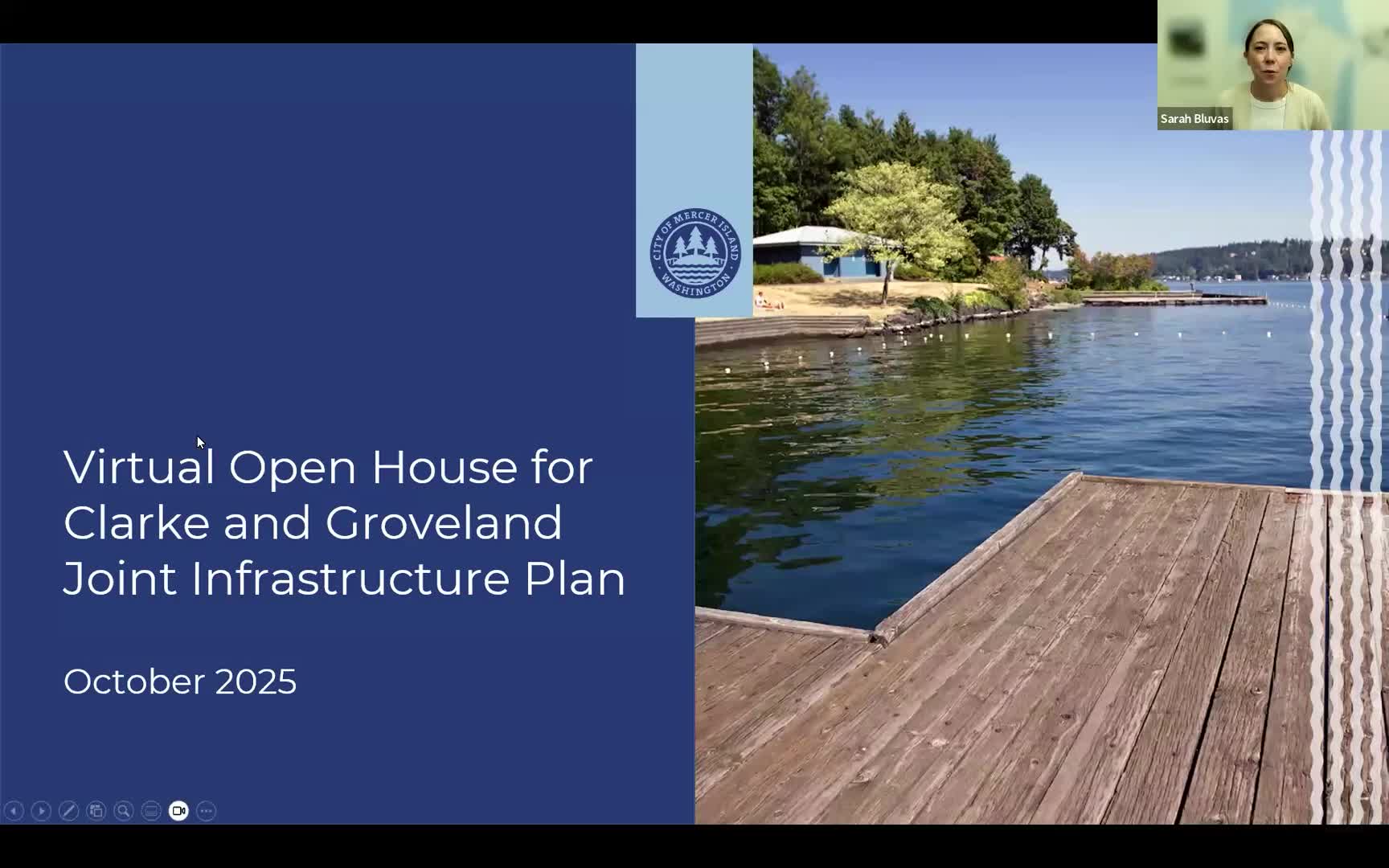
Summary
City staff and consultants presented three preliminary designs that would replace aging waterfront structures, soften concrete bulkheads to improve salmon habitat, and add new amenities; the city is seeking public feedback via an online survey open through Nov. 3.
Mercer Island is asking residents to weigh three preliminary design concepts for Clark Beach Park and Groveland Beach Park that would guide 10 to 15 years of repairs and renovations to aging waterfront infrastructure, city staff said at a virtual open house.
Sarah Blubas, a capital project manager for the City of Mercer Island, told viewers that "the joint infrastructure plan for these waterfront parks will identify and prioritize specific park renovations and repairs to implement over the next 10 to 15 years." She said existing park features are nearly 50 years old and that "waterfront and in-water structures, such as bulkheads, docks, and piers, must be repaired or replaced soon."
The plans presented by Berger Partnership Landscape Architects focus on shoreline restoration and updated amenities while recognizing limited funding. "Survey results will be used to develop the preferred concept for each park," Blubas said, and the city has posted the concept graphics and an online survey at www.mercerisland.gov/cgip; the survey is open through Nov. 3. The preferred concept is scheduled to be shared with the community in early 2026, the presentation said.
Consultant Jordan Zlatoff of Berger Partnership described existing conditions at Groveland Beach Park, noting steep terrain, timber steps, concrete bulkheads, an existing swimming pier and swim area, and an upland restroom. He said the park lies within the Cedar River watershed and that the "nearshore" zone — the area with water less than 15 feet deep — is important for Chinook, coho and sockeye salmon. "One of our project goals is to remove this extended bulkhead to restore better conditions for the fish," Zlatoff said, explaining that an extended wooden wall at the south end currently blocks nearshore habitat and that much of the shoreline is lined with concrete bulkhead that "wouldn't meet today's environmental standards."
All three concepts presented share several consistent elements: removal of the existing concrete bulkhead to soften the shoreline and restore fish habitat, replacing the existing elevated pier with a new floating pier to improve swimmer access and calm wave activity in the swim area, and replacing the existing restrooms with an improved facility that includes gender-neutral stalls and changing rooms.
The three concepts differ chiefly in the balance between structured seating and open beach and in the placement of play areas and circulation: Concept 1 replaces the existing playground with a mid-level gathering space accessed by an elevated boardwalk and tree canopy walk, adds wide grassy terraces at the waterfront, and locates a floating pier roughly in the same size and location as the existing pier. Concept 2 relocates the playground to the waterfront, moves the sand volleyball court upland, tightens terrace seating to increase usable beach width, and expands the pier platform while adding a detached floating swim platform. Concept 3 retains the playground in its current location, preserves a wider open beach with an extended seawall and central path, and proposes an expanded floating mirror pier for hanging out and swimming.
Zlatoff also showed cross sections and visual examples to illustrate how sand mixed with small habitat gravel would be needed to meet environmental permitting and create a stable beach slope, and he described a variety of possible nature-play elements, terrace seating, and floating swim-pier configurations for later design phases.
City staff emphasized that funding is limited and that not every idea shown will be included in the final plan. The presentation asked the public to review the posted graphics on Let's Talk and complete the survey to indicate which elements matter most. The city plans to use survey responses to refine and select a preferred concept for each park before advancing to more detailed design and permitting work.
How to respond: the concept materials and the survey are available at www.mercerisland.gov/cgip or via the QR code shown in the presentation; the survey is open through Nov. 3. The preferred concepts are expected to be shared with the community in early 2026, per the presentation.