
Planning staff presents draft Environmental Justice element; county finds no state‑designated disadvantaged communities
Get AI-powered insights, summaries, and transcripts
Subscribe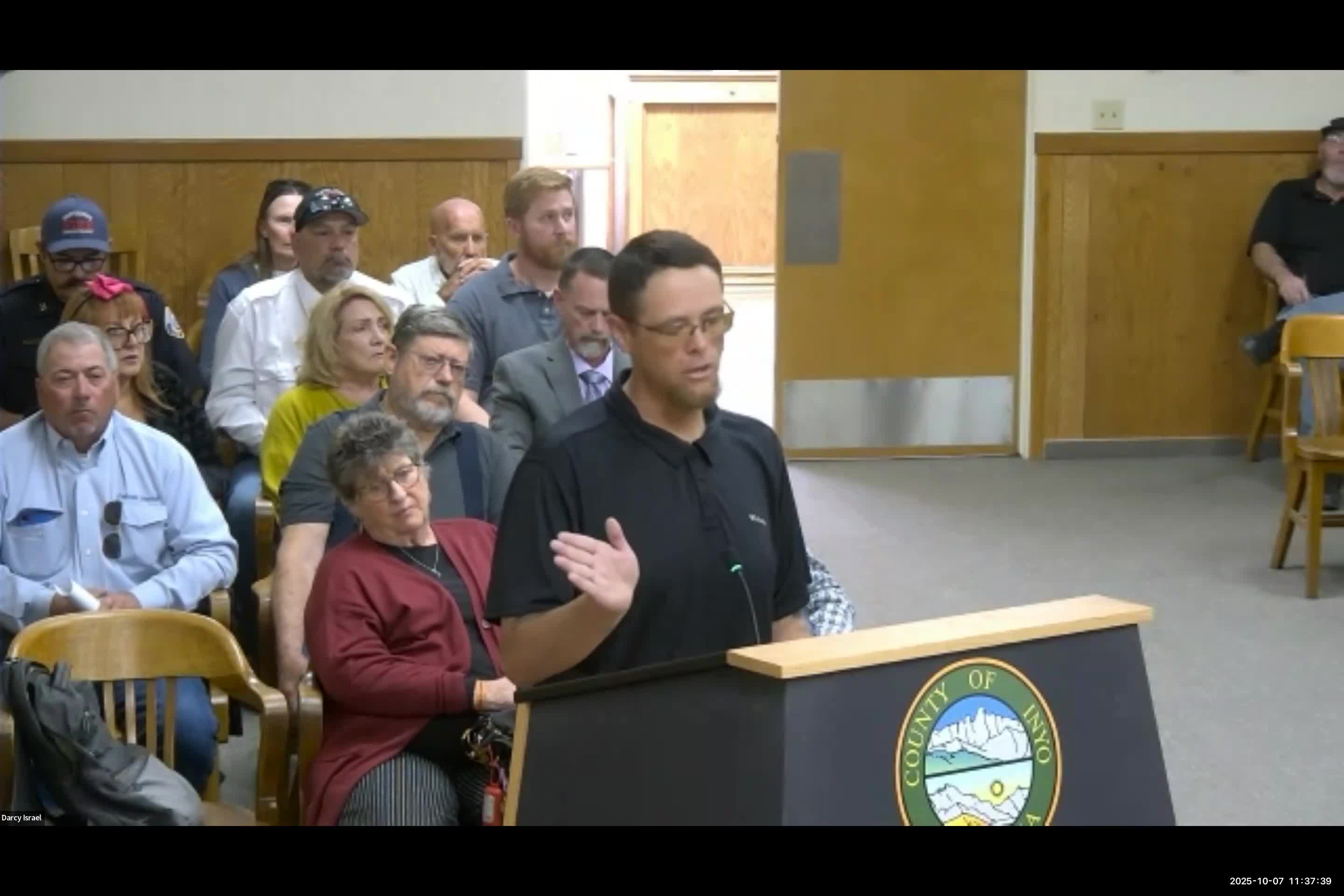
Summary
Planning staff presented a draft environmental justice element required by state guidance tied to housing‑element certification, concluded that Inyo County contains no CalEPA‑designated disadvantaged communities, and said the draft consolidates existing general‑plan policies while adding targeted provisions on food access and legacy communities.
Planning staff presented a draft Environmental Justice element to the Board on Oct. 7 and explained why the county is preparing the stand‑alone chapter even though CalEPA’s mapping tools currently show no state‑designated disadvantaged communities within Inyo County.
Planner Danielle Viswanio said Senate Bill 1000 requires jurisdictions with state‑identified disadvantaged communities to include an environmental justice element, and that the California Environmental Protection Agency’s CalEnviroScreen tool is used to identify those census tracts. Staff reviewed EnviroScreen data and determined that Inyo County does not include any census tracts reaching the state threshold for a designated disadvantaged community. Viswanio said a few places near the county border show higher EnviroScreen indicators but are not inside the county boundary.
Staff said they drafted the element to consolidate public‑health, housing, air‑quality, food‑access and civic participation policies into a single place that will make the county’s current goals and programs easier to reference. The draft incorporates about 132 existing general‑plan goals, policies and programs and adds roughly 22 new environmental‑justice provisions and nine new implementation actions, planning staff said. New language calls for easier development of community gardens and farmers markets, attention to “legacy communities” (defined in the draft as isolated places with household incomes less than 80 percent of the state median and a history of long‑term habitation), and targeted infrastructure and hazard mitigation assistance for such places.
Viswanio said staff will consolidate public comments, revise the draft as needed, and seek a Planning Commission recommendation in December, with a subsequent Board hearing on adoption.
Ending
The board did not act on the draft Oct. 7. Planning staff said it will accept input, revise the draft and aim for Planning Commission recommendation in December and a final board adoption hearing thereafter.