
City Council adopts findings on tax-increment financing study, urges alternative tools
Get AI-powered insights, summaries, and transcripts
Subscribe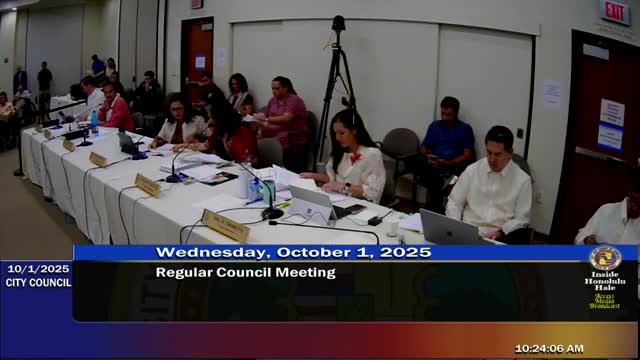
Summary
The Honolulu City Council on Wednesday adopted the final report from a permitted interaction group that studied tax-increment financing and recommended exploring alternative financing tools such as community facilities districts and public–private partnerships.
The Honolulu City Council adopted council communication 221 on Wednesday, accepting the findings and recommendations of a permitted interaction group that studied tax-increment financing (TIF) for the city.
The report, created under resolution 25-56 CD1, summarized models the group examined — including pay-as-you-go approaches and bond-financed TIF — and recommended focusing on alternative financing tools such as community facilities districts (CFDs), impact fees, public–private partnerships and “synthetic” TIF models. Council Member Kia Aina moved to adopt the report; members moved and seconded the motion and no objections were recorded.
Why it matters: Council members and city staff said the review was intended to keep “every arrow in the quiver” when planning infrastructure to support housing and neighborhoods, while acknowledging potential legal or statutory barriers at the state level.
Details and debate: Council Member Ricardo, who chaired the permitted interaction group, told members the committee was formed by resolution 25-56 CD1 and that the report was developed through in-person and virtual meetings with the Department of Budget and Fiscal Services, the Department of Planning and Permitting and the Department of Housing and Land Management. He said the group considered different TIF structures and shifted discussions toward other financing sources to avoid overly narrow focus on one financing mechanism.
Mark Anthony Clemente, representing the Hawaii Regional Council of Carpenters, testified in support of keeping TIF as an option: “we don't think that the door should be closed on TIF,” he said, adding that municipalities on the U.S. mainland sometimes use TIF and CFDs together to finance infrastructure for housing.
Next steps: The adopted report lists recommendations for prioritizing CFDs in areas such as Iwilei, Kapalama and Halawa and for continuing evaluation of impact fees and public–private partnerships. The council did not approve a specific TIF program nor allocate construction funds; members said further committee work would be needed to move tools from study to implementation.
Ending: With the report adopted, council members said they expect committee- and department-level follow-up on recommended financing options and possible implementing ordinances or pilot projects.