Get Full Government Meeting Transcripts, Videos, & Alerts Forever!
Get email alerts on the Stormwater Funding topic
No spam. Unsubscribe anytime.
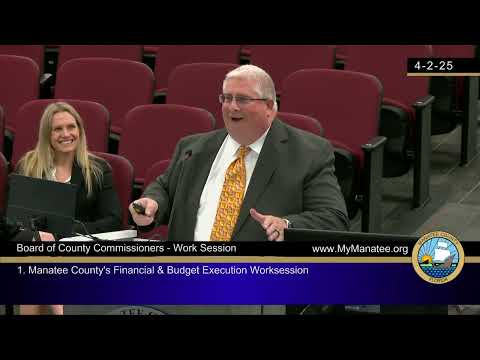
Manatee County work session probes stormwater funding options — fee, MSTU or millage among choices
Summary
Manatee County staff and commissioners spent a substantial portion of their April 2 work session scrutinizing how to fund stormwater operations and flood mitigation, reviewing several funding mechanisms — a dedicated fee based on equivalent residential units, a countywide municipal‑service taxing unit (MSTU) millage, or basin‑specific drainage districts — and discussing fairness, administrative costs and scale of needs.
Manatee County staff and commissioners spent a substantial portion of their April 2 work session scrutinizing how to fund stormwater operations and flood mitigation, reviewing several funding mechanisms — a dedicated fee based on equivalent residential units, a countywide municipal-service taxing unit (MSTU) millage, or basin‑specific drainage districts — and discussing fairness, administrative costs and scale of needs.
“Technically, we are not moving forward on things at the moment,” Chad Butso, Public Works, told the commission as he opened the stormwater briefing. Butso reviewed the structure of current stormwater activity (operations, engineering, natural‑resource water‑quality work and contracting) and the fund flows that today draw support from a mix of sources including solid‑waste transfers, ad valorem and grants.
Why it matters: Manatee County experienced major storms in 2024 and officials say there is a backlog of maintenance and remediation needs. Staff and commissioners agreed the county needs a stable, dedicated funding source for recurring maintenance and for larger capital projects that reduce flooding; board members debated whether to start incremental (base fee) or pursue larger dedicated millage or district financing for capital outlays.
Staff numbers and options: Butso presented the current stormwater fund’s approximate operating cost of $13,300,000 and noted a capital figure in his slides of roughly $12,000,000 for FY24 work. He told commissioners a practical near‑term increase in maintenance and in first‑time cleanup of unmapped canals and ditches could push annual stormwater needs substantially higher — staff cited ranges in presentations that, when combined, suggested a $20 million to $40 million annual scale depending on scope and whether the county takes over previously unmaintained channels.
Funding mechanisms discussed included: - A countywide monthly fee modeled on an equivalent residential unit (ERU) or an impervious‑surface ratio (ISR). Butso described the ERU approach used in prior work and noted implementation complexity for commercial properties. He presented a back‑of‑the‑envelope calculation that an ERU approach could imply a rate in the range of about $187 per ERU (2019 ERU base updated for growth) for larger revenue targets; commissioners and staff noted that a smaller starting fee to fund recurring maintenance only would be more politically feasible. - A countywide MSTU millage (an unincorporated municipal service taxing unit) levied on the tax roll. Staff and several commissioners said the MSTU approach is administratively simpler and reaches property owners through the property-tax bill; it can be established and adjusted by the board for unincorporated areas without a referendum, though it would affect only unincorporated residents unless organized differently. - Basin‑by‑basin drainage maintenance districts or special assessments for betterments. Staff said these can focus capital work where benefits are concentrated but complicate fairness and administration if many small districts are needed.
Commissioners’ positions and concerns: Commissioner Cruz argued for decisive action to avoid repeating recurring flood damage and urged approaches that incorporate fairness for rural properties and credits for pervious surfaces: “We need to figure out how much it costs to fix this, and we need to go out and fix it,” he said. Commissioners Feltz and Phelps emphasized the need for clear benefit for taxpayers (show what the fee buys), credits for properties that reduce runoff and plans to avoid duplicating existing CDD/HOA responsibilities. Several commissioners urged starting with a modest, net‑new fee that covers recurring maintenance and procuring a defensible technical study before expanding to large‑scale capital financing.
Administrative and legal notes: Staff said an annual assessment or millage is simpler administratively than a monthly bill because collection and annual reconciliation align with the property‑tax schedule. Butso noted a past attempt to implement a fee in 2019 failed in part because of pushback about how commercial and rural properties were treated; commissioners asked staff for a defensible crediting approach (impervious ratio or multiplier on ERU) and for an outreach plan.
Public comments and technical concerns: Public speakers and callers urged attention to documented local causes of flooding, including backwater/tailwater effects tied to dam and river behavior, and asked the county to couple funding proposals with targeted remediation in documented high‑risk basins. Staff acknowledged a need to map additional channels and to estimate long‑term maintenance for assets the county might assume.
Next steps and timing: Staff estimated that an ERU‑fee implementation with supporting study and public notifications could take roughly 6–12 months; a tax‑roll assessment tied to the trim notice cycle would take longer (roughly 12–18 months depending on timing). Commissioners asked staff to deliver a short plan and cost estimate so the board can decide whether to start with a modest maintenance fee, pursue an MSTU, or combine measures and to report back with a draft approach for the FY26 budget discussions.
Ending: The board did not adopt a funding mechanism at the work session. Staff will return with more detailed cost estimates, proposed rate structures (ERU/ISR examples), implementation timing and public‑outreach options so the board can make a policy decision during the FY26 budget process.