Get Full Government Meeting Transcripts, Videos, & Alerts Forever!
Get email alerts on the Pedestrian Bicycle Safety topic
No spam. Unsubscribe anytime.
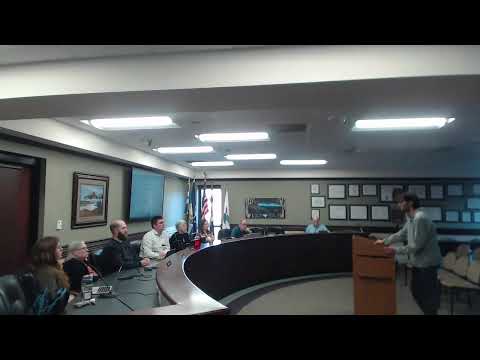
Resident urges Planning Commission to prioritize pedestrian, bicycle safety on Presque Isle Avenue
Summary
A community member presented a two‑week observational study finding that drivers frequently ignore people crossing Presque Isle Avenue, leaving pedestrians and cyclists feeling unsafe and urging the Planning Commission to prioritize nonmotorized transportation in long‑range plans.
A community member who presented a pedestrian and cyclist safety study told the Planning Commission that "traffic and infrastructure conditions on Presque Isle Avenue does not make people walking and biking feel safe." The presenter said she observed the corridor and surveyed more than 30 people over two weeks in late March and concluded drivers often fail to stop or yield to people waiting to cross.
The presentation focused on the stretch of Presque Isle Avenue between Walden Street and Myrtle Street, adjacent to Superior Hill and near the university campus. The speaker said the university’s master plan sees Presque Isle Avenue as a "pedestrian centric entertainment corridor" with new mixed‑use development, but that the street in its current form "is not ready to serve the University Entertainment District." She said the street was reconstructed a few years ago but that design and driver behavior combine to make crossings feel unsafe.
The presenter listed repeated driver behaviors she observed or heard about from residents: speeding, distracted driving, and "regularly running stop signs at Center and Summer Streets," which she said forces pedestrians to rush across. She also told commissioners that nearly every cyclist she observed rode on the sidewalk, and that only one northbound bike lane exists on the corridor.
When asked for improvements, the presenter said she had spoken with city engineers and a consulting firm working on an active‑transportation study and suggested pedestrian‑activated crossing controls. She described the device engineers mentioned as a HAWK signal (a pedestrian‑activated midblock crossing) and said such a measure could make people waiting to cross more visible to drivers. She also said trucks travel the corridor frequently and questioned whether speed humps would be appropriate for that street.
The presenter noted that traffic‑control measures typically require meeting engineering warrants before installation, and she relayed that local enforcement and street geometry may limit how quickly behavioral changes can be achieved. A commissioner asked for specific recommendations; the presenter reiterated advocacy for devices that increase visibility at crossings and for the city’s active‑transportation planning to prioritize nonmotorized users.
No formal action or vote was taken during the meeting on the study or on specific traffic changes. The commission did not adopt any motion; the presentation was received as information and discussed by commissioners and the presenter. The record shows the presenter asked the commission to "consider these implications and prioritize non motorized transportation, AKA pedestrians and cyclists, while planning this corridor," and she emphasized community and business support for safer crossings.
Background details provided during the presentation: the presenter said she stood on the street in cold, windy conditions while observing behavior; she surveyed over 30 passersby; she referenced conversations with local law enforcement and city engineers; and she said the corridor is wider than typical local streets, which may encourage higher speeds. The presenter also referenced past conditions on the street and an MDOT reconstruction of a different nearby section as part of the historical context she offered.
The commission’s agenda contained no related motions, ordinances, or votes at this meeting. Commissioners and staff are engaged in an active‑transportation planning study, as mentioned by the presenter, which could inform future engineering recommendations and potential warranting for crossing devices or other traffic controls.