Get Full Government Meeting Transcripts, Videos, & Alerts Forever!
Get email alerts on the County Finance topic
No spam. Unsubscribe anytime.
Manatee County presents clean FY2024 audit, but commissioners press for clearer debt and budget planning
Summary
Clerk and county finance staff reported an unmodified audit opinion and rising cash, investment earnings and net position for FY2024. Commissioners pressed staff for clearer debt-service breakdowns, multi-year debt capacity analysis and a timeline to decide how much of rising revenue to dedicate to priorities before the FY26 budget cycle.
Manatee County released its audited fiscal-year 2024 financial results on April 2, and county officials reported an unmodified audit opinion, roughly $2 billion in county investments and rising net position while flagging growth in total debt and capital commitments.
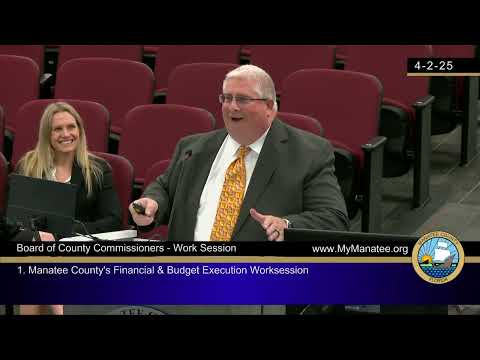
The Clerk of the Circuit Court and county finance staff presented the annual comprehensive financial report and supporting budget updates at the Board of County Commissioners’ work session. Angel Coloniso, Clerk of the Circuit Court, and Neil Unruh, Director of Finance in the Clerk’s Office, told commissioners the independent audit by Carr, Riggs & Ingram produced “unmodified opinions and no material weaknesses to report for this year.” Unruh also reported roughly $2,000,000,000 in invested assets and about $102,900,000 in investment earnings for FY2024.
Why it matters: commissioners must set millage, prioritize capital projects and decide whether to dedicate rising revenues to specific long-term needs such as stormwater and housing. Finance staff said the county’s reserves and liquidity remain strong, but that total debt has more than doubled since 2019 and needs active monitoring to protect bond ratings and future operating flexibility.
At the top level, Chief Financial Officer Sheila McLean said the county’s total net position rose by about $460,000,000 — a 13.6% increase — with governmental net position up roughly $249,000,000. McLean said audited cash and investments adjusted for fiduciary and restricted funds totaled about $1,878,000,000 at Sept. 30, 2024, and that the county has a broad capital-improvement program (CIP) totaling about $5.2 billion across 788 projects.
“The numbers continue to support that the county has solvency as well as long-term stability, liquidity and short-term resilience,” McLean said. She also flagged that total outstanding debt rose to roughly $917,000,000 from about $432,000,000 in 2019, and that annual principal-and-interest commitments currently run near $70,000,000.
Unruh described drivers behind the audited increases: capital-asset purchases for parks and transportation, purchases of environmentally sensitive land, utility capacity projects and grants and developer-contributed infrastructure. He noted the county earned awards from the Government Finance Officers Association for reporting and budgeting best practices.
Staff walked commissioners through several ratios and policy tests used by rating agencies. McLean said the county’s governmental debt-to-equity ratio is about 0.26 (rating agencies prefer 0.40 or lower) and that utilities’ debt-coverage ratios and other sufficiency tests currently meet policy targets. She noted required coverage for utilities (as measured in the CIP analyses) is 1.15 and that utilities were well above that threshold.
Commissioners sought more granular reporting. Commissioner Cruz said he worried that rising utility borrowing to meet water-capacity needs could leave general-government taxpayers carrying long-term debt: “We’re gonna stick future boards and future residents with being stuck paying 30 years worth of debt service on stuff that they don’t remember us ever doing,” he said. Cruz asked staff to separate general-government and enterprise debt in future capacity displays and to produce a focused view of debt service funded by ad valorem taxes.
Treasurer Commissioner Sadique and others asked for scenario modeling showing sustainable debt levels under alternative revenue assumptions. McLean told the board staff will provide additional forecasting and suggested debt-refunding opportunities are being monitored; she said utilities’ 2015 bonds may be candidates for refunding if market conditions yield net savings.
Staff also summarized major revenue sources that underpin budgeting decisions: ad valorem taxes (the single largest general-fund revenue), the half-cent infrastructure sales tax (sunset 12/31/2031), tourist-development tax (a sixth penny approved by referendum effective 1/1/2025), state revenue-sharing and impact fees (impact fees were a strong source, about $68,000,000 in FY24). Danielle Frasier, Fiscal Services Division Manager, noted that ad valorem revenue rose materially in recent years and that the FY25 ad valorem budget assumption was a 13% growth in assessed value; staff said they planned a more conservative 10% growth assumption for FY26 projections.
What staff recommended: McLean and her team recommended continuing routine debt policy practices, reviewing spending of bond proceeds at six-month intervals and updating policies (including travel, uniforms and software-implementation controls) to address auditors’ findings. Unruh said the external audit recommended formal testing standards for major software implementations after controls concerns tied to a recent utility-billing system conversion; the auditors found no material financial misstatement but recommended stronger documented implementation controls.
No formal board action was taken at the work session; commissioners instructed staff to return with more detailed multi-year debt and revenue scenarios ahead of the FY26 budget process. McLean said staff would produce a comprehensive draft FY26 budget for the county administrator by May 6 and begin commissioner briefings in April and May, with tentative millage and public hearings scheduled under the statutory calendar.
Ending: Staff said they would return with a clearer breakdown of how much of rising revenue and reserves could be dedicated to priorities such as housing or stormwater, and with debt-service schedules that isolate tax-supported general-government obligations from enterprise-backed debt. Commissioners said they expect scenario analyses and options ahead of the formal budget cycle.