
Arts Commission hears debate over Vaillancourt Fountain after Rec & Park outlines $29 million restoration estimate
Get AI-powered insights, summaries, and transcripts
Subscribe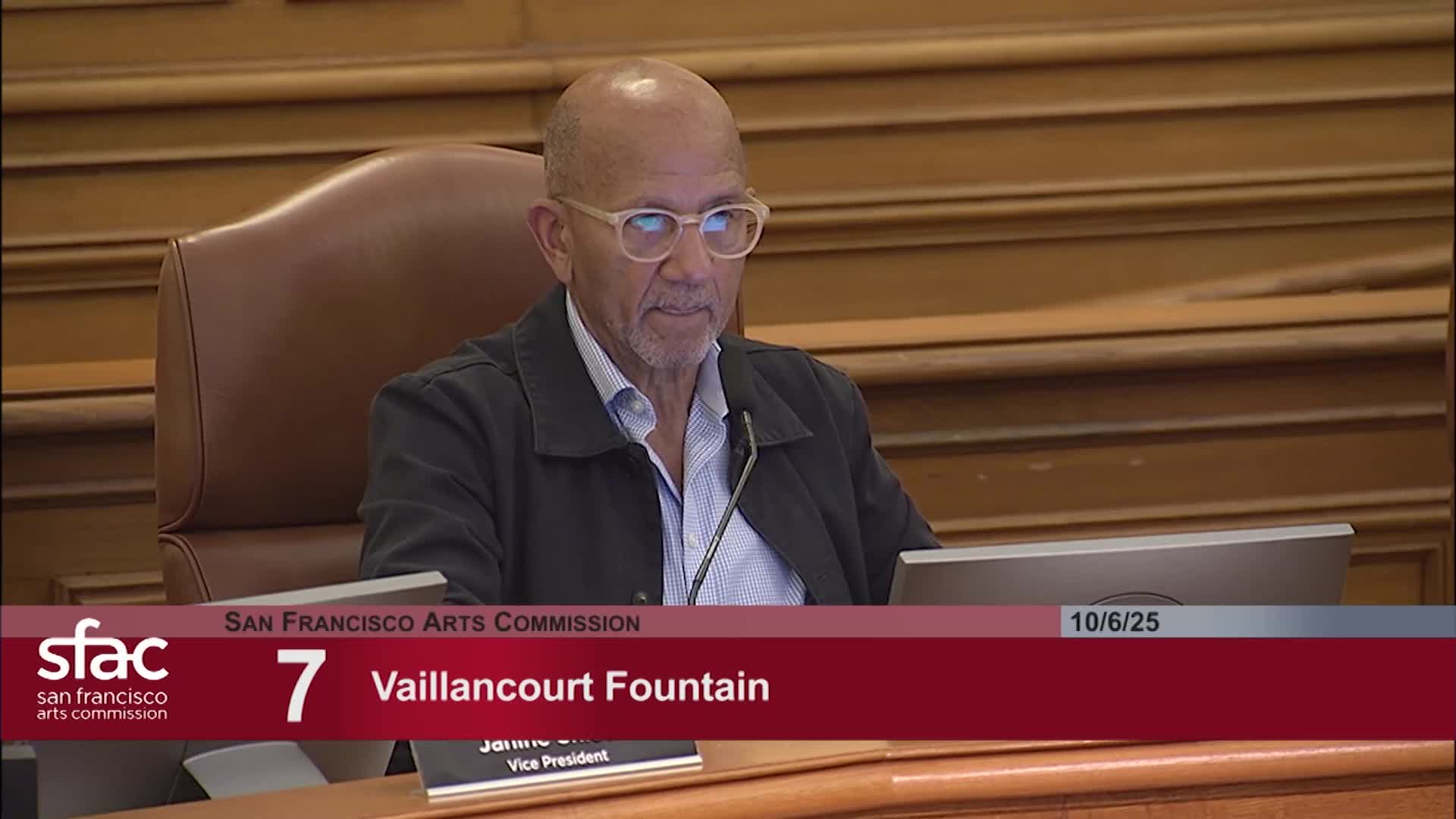
Summary
At an informational hearing Oct. 6, Recreation and Park staff told the San Francisco Arts Commission that the Vaillancourt Fountain is structurally deteriorated, mechanically inoperable and fenced for safety; staff shared a third‑party ROM restoration estimate of $29 million and two lower-cost alternatives for removal or temporary disassembly. The
The San Francisco Arts Commission on Oct. 6 received an informational briefing from Recreation and Park on the future of the Vaillancourt Fountain at Embarcadero Plaza, the 1971 monumental concrete fountain by Armand Vaillancourt that sits within the planned Sue Bierman Park/Embarcadero Plaza renovation. Recreation and Park staff said the presentation was for information only and that no commission action was requested.
The museum and parks presentation laid out the agency’s findings from a Historic Resources Review, conditions and accessibility assessments, and an independent construction cost estimate prepared by Swinerton. "There are no actions associated with this item today," said Mary Chu, director of public art programs and civic art collection. Recreation and Park project manager Yolanda Goodwin told commissioners the fountain’s mechanical systems have failed and its structure shows medium to large cracking and spalling driven by corrosion of internal steel. She said hazardous materials (lead‑containing paint and asbestos), a flooded, non‑compliant equipment vault and failed waterproofing create safety and life‑safety hazards that have required fencing since June 2025.
Why it matters: the fountain is a high‑profile work in the city’s civic art collection and sits at the most prominent downtown waterfront approach. The commission heard competing public views about preserving the work as a landmark of 20th‑century public art versus removing the fountain to make way for an expanded, accessible, multifunctional Sue Bierman Park and plaza. Any decision has funding, legal and procedural consequences including environmental review and potential deaccession or disposition of a civic art asset.
Most important facts: Recreation and Park said the fountain originally circulated about 30,000 gallons of water per minute and was completed in 1971 at a contract price of $310,000. The department reported that the fountain’s original pumps have failed (the last pump failure occurred in May 2024), the underground vault is a confined, frequently flooded space and is not OSHA‑compliant, and that the fountain predates the Americans with Disabilities Act and does not meet current accessibility standards. An independent ROM construction estimate from Swinerton put full restoration construction costs at approximately $29,000,000. Recreation and Park provided two lower‑cost options for comparison: full removal estimated at about $2,700,000 and disassembly plus three years of storage at about $4,400,000. Those figures, the department said, include direct construction costs plus bonds, insurance, overhead, contingencies and escalation; they do not include staff time, design, permitting or ongoing maintenance.
What staff recommended and next steps: staff said immediate hazards (structural deterioration, hazardous materials, flooded vault and electrical risks) are the priority. They are consulting with Public Works and the Department of Building Inspection to identify safe next steps. Planning will continue for the larger plaza/park concept; once a concept design is finalized it will be subject to environmental review by the Planning Department and then to the Recreation and Park Commission before design phases and fundraising proceed. Recreation and Park staff told the Arts Commission that, as of the Oct. 6 meeting, no funding had been committed for full restoration.
Public comment and positions: the commission heard more than 40 public speakers during the item and received more than 250 written comments submitted in advance. Many speakers and preservation advocates, including members of Docomomo US Northern California and the Barbary Coast Neighborhood Association, urged rehabilitation and cited the Arts Commission’s charter responsibility to maintain civic collection works. “Actions are louder than words,” said Camilla Baum of Docomomo Noca. Supporters argued that the fountain is historically and culturally significant and that deaccession would erase an important civic asset.
Other speakers favored removal to make way for a redesigned, accessible downtown park. Those speakers emphasized downtown revitalization, safety, and programming needs and questioned whether scarce public funds should be spent on a single, complex restoration. "That single fountain would consume three years of the entire grants program," said one speaker who compared the $29 million estimate to the Arts Commission’s grant budget.
Commissioner questions and staff responses: Commissioners asked about fundraising, timelines and precedents for deaccession. Commissioner Deborah Walker and others asked whether private fundraising or philanthropic partnerships were being pursued; Stacy Bradley, manager of Recreation and Park’s Capital and Planning Division, replied that private fundraising conversations were appropriate and should be part of the financial strategy. Commissioners also asked whether the Arts Commission had deaccessioned works before; the city attorney’s office confirmed the commission has deaccessioned items and explained that deaccession (administrative removal from the collection) and disposition (what happens afterward) are separate processes that have occurred in past projects.
Artist and family position: staff said the project team met with the artist Armand Vaillancourt and family representatives. According to staff, the artist’s family indicated they would only accept the work returned to the original form with running water and suggested adding projection lighting, but were not interested in partial reuse or reconfiguration of individual parts.
Unresolved matters and legal context: multiple speakers referenced the California Environmental Quality Act (CEQA) and the California Art Preservation Act (CAPA). Staff and the deputy city attorney reminded the commission that today’s item was informational; any formal action would require additional legal review and could trigger CEQA review and other procedural steps. Staff also noted accessibility and OSHA compliance issues that would need to be addressed in any restoration or work around the vault.
Bottom line: the Arts Commission was presented with technical assessments that Recreation and Park characterized as showing unsafe conditions and high restoration costs; the commission did not take action. Recreation and Park and the Arts Commission will be part of a continuing process that includes environmental review, fundraising options and further study of preservation, removal or temporary storage alternatives.
Ending: With no vote taken, the commission’s role at this stage is primarily fact finding. Recreation and Park said it will continue to consult with city agencies, refine cost and scope options, pursue fundraising discussions and return with recommendations that will be subject to environmental and commission review.