
Guam Water Authority outlines response after dieldrin detected in Jigo well; interim treatment due in October
Get AI-powered insights, summaries, and transcripts
Subscribe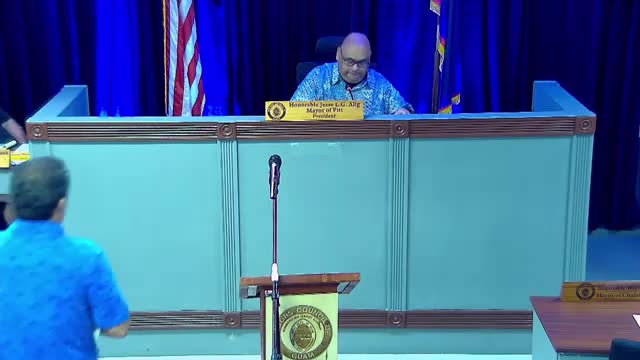
Summary
Guam Water Authority General Manager Miguel Bergadio told the Mayor’s Council of Guam on Tuesday that the pesticide dieldrin has been found in multiple source wells across the island and that one large producing well serving the Jigo area (Y15) exceeded Guam Environmental Protection Agency’s interim action level of 0.2 parts per billion.
Guam Water Authority General Manager Miguel Bergadio told the Mayor’s Council of Guam on Tuesday that the pesticide dieldrin has been found in multiple source wells across the island and that one large producing well serving the Jigo area (Y15) exceeded Guam Environmental Protection Agency’s interim action level of 0.2 parts per billion.
Bergadio said GWA has allocated more than $7 million for design and construction of permanent granular-activated-carbon (GAC) treatment systems at three affected wells and received legal approval to award a construction contract on Sept. 11, 2025. The single bid for the three-site project was $7.14 million, above the engineer’s estimate; GWA secured additional funding and the contractor is scheduled to complete permanent systems in 2026. In the near term, Bergadio said an interim flow‑reduction and two‑vessel treatment system is being built and GWA expects it to be operational by mid‑October, after which GWA will collect repeat samples; Guam EPA has agreed to lift the public advisory for the Jigo area after four consecutive non‑detect sampling events.
Why it matters: Dieldrin is a pesticide that was widely used decades ago as a termiticide and was banned nationally in 1987. Because the chemical persists in soils and groundwater, regulators and the water utility must balance public‑health protection with the immediate need to maintain water supply from a large producing well. Bergadio told mayors that shutting Y15 without replacement would cause cascading supply shortfalls across the Santa Rosa zone.
What GWA reported to the mayors - Historical data: GWA has monitored pesticides as part of its routine testing for decades and reports both regulated and unregulated detections in its annual water‑quality reports. Bergadio said dieldrin detections go back to the 1990s and are “scattered throughout the island,” but that the vast majority of detections (84 of 93 locations with detections) were well below 0.1 ppb, or half the interim action level. - Extent of elevated detections: Of 124 source sampling locations in GWA records, 31 showed no detections; 93 showed detections and most were low. Seven wells ranged above 0.1 ppb but still below 0.2 ppb; two wells exceeded the 0.2 ppb interim action level and only one of those, Y15, was in regular operation when the advisory was issued. - Actions taken: GWA engaged an engineering contractor in 2024 to design treatment systems once Guam EPA finalized action levels. GWA issued an IFB and received the sole $7.14 million bid in April 2025, obtained additional funding from the Consolidated Commission on Utilities (approved May 2025), and received attorney general approval to award the contract on Sept. 11, 2025. GWA says it has procurement, design and construction contracts in place and has committed funds for completion. - Interim measures and customer support: GWA reported an interim treatment system to reduce flow from Y15 and treat water with two vessels is under construction and expected to be running by mid‑October; GWA plans to verify effectiveness with multiple consecutive non‑detect samples before asking Guam EPA to lift the advisory. The utility also said it will use U.S. EPA grant funding for point‑of‑entry/point‑of‑use systems for affected households, and that an emergency declaration by the acting governor unlocked resources for bottled‑water distribution and deliveries to residents.
Uncertainties and responsibilities Bergadio stressed that GWA did not place dieldrin in the groundwater and said tracing the original sources is difficult because national use of the pesticide dates back decades. He described the history of regulatory engagement: U.S. EPA inspectors documented dieldrin in GWA systems in a 2012 letter that offered to assess risk; Guam EPA began drafting regulations and risk assessments after 2022 inspections and produced draft action levels and public comment opportunities in 2023–24. Guam EPA adopted an interim action level of 0.2 ppb and proceeded to issue advisories that prompted GWA’s accelerated engineering response.
What residents asked and how GWA responded Mayors asked when interim and permanent fixes would be online, how customers could request testing, who pays for household treatment and whether wells can be taken offline and the system back‑fed. Bergadio said the interim system is expected to be operational mid‑October, with sampling turnaround time for off‑island laboratory analysis, and that GWA will procure and install point‑of‑use/entry systems paid with federal grant funds; the utility will handle procurement and seek reimbursement from EPA. He said wells can be shut only for short periods without broader supply impacts; for Y15, shutting the well would reduce reservoir levels and require water to be pumped from outside the zone.
Direct quotes “We failed. We should have done more,” Bergadio said when describing GWA’s communication after the advisory, adding the utility is now populating a dedicated Guam Water Safety web portal with historical data and updates.
“The action levels… are fairly conservative already and involve a lifetime of exposure,” Bergadio said, describing the toxicological basis Guam EPA used in proposing the interim standard.
What to watch next - GWA’s interim treatment performance tests and Guam EPA’s decision to lift or maintain the Jigo advisory after verification samples. - Delivery schedule and eligibility criteria for EPA‑funded point‑of‑entry/point‑of‑use systems, with GWA expecting first shipments in mid‑October in batches reported by vendors. - Progress on permanent GAC systems under the awarded construction contract and any additional funding requests if construction costs increase.
Ending note: GWA said it will post maps and the historical detection record on a new Guam Water Safety web portal within days and provide bi‑weekly joint updates with Guam EPA until permanent solutions are in place.