Get Full Government Meeting Transcripts, Videos, & Alerts Forever!
Get email alerts on the Civic Process topic
No spam. Unsubscribe anytime.
Residents press council on planning commission conduct, Whitlock Avenue, utility spending and state bill SB 375
Summary
Multiple residents used unscheduled appearance comments to urge council action on planning commission performance, Whitlock Avenue upgrades, transparency for a utility expenditure and to ask the city to oppose Georgia SB 375.
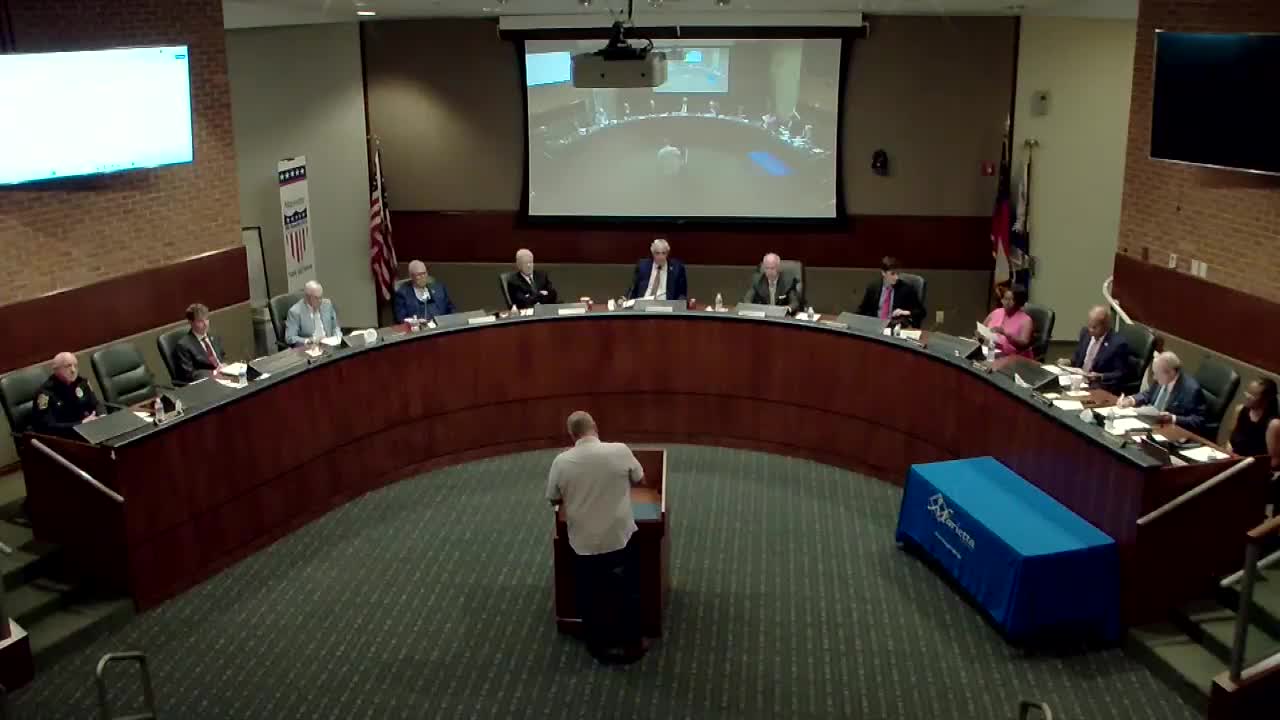
Several residents used the public comment period at the Oct. 8 Marietta City Council meeting to raise concerns about local planning processes, infrastructure plans, utility spending transparency and a proposed state law.
Tracy Stevenson urged the council to review its irrigation-meter and sewer-billing practices and questioned staffing and engineering responses in the city’s utility operations; she recommended winter-quarter averaging for sewer calculations and said the city’s current irrigation-meter process imposed high costs on homeowners.
Larry (Larry Wills) and other speakers criticized recent Planning Commission meetings and urged clarity about long-term proposals for Whitlock Avenue. Wills said Whitlock Avenue, which is also State Route 120, “will never be safe until Whitlock is taken off the state route system” and called for mayoral and council candidates to state where they stand on potential widening and alignment projects that residents say have been proposed in earlier plans.
Another resident, identifying himself as a long-time neighborhood homeowner and a disabled veteran, asked the mayor and his councilmember to inspect alleged HOA mismanagement at Cunningham and Westwood Drive, citing an unmaintained detention pond, missing signage and increased dues; he asked for council assistance to review documented complaints.
A public commenter also raised transparency concerns about an item placed on the consent agenda described as “BLW actions,” saying the council had placed an experimental utility expenditure (he stated $1,300,000) on consent without detailed justification or an open vote. The speaker requested a written justification, an open council vote, and a public hearing for utility expenditures that exceed routine capital maintenance.
Separately, Peter Friedrich, a Kennesaw State professor, asked the council to oppose Georgia Senate Bill 375 (referred to in the meeting as SB 375), which he said would chill academic freedom and free expression by weaponizing a civil-rights framing to censor critics of political ideology abroad. He asked the council to pass a resolution opposing SB 375 and to send it to state lawmakers.
None of these public comments resulted in immediate council actions during the Oct. 8 meeting; councilmembers acknowledged the concerns and, in some instances, noted that items can be referred back to staff or committees for follow-up.