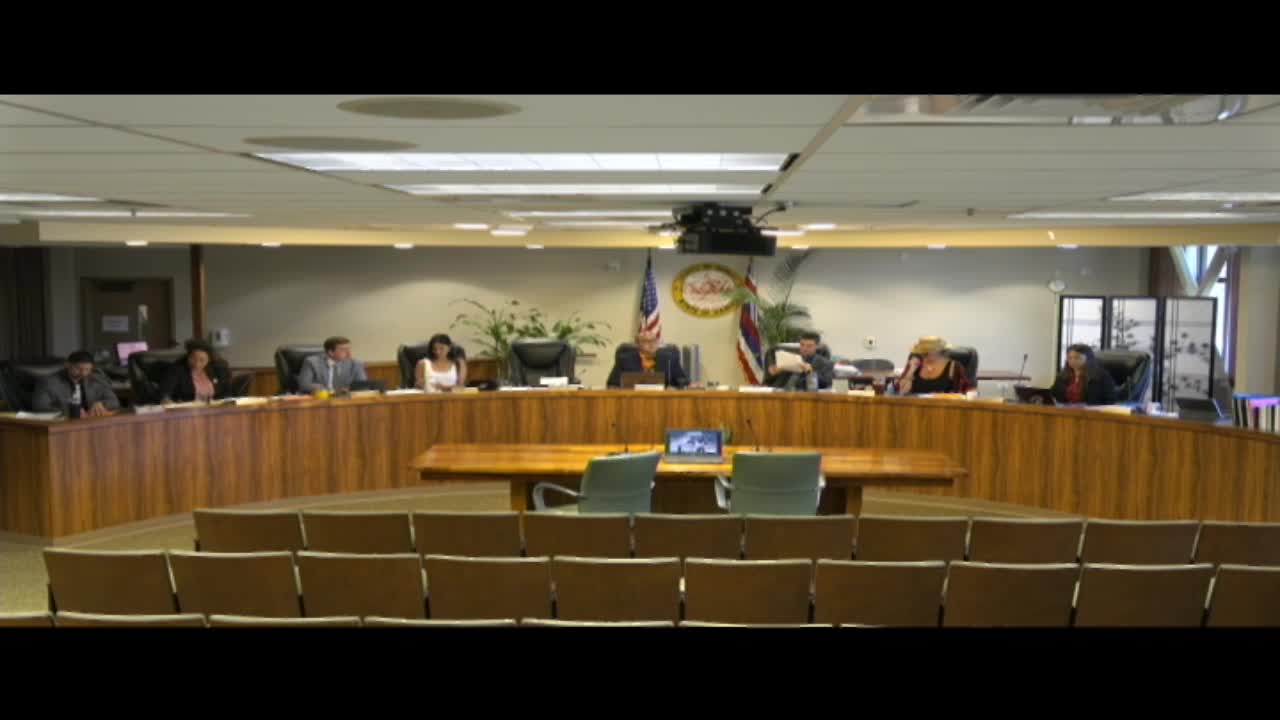
Committee advances Bill 83 to curb single-use foodware; adds compostable and reusable standards
Loading...
Summary
A Hawaii County committee on Wednesday advanced Bill 83, a proposed ordinance to limit single‑use plastic and polystyrene foodware, adopting several amendments that added definitions, set certification standards for compostable products and detailed a reusable‑foodware definition.
A Hawaii County committee on Wednesday advanced Bill 83, a proposed ordinance to limit single‑use plastic and polystyrene foodware, adopting several amendments that added definitions, set certification standards for compostable products and detailed a reusable‑foodware definition.
The bill — introduced by Councilmember Michelle Galimba and Committee Chair Rebecca Villegas and discussed at the committee’s Oct. 8 meeting in Hilo — was amended and its revised draft will be forwarded to the Department of Environmental Management and the Environmental Management Commission for review before the committee takes further action. The committee also postponed final action on Bill 83 to its Oct. 21 meeting.
Why it matters: Bill 83 is intended to advance the county’s zero‑waste goals and align local rules with state targets such as the Aloha+ Challenge. The committee’s amendments aim to close loopholes identified in earlier island ordinances, require industry certification for compostable products and expressly allow vetted reusable systems, a step proponents say could reduce landfill inputs and support circular‑economy approaches.
What the committee did
- The committee adopted a series of amendments (communications 482.1, 482.3, 482.5, 482.6, 482.7, 482.8 and 482.9) that, among other changes, clarified that commercial activities at county facilities are covered, required coordination between the Department of Environmental Management and the county Sustainability Administrator, and refined the bill’s definitions for prepackaged food, prepared food, and reusable foodware.
- The committee voted to forward the next draft (Draft 2) of Bill 83 to the director of the Department of Environmental Management and the Environmental Management Commission for review. Under county procedure, those bodies have 45 days to act on a transmitted draft.
- The committee postponed formal passage and first reading to the Oct. 21 committee meeting to allow time for the EMC/DEM review and any resulting edits.
Key vote results
- The motion to adopt Communication 482.8 (amendment clarifying covered entities and adding “business” to the scope) passed 7–1–1 (seven yes, one no from Councilmember Fresh Onishi, one absent: Councilmember Kerkowitz). The transcript roll‑call recorded: Kalimba, Eustace, Kagiwara, Kylie Kleinfelder, Kimball, Villegas and Galimba voting "aye"; Onishi "no"; Kerkowitz absent.
- Motion to adopt Communication 482.6 (detailed reusable definition and certification requirement language) passed 8–1 (Onishi opposed).
- Other amendments (482.1, 482.3, 482.5 and 482.9) were adopted unanimously in committee votes recorded on the transcript.
Public testimony and industry concerns
Multiple testifiers and stakeholders spoke during the public‑testimony portion. Highlights:
- Sarah Warr, representing Sustainable Island Products, told the committee that “Food, soiled plastics and mixed resins rarely move through a real recycling stream.” She urged recognition that compostable products generally have lower production footprints than virgin plastics and said a stable feedstock would encourage investment in composting infrastructure.
- Victor Lim, a McDonald’s franchisee who testified for the Hawaii Restaurant Association, urged inter‑island regulatory consistency: “it’s very, important that all the islands have the same regulations if possible because we’re a small marketplace.” Lim warned that sustainable packaging currently costs “about 2 to 3 times what the product that it replaced,” that there is no commercial composting on the island, and that rising labor costs (a $2 minimum‑wage increase referenced for Jan. 1, 2026) will put additional pressure on small restaurants.
- Kensho (Sierra Club Hawaii Island Group) supported the bill and urged the committee to preserve reusables in the ordinance; their written testimony recommended tightening the reusable definition to require items be part of a functioning return‑and‑wash system and to exclude polystyrene or plastics in primary food contact surfaces.
- Ellie Moss, testifying about the Hilo Reusable Food Program, described the planned system and procurement details: “This program will be using stainless steel reusable containers,” she said, adding that comparable systems “typically achieve over 90% return rates” and that the selected service provider has a 99% return rate on other programs. Moss said 5,000 stainless‑steel school lunch trays already purchased are made from 100% recycled stainless steel and that procurement will emphasize recycled content (she referenced containers on the market made from 75–80% recycled stainless steel).
How the bill changed in committee
- Scope and sales: Amendments expanded the bill’s reach from food providers and county facility users to explicitly include businesses and the sale/distribution of disposable foodware within county limits, aiming to prevent the sale of the now‑regulated single‑use items on the island and thereby encourage economies of scale.
- Definitions: The committee clarified the distinction between prepackaged food (items packaged and sold ready for pickup) and prepared food (made to order or packaged at point of sale), with prepackaged foods exempted from certain prohibitions so long as they meet the bill’s language. Members repeatedly used examples (musubi, hot‑plate deli items, microwaveable prepackaged meals) to make the distinction operational.
- Reusable standard: The committee adopted a detailed definition of reusable foodware that requires: (a) repeated return to a food provider or reuse service provider, (b) design and marketing for multiple uses, (c) durability to function through multiple cycles, (d) an established system for recovery, inspection and cleaning, and (e) exclusion of polystyrene or plastic as the base material in primary food contact surfaces.
- Compostable certification: The amended language references industry standards and labeling such as CMA and the BPI certification mark for compostable serviceware to reduce past loopholes where manufacturers slightly altered products (thicker plastics, ambiguous “reusable” claims) to evade restrictions.
Staff, agency roles and next steps
Committee members requested detailed input from DEM about timelines, local composting capacity and cost implications for the landfill and potential localized composting solutions. Committee Chair Rebecca Villegas and other members noted that the ordinance, as amended, requires consultation between the Department of Environmental Management and the county Sustainability Administrator. The committee’s makers will submit Draft 2 to DEM and the Environmental Management Commission; those entities have a 45‑day review period under county code. The committee left Bill 83 on the Oct. 21 committee agenda to consider any feedback before recommending first reading.
Remaining issues raised in the hearing
- Cost impacts on small businesses and supply‑chain logistics if islands or counties adopt different technical standards.
- The island’s lack of an industrial/commercial composting facility and the need to evaluate smaller in‑vessel or regional composting options and funding to process certified compostables.
- The need to track and ensure that reusable systems achieve high return and cleaning rates in practice, and clarity on who will approve vendor materials and replacement items (the committee referenced DEM oversight).
What to expect next
Draft 2 will be prepared after staff consolidates the approved amendments and will be transmitted to DEM and the Environmental Management Commission for review. The committee postponed Bill 83 to the Oct. 21 policy committee meeting to consider the EMC/DEM input and any further edits.
Ending note
Committee Chair Rebecca Villegas closed the meeting after the postponement vote; the committee adjourned at 12:18 p.m.
Speakers quoted in this article appear in the extracted speaker list below and quotes are drawn directly from the meeting transcript.